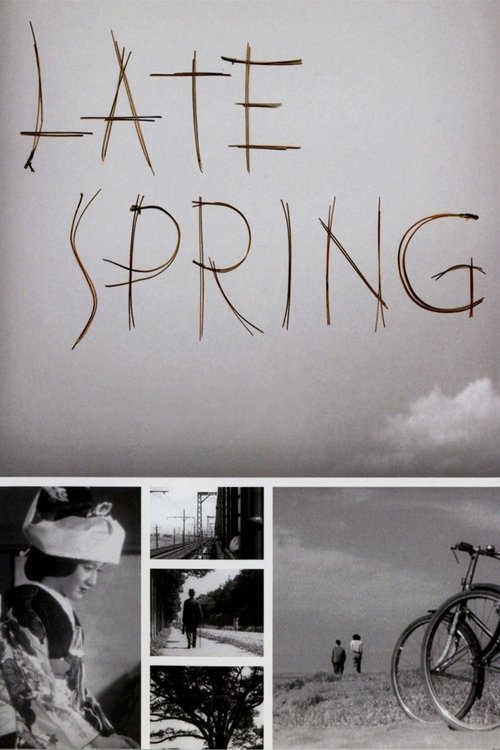
Late Spring (1949)
Directed by Yasujirō Ozu
No · Ultra Based
How we score movies →Consciousness Markers
While the film avoids explicit preachiness, it contains a subtle moral framework that asks the audience to endorse patriarchal sacrifice as noble and necessary.
The cast features primarily Japanese actors in what is explicitly a story about Japanese family life. This is casting appropriate to the story, not diversity-conscious casting.
No LGBTQ themes are present. The film is entirely concerned with heterosexual marriage as the only viable social arrangement.
The film actively reinforces traditional patriarchal structures. Noriko's agency is systematically undermined in service of paternal authority and conventional marriage.
The film contains no racial consciousness or interrogation of racial structures. It is set within a homogeneous Japanese society.
No climate themes are present. The film predates environmental consciousness in cinema by decades.
While the film depicts modest middle-class life, it contains no critique of capitalism or class structures.
The film makes no statements about body positivity or the celebration of diverse body types. This concept would be anachronistic to 1949.
No representation of neurodivergence is present. The film does not engage with disability or neurodivergent experience.
The film does not attempt to revise historical narratives. It simply depicts domestic life within the historical moment.


Synopsis
Noriko is perfectly happy living at home with her widowed father, Shukichi, and has no plans to marry -- that is, until her aunt Masa convinces Shukichi that unless he marries off his 27-year-old daughter soon, she will likely remain alone for the rest of her life. When Noriko resists Masa's matchmaking, Shukichi is forced to deceive his daughter and sacrifice his own happiness to do what he believes is right.
Why it received this score
Here we have a film from 1949, which is to say a film made during an era when progressive social consciousness had not yet calcified into its modern institutional forms. Ozu's "Late Spring" is a profound meditation on family obligation, filial duty, and the social machinery of marriage in postwar Japan. It is also, without question, a deeply patriarchal work that treats the unmarried woman as a problem requiring paternal intervention. The film presents Noriko's contentment with her domestic life not as a valid choice but as a condition to be remedied through deception and sacrifice. Her father lies to her about remarrying in order to manipulate her into marriage to a suitable man. We are invited to see this deception as noble. The film's entire moral architecture depends on accepting that a woman's happiness must be subsumed into family structures controlled by male authority.
What makes this film important to cinema history is precisely what prevents it from registering on contemporary scales of progressive sensibility. Ozu captures the texture of lived experience with unparalleled subtlety. His compositions are mathematical. His understanding of human emotion is profound. None of this, however, constitutes engagement with modern social justice frameworks. The film does not wrestle with gender as a constructed system. It does not interrogate the logic that makes an unmarried woman dangerous. It simply assumes these things as natural facts of existence, which was indeed the assumption of his time and place.
For the purposes of this assessment, the film's complete absence of any contemporary progressive markers is actually appropriate to its historical moment. It would be anachronistic and absurd to fault a 1949 film for not exhibiting cultural sensibilities that would not emerge for another seventy years. This is not a film that championed women's liberation or questioned patriarchal structures. It is a film that accepted them as the given conditions of human life. That it does so with such artistic mastery only deepens the melancholy of its worldview.
Analysis generated by our Consciousness Algorithm
Critic Reviews
“Each shot in Late Spring is striking on its own; the mature Ozu belongs to that rare category of filmmakers whose work can be recognized from a single frame. But together—with all their abrupt shifts in visual perspective and time—they become a mosaic, deeply poignant and ultimately mysterious in the way it envisions a relationship between two people trapped by how much they care for one another.”
“Late Spring is one of the best two or three films Ozu ever made.”
“You either get it or you don't. I get it. At least until I see some Ozus I've missed, Late Spring seems to me his greatest achievement, and, thus, one of the 10 best films of all time. [17 Aug 1972, p.57]”
“Not as affecting as Ozu's classic Tokyo Story, Late Spring still charms with it's similar theme of development of the parental bond as the children mature and become more independent. Although well acted, the visual are equally arresting but when the themes are so similar a new approach is required to keep it interesting.”