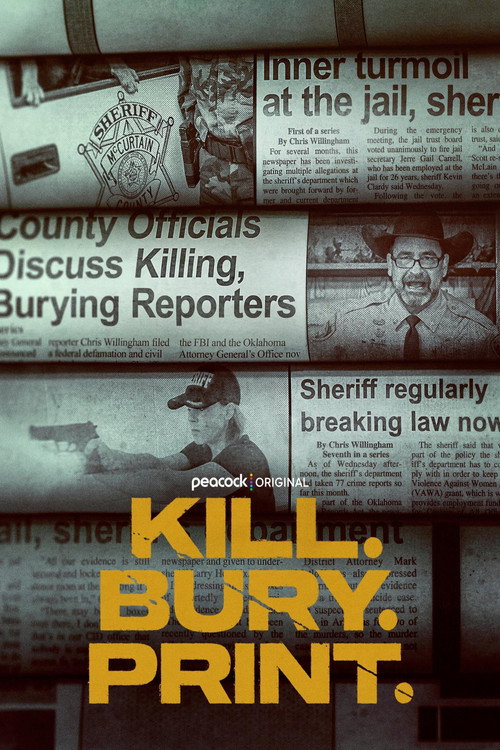
Kill. Bury. Print. (2026)
Directed by Ben Klein
Ben Klein's documentary arrives carrying the full weight of its subject matter and the unmistakable fingerprints of its media ecosystem.
Consciousness Markers
The recording at the heart of the scandal contains officials making racist remarks about lynching Black people, and the film engages with ongoing civil rights cases tied to the same sheriff's office. The racial dimension is real and documented, not invented for effect, but it is a genuine element of the story's moral stakes.
Rachel Maddow's producer credit and the film's heavy promotion through progressive media infrastructure (MSNBC, Lawrence O'Donnell, Stephanie Ruhle) gives the whole enterprise a certain editorial posture. The framing of local journalism as democracy's last line of defense against systemic corruption is earnest and not subtle, though it stops well short of sermonizing.
This is a documentary about real people, so casting choices do not apply in the conventional sense. The Willingham family are who they are, and the film does not appear to have engineered its subjects for demographic representation.
No LGBTQ+ themes, characters, or framing are present in the film or its surrounding discourse. This marker registers a clean zero.
No feminist narrative framing is evident. The central figures are a father-and-son journalism team, and the story does not invoke gender politics as a lens.
No climate themes, environmental messaging, or ecological consciousness of any kind. Rural Oklahoma journalism does not, it turns out, pivot to carbon emissions.
The antagonists are corrupt public officials and law enforcement, not corporations or the wealthy class. The film has no interest in critiquing economic systems.
No body positivity themes are present. The film is preoccupied with threats to human life, which is a related but distinct concern.
No neurodivergence themes or representation are present in any form. Zero.
The film documents recent, ongoing events rather than reinterpreting historical narratives. There is no revisionist agenda at work here.
Why it received this score
Ben Klein's documentary arrives carrying the full weight of its subject matter and the unmistakable fingerprints of its media ecosystem. The story itself is genuinely alarming: a small-town Oklahoma newspaper family obtains a recording of local officials casually discussing their murder, and the recording also contains remarks about lynching Black people that would be unremarkable only to someone who had never encountered the concept of a public scandal. This is, by any measure, a serious story. The film treats it as such, which is both its virtue and the source of its modest score on our cultural index.
Where the documentary earns its few points is not in the story it tells but in the frame it chooses. Produced by Rachel Maddow and promoted with the full enthusiasm of the MSNBC extended universe, the film arrives pre-sorted into a familiar political taxonomy: independent press as sacred institution, rural law enforcement as systemic rot, and the Willingham family as vessels of democratic principle. These interpretations may all be correct. They are also the interpretations you would expect from this particular production team, delivered to this particular audience, on this particular streaming platform. The racial dimensions of the recording are real and documented, not manufactured for effect, but the film's broader framing of press freedom as an ongoing civil rights emergency does carry a certain earnest weight that accumulates over its runtime.
Director Klein previously made "The Exiles," a film about Tiananmen Square dissidents, and his interest in people who absorb enormous personal cost in defense of principle is consistent and, frankly, admirable. The Willinghams were forced to leave their hometown entirely. That is a real consequence, not a talking point. "Kill. Bury. Print." is, in the end, a competent and morally serious documentary about a genuinely outrageous series of events, filtered through a production apparatus that cannot quite resist underlining the lesson. The underlining is unnecessary. The lesson was already there.
Analysis generated by our Consciousness Algorithm


Synopsis
When the McCurtain Gazette, a small family-run newspaper, begins reporting on alleged sex, drugs, and violence within the county sheriff's office, they find themselves the target of the sheriff's retaliation. Tensions escalate when the paper obtains a secret recording revealing the sheriff and local officials allegedly discussing having the family killed, turning a local investigation into international news.