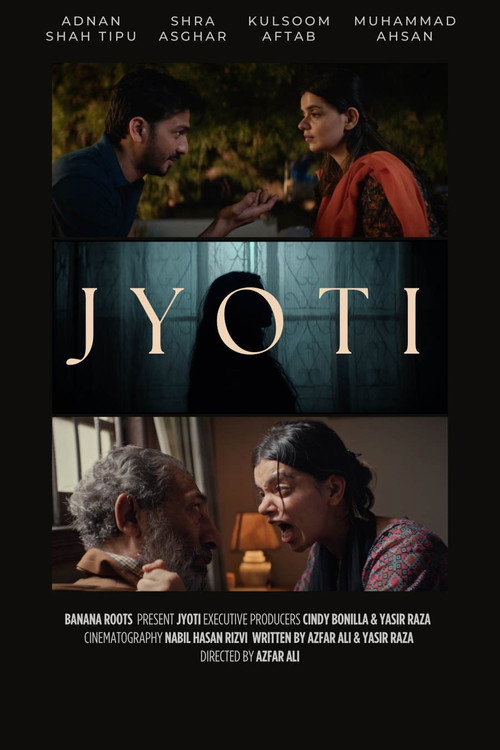
Jyoti (2026)
Directed by Azfar Ali
Jyoti arrives from the Pakistani indie circuit bearing the quiet, slightly bruised dignity of a film that has won festival awards in Houston and Chicago and remains almost entirely unknown to everyone else.
Consciousness Markers
The film's thematic core, a woman constrained by domestic obligation, social isolation, and patriarchal family structure, carries a quiet feminist undertow. Festival curators explicitly noted themes of women's social isolation and repressed personal agency, though the film appears to dramatize these conditions rather than sermonize about them.
The film centers on a Pakistani woman in Karachi, with a cast drawn from the Pakistani television and indie film industry. This reflects authentic regional representation, though it reads as organic cultural specificity rather than a calculated diversity exercise.
Festival framing around patriarchy and generational silence suggests some thematic weight on social critique, but the film's psychological and restrained dramatic mode appears to keep any messaging embedded in character rather than delivered from a podium.
No LGBTQ+ themes, characters, or subtext have been identified in the film's narrative or any available critical discussion.
The film is a Pakistani drama set in Karachi with no identified engagement with racial identity politics, systemic racism discourse, or cross-racial consciousness themes in the modern sense.
There is no evidence of climate, environmental, or ecological themes anywhere in the film's narrative or reception.
No anti-capitalist critique, class warfare framing, or wealth-shaming narrative has been identified. The economic constraints on the protagonist appear as lived backdrop, not ideological target.
No body positivity themes, messaging, or discourse have been identified in connection with this film.
No neurodivergence themes or characters have been identified in available materials.
The film is an original contemporary drama with no engagement with historical revisionism or recontextualized historical narratives.
Why it received this score
Jyoti arrives from the Pakistani indie circuit bearing the quiet, slightly bruised dignity of a film that has won festival awards in Houston and Chicago and remains almost entirely unknown to everyone else. That is not a criticism. Director Azfar Ali presents a Karachi seamstress named Sharmeen, whose life is organized around a bedridden father, a sewing machine, and the careful suppression of anything resembling personal desire. It is, by all accounts, a genuinely interior drama about memory and inherited constraint. The film's social architecture, a woman circumscribed by domestic duty and patriarchal expectation, is noted by festival curators with the kind of solemn enthusiasm reserved for films that confirm what the audience already suspects about the world.
The feminist register here is present but muted. Sharmeen's confinement is dramatized, not diagnosed. The film does not appear to pause its narrative to explain to us what patriarchy is, which is a courtesy not all contemporary dramas extend. The festival circuit framing does more ideological heavy lifting than the film itself seems to, which is a familiar dynamic: the press release arrives woke, the film arrives human. The remaining markers, LGBTQ+ themes, climate consciousness, racial identity politics, body positivity, the full modern constellation, are simply absent. This is a psychological drama about a woman in Karachi. It does not require the complete checklist.
The result is a film that scores low on our instrument not because it lacks seriousness, but because it is operating in a different register entirely. Generational trauma, repressed memory, the slow negotiation between isolation and connection: these are old themes, handled in the old way, with patience and restraint. We note this without complaint. The instrument measures what it measures, and Jyoti, to its considerable credit, appears largely indifferent to it.
Analysis generated by our Consciousness Algorithm
Synopsis
In Karachi, Sharmeen, a reserved seamstress caring for her bedridden father, lives a life shaped by routine, responsibility, and quiet restraint. When a kind neighbor begins to draw her toward the possibility of love and a life beyond her home, long-buried memories begin to surface.