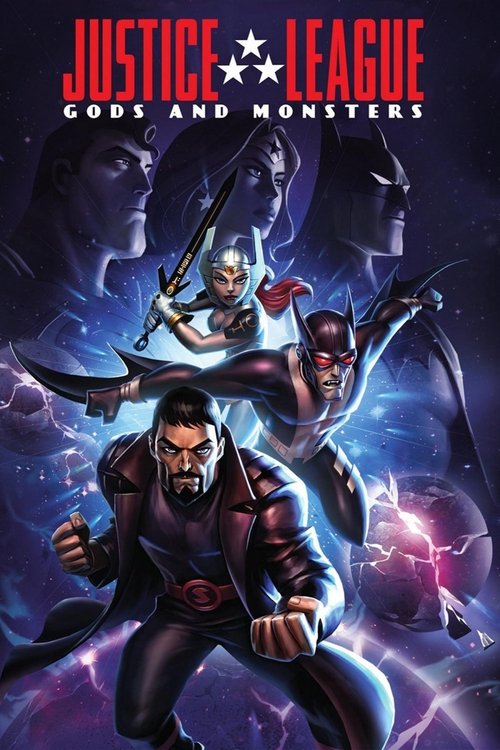
Justice League: Gods and Monsters (2015)
Directed by Sam Liu
No — Justice League: Gods and Monsters is not woke, scoring 15 out of 100 on our wokeness meter.
Justice League: Gods and Monsters arrives from 2015, an alternate-universe DC animated feature in which the Trinity is recast as a brutal, government-distrusted trio.
Consciousness Markers
The alternate-universe Trinity deliberately reimagines Superman as the Mexican-raised Hernan Guerra and Wonder Woman as the Black-voiced New God Bekka, though the film presents this as character concept rather than explicit diversity messaging.
Wonder Woman/Bekka is a central warrior with agency and a backstory, but the film does not advance an explicit feminist thesis.
A Latino Superman and Black Wonder Woman appear, but race and racism are not thematic concerns or subjects of commentary.
There is mild moralizing about heroism and public trust, but it is delivered through superhero action rather than modern social lecture.
No LGBTQ+ characters, relationships, or themes are present.
No climate or environmental themes are present.
The conflict involves government distrust and rogue science, not anti-capitalist critique.
No body-positivity themes or messaging are present.
No neurodivergence themes or representation are present.
The film is an alternate-universe superhero story, not a revisionist treatment of real history.
Why it received this score
Justice League: Gods and Monsters arrives from 2015, an alternate-universe DC animated feature in which the Trinity is recast as a brutal, government-distrusted trio. Superman is Hernan Guerra, raised in Mexico; Wonder Woman is Bekka, a New God with a warrior's past; Batman is Kirk Langstrom, a man-bat with a serum problem. This is a representational shuffle delivered as character concept, not as a sermon. The film has no interest in explaining why these changes matter. It simply lets them exist, which is either refreshing or evasive depending on the viewer's appetite for subtext.
The social consciousness here is faint and intermittent. Bekka has agency and a backstory, but the film does not advance a feminist thesis. Hernan's Latino identity and Bekka's Black voice casting register as casting choices, not as thematic arguments about race or racism. The film's concerns are elsewhere: rogue science, government paranoia, and a nanite hive-mind plot. It does not pause for the later cultural fixations that would become standard in studio animation. Its mild moralizing about heroism and public trust is delivered through punches and explosions, not through a lecture.
This leaves a competent, violent, occasionally thoughtful animated feature that wants to ask whether gods can be monsters. It does not want to re-educate the audience. It does not revise real history. It does not tell us how to feel about the world beyond the screen. The result is a curious artifact: a superhero story with a few progressive casting notes, a warrior woman with presence, and almost no interest in the contemporary sermonizing that would become commonplace in the years after its release. We classify it as lightly seasoned, not doctrinaire. A modest vintage. Drinkable, but not one for the cellar.
Analysis generated by our Consciousness Algorithm
Part of


Synopsis
In an alternate universe, very different versions of DC's Trinity fight against the government after they are framed for an embassy bombing.
Questions about Justice League: Gods and Monsters
Is Justice League: Gods and Monsters woke?
No — Justice League: Gods and Monsters is not woke, scoring 15 out of 100 on our wokeness meter. That earns it a verdict of Ultra Based.
Does Justice League: Gods and Monsters have any woke elements?
1 of the 10 markers register at 30 or above, led by Representation Casting (45). On Representation Casting: The alternate-universe Trinity deliberately reimagines Superman as the Mexican-raised Hernan Guerra and Wonder Woman as the Black-voiced New God Bekka, though the film presents this as character concept rather than explicit diversity messaging.
How does Justice League: Gods and Monsters compare to other 2015 movies?
It ranks #104 of the 289 films from 2015 we've scored; their average is 15. The wokest is Chi-Raq (78).
How is the Woke Score calculated?
An AI-assisted process researches the film and its reception, scores it 0–100 on ten markers, then combines those into one 0–100 Woke Score. It measures a specific set of 2020s cultural themes, not film quality.