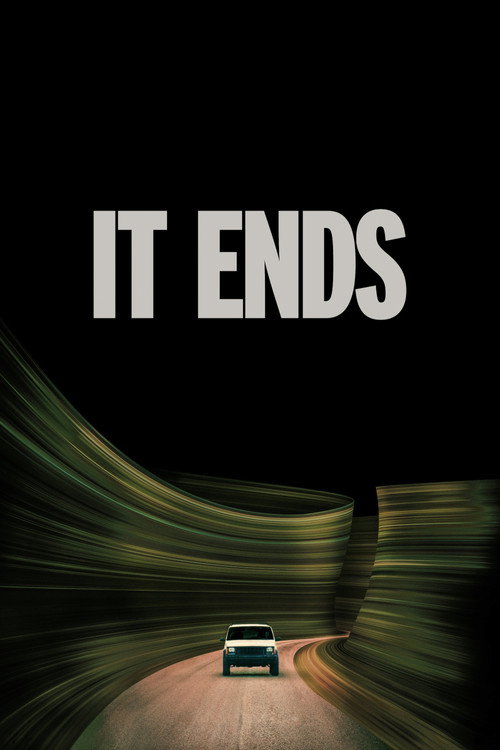
It Ends (2026)
Directed by Alexander Ullom
Alexander Ullom's It Ends arrives with an $80,000 budget, a Jeep Cherokee, and the weight of an entire generation's post-collegiate despair loaded into the trunk.
Consciousness Markers
Mental health is a genuine narrative thread: one character discloses a past suicide attempt, another experiences panic attacks, and emotional repression and detachment are character-defining traits. The director's own mental health struggles are the film's stated origin point.
The director explicitly framed the film as a metaphor for young people inheriting a burning house of economic precarity and late-stage capitalism. The allegory is present but delivered through atmosphere rather than lecture.
The ensemble features a naturally diverse group of recent graduates, including Phinehas Yoon and Akira Jackson, but the film makes no discernible production-level statement about representation. The diversity appears incidental rather than programmatic.
The film's thematic concerns about post-graduate precarity and generational anxiety are present but are expressed through allegory and atmosphere rather than speechifying. The road does the talking, mostly.
No LGBTQ+ characters, themes, or content are present in the film or noted in any available coverage.
No feminist agenda, gender-power commentary, or female-empowerment framing is present. The film does not organize itself around gender dynamics.
Race is not a thematic element. No character's racial identity is invoked as a lens for the story, and no commentary on systemic racism or racial identity is present.
There is no climate messaging or environmental allegory in the film. The infinite road is framed as a metaphor for personal and generational dread, not ecological collapse.
No body positivity themes or content are present in the film or its surrounding discourse.
The film is an original, contemporary horror story with no historical setting or revisionist framing of any kind.
Why it received this score
Alexander Ullom's It Ends arrives with an $80,000 budget, a Jeep Cherokee, and the weight of an entire generation's post-collegiate despair loaded into the trunk. Four recent graduates drive into a highway that never ends. This is, we are told, a metaphor. The film is admirably restrained about stating this out loud, preferring instead to let the creeping dread do the heavy lifting, which is a directorial choice that should be commended and is, in this assessment, noted with the same quiet approval one reserves for a waiter who does not describe every ingredient in the soup.
The mental health dimension is where the film does its most earnest work. Characters carry their psychological freight with specificity: a disclosed suicide attempt here, a panic attack there, a studied interpersonal detachment that reads less as character flaw and more as generation-wide operating system. Ullom, who has been forthcoming in interviews about his own dissociative depression as the film's creative seed, is not exploiting these themes. He is processing them. The distinction matters. The result is a horror film that is genuinely interested in its characters' inner lives, which places it in a rather small and grateful subcategory of the genre.
The anti-capitalist undertow is real but mercifully underdeveloped as rhetoric. The infinite road-as-broken-social-contract is a legitimate piece of allegorical architecture, and Ullom has the good sense not to have anyone explain it. No character turns to another and says "this highway is late-stage capitalism," which is precisely the kind of creative discipline that separates a film from a think-piece. On the full spectrum of progressive cultural signaling, It Ends registers as a faint but sincere blip: a work of genuine personal anxiety that has absorbed its cultural moment without particularly trying to score points for doing so. It is, in the taxonomy of this column, a mild case. The patient is conscious and responsive.
Analysis generated by our Consciousness Algorithm


Synopsis
A group of recent grads head out on a late night drive for grub, hoping to enjoy one final hangout before their paths diverge. Instead, they accidentally turn onto a never-ending, two-lane hellscape surrounded by untold horrors and cosmic forces beyond their understanding. Cramped together inside a Jeep Cherokee and with the miles stretching infinitely ahead, they face a choice: embrace their new existence or fight to escape it.