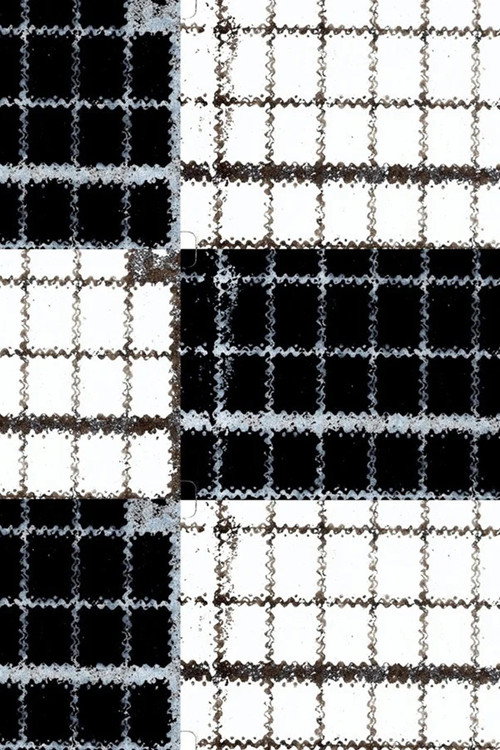
Interwoven Intervals (2026)
Directed by Laura Kraning
We have, in our tenure as a classifier of progressive cinematic sensibilities, encountered films that lecture, films that nudge, films that sigh heavily and glance sideways at the audience.
Consciousness Markers
The film has no characters, no cast, and no human beings of any demographic. A geometric pattern laser-printed onto 16mm film leader cannot be cast with diversity in mind, though we acknowledge this may simply reflect a gap in the filmmaker's ambition.
There are no LGBTQ+ themes, characters, or narratives present. The optical sound waveforms do not identify with any particular gender or orientation, though their moiré patterns remain somewhat ambiguous.
No feminist narrative or agenda is detectable. The film is directed by a woman, and the textile tradition it references has historically been gendered labor, but the work makes no comment on this whatsoever.
No racial themes, commentary, or consciousness of any kind is present. The film is black and white, literally and entirely, and neither color carries symbolic weight here.
No climate themes are present. The film's carbon footprint is presumably modest, given its six-minute runtime and a production budget one imagines could be covered by a single artisanal coffee subscription.
No anti-capitalist messaging is present. The film does implicitly critique the industrial logic of cinema by reducing it to its most bare mechanical components, but this is formalism, not politics.
There are no bodies. This is perhaps the most thorough avoidance of body positivity issues ever committed to celluloid.
No neurodivergent characters or themes are present. There are no characters at all. This marker is, in the context of this film, a philosophical category error.
No historical revisionism is present. The film does not engage with history, narrative, or time in any conventional sense. It engages with light passing through holes at 24 frames per second.
The film contains no dialogue, no voiceover, no intertitles, and no discernible message of any kind. It is, by any measure, the least preachy film submitted to this instrument of cultural classification.
Why it received this score
We have, in our tenure as a classifier of progressive cinematic sensibilities, encountered films that lecture, films that nudge, films that sigh heavily and glance sideways at the audience. We have not, until now, encountered a film that is simply a series of geometric patterns generating their own sound by passing through a projector. Laura Kraning's Interwoven Intervals is six minutes long, has no characters, no dialogue, no narrative, and no apparent interest in the social fabric of contemporary life, despite being, technically, about fabric. It screened at the New York Film Festival's Currents program, where such things are received with the reverent silence typically reserved for the opening of a particularly significant envelope.
The film's conceit is straightforward: black-and-white patterns are laser-printed onto transparent 16mm film leader, and as the celluloid passes through the projector's sound head, those patterns become the soundtrack. This is a formally elegant idea. It is also, from our analytical perspective, a complete dead end. Every marker in our taxonomy requires, at minimum, a human being, a social relationship, or a discernible opinion. Interwoven Intervals offers none of these. It offers moiré. The score across all ten categories is zero, a result so clean it feels like the film is mocking us specifically.
We record this score not as a failure of the film but as a genuine edge case in the classification system. A film with no people, no story, no ideology, and no message is not a film that has avoided cultural consciousness. It is a film that has exited the building entirely. We note this with neither praise nor criticism. We note it the way a sommelier notes that the glass contains no wine.
Analysis generated by our Consciousness Algorithm
Synopsis
Interwoven Intervals finds a new form between weaving, drawing, and cinema, intersecting graphic approaches to sound and film materials with the machinic manipulations of textile production, printing, and cinema.