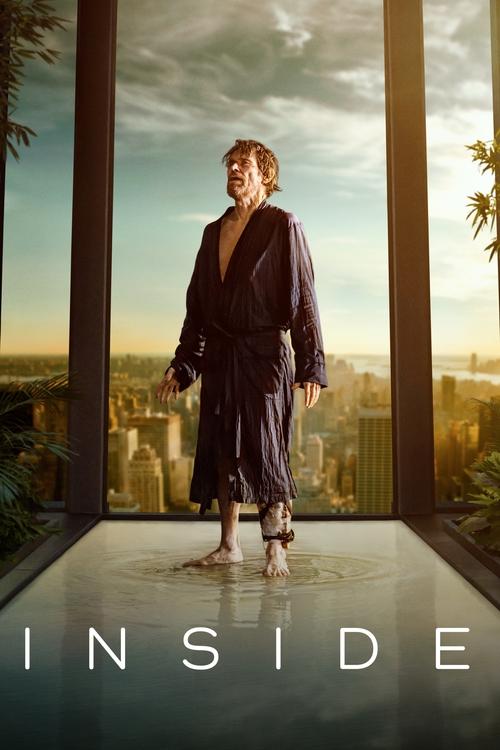
Inside (2023)
Directed by Vasilis Katsoupis
No — Inside is not woke, scoring 3 out of 100 on our wokeness meter.
Vasilis Katsoupis opens his feature debut with a question posed to a child: which three things would you save from a burning house.
Consciousness Markers
The protagonist robs a wealthy art collector, but the film is a meditation on art and creation rather than a critique of wealth or capitalism.
The closing aphorism 'there is no creation without destruction' gestures at a theme, but the film shows rather than preaches.
The cast is a small, predominantly white European ensemble led by Willem Dafoe, with no diverse casting choices made as a statement.
There are no LGBTQ+ characters, relationships, or themes anywhere in this single-location survival thriller.
The only notable female presence is the housekeeper 'Jasmine,' observed voyeuristically through a security feed; the film makes no feminist argument.
Race is entirely absent as a subject; the film concerns one man's physical and psychological entrapment.
The malfunctioning smart-home thermostat is a plot device for discomfort, not an environmentalist statement.
Dafoe's character physically deteriorates through starvation and injury, but this is survival horror, not a body-positivity message.
The protagonist's hallucinations stem from isolation and starvation, not a depiction of neurodivergence as identity.
The film is a fictional contemporary thriller with no historical subject matter to revise.
Why it received this score
Vasilis Katsoupis opens his feature debut with a question posed to a child: which three things would you save from a burning house. The answer, a cat, an AC/DC record, and a sketchbook, tells us most of what we need to know about Nemo, an art thief who spends the remainder of the picture sealed inside a Manhattan penthouse with a malfunctioning thermostat and a dwindling supply of dog food. It is a lean, airless endurance test, and it carries almost no ideological freight at all.
The cast is small and European, assembled for talent instead of statement. No LGBTQ thread surfaces. The lone female presence, a housekeeper the film calls Jasmine, exists to be watched through a security feed while vacuuming in earphones, and the film draws no feminist conclusion from this. Race never enters the frame as a subject. The thermostat tortures Nemo with heat and cold, yet the film has no interest in environmentalism. His body wastes away and his teeth rot, which is survival horror, not a lesson about self-acceptance. His hallucinations arrive from starvation and solitude, not from any exploration of neurodivergence as identity. There is no history here to revise.
Two faint signals remain. Nemo robs a wealthy collector, but the film is a meditation on art and creation, and it never turns that theft into an argument about capital. And when Nemo scrawls "there is no creation without destruction" across the walls, we get a theme delivered by image instead of sermon. A pigeon starves on the patio. A man builds a scaffold. That is the whole of it.
Analysis generated by our Consciousness Algorithm


Synopsis
An art thief trapped in a New York penthouse after his heist doesn't go as planned. Locked inside with nothing but priceless works of art, he must use all his cunning and invention to survive.
Questions about Inside
Is Inside woke?
No — Inside is not woke, scoring 3 out of 100 on our wokeness meter. That earns it a verdict of Ultra Based.
Does Inside have any woke elements?
Very few. None of the 10 markers reaches 30, the level where a marker counts as present; the highest is Eat the Rich at 5.
How does Inside compare to other 2023 movies?
It ranks #190 of the 200 films from 2023 we've scored; their average is 24. The wokest is Origin (84).
How is the Woke Score calculated?
An AI-assisted process researches the film and its reception, scores it 0–100 on ten markers, then combines those into one 0–100 Woke Score. It measures a specific set of 2020s cultural themes, not film quality.