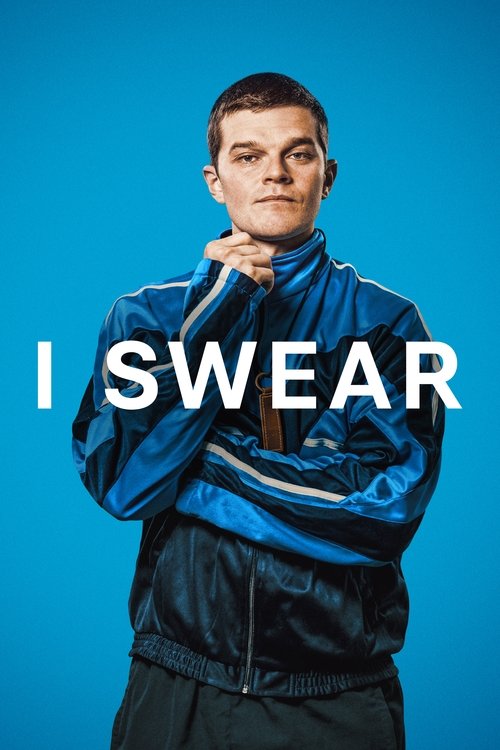
I Swear (2025)
Directed by Kirk Jones
Partly — I Swear is somewhat woke, scoring 40 out of 100 on our wokeness meter.
Kirk Jones has made a film about a man who cannot stop swearing, and he has done it with a straight face and a soft heart.
Consciousness Markers
Tourette syndrome is the film's entire subject, portrayed in granular detail across decades, with workshops, school talks, and a closing plea for societal awareness.
The film largely dramatizes rather than preaches, but the awareness-raising speeches, police-station talks, and closing postscript about societal management push it toward explicit messaging.
The film centers a disabled protagonist and includes the real John Davidson in closing footage, but the lead role is played by a non-disabled actor, muting the marker considerably.
Maxine Peake and Shirley Henderson give substantial, unsentimental turns as the mother and Dottie, but the film's concerns are filial and medical rather than feminist.
A working-class Galashiels family under Thatcher-era strain, with institutional cruelty from a belt-wielding head teacher, but class is backdrop rather than argument.
No LGBTQ+ characters, themes, or subtext appear in the narrative.
The cast and story are uniformly white Scottish; race is never engaged as a theme.
No environmental content whatsoever.
No body-positivity discourse; the film is about involuntary behavior, not body image.
A straightforward biographical account of a real man; no historical narrative is being revised or reclaimed.
Why it received this score
Kirk Jones has made a film about a man who cannot stop swearing, and he has done it with a straight face and a soft heart. I Swear follows John Davidson from a Galashiels childhood in 1983, where a belt across the knuckles from a head teacher arrives well before any diagnosis, through decades of tics, expulsions, a suicide attempt, a wrongful assault charge, and eventually an MBE. The condition is the film's entire subject, and it is rendered in granular, unglamorous detail: the spitting at dinner, the insults shouted at strangers, the exhausting arithmetic of getting through a single library visit. That is the picture's real accomplishment, and it is a substantial one.
The casting question hangs over proceedings. Aramayo gives a performance of genuine control, having spent three months in Galashiels with Davidson himself, but the role of a disabled man is played by an able-bodied actor, which tempers the film's claims to authenticity. The closing footage of the actual Davidson is a graceful gesture and a partial corrective. Around him, Maxine Peake and Shirley Henderson do unsentimental work as the mother and the nurse who first sees him clearly, though the film's interests are filial and medical. The working-class setting under Thatcher is present and felt, and the institutional cruelty is vivid, but class sits as backdrop. Race and sexuality do not enter the frame, and the film does not pretend otherwise.
Where the picture leans forward is in its final movement. The school talks, the police-station sessions, the Tourette's workshops, and the postscript about societal management all nudge it from drama toward advocacy. This is mostly earned, since the drama has done the work first, and the sermonizing stays brief. Still, the closing plea lands with the weight of a public service announcement stapled to a good film. We are left with a portrait of endurance that is honest about the body and a little too eager about the lesson.
Analysis generated by our Consciousness Algorithm


Synopsis
Diagnosed with Tourette Syndrome at 15, John Davidson navigates his way against the odds through troubled teenage years and into adulthood, finding inspiration in the kindness of others to discover his true purpose in life.
Questions about I Swear
Is I Swear woke?
Partly — I Swear is somewhat woke, scoring 40 out of 100 on our wokeness meter. That earns it a verdict of Woke-Adjacent.
What makes I Swear woke?
3 of the 10 markers register at 30 or above, led by Neurodivergence (88), Lecture Energy (50) and Representation Casting (30). On Neurodivergence: Tourette syndrome is the film's entire subject, portrayed in granular detail across decades, with workshops, school talks, and a closing plea for societal awareness.
How does I Swear compare to other 2025 movies?
It ranks #49 of the 217 films from 2025 we've scored; their average is 26. The wokest is STRAW (92).
How is the Woke Score calculated?
An AI-assisted process researches the film and its reception, scores it 0–100 on ten markers, then combines those into one 0–100 Woke Score. It measures a specific set of 2020s cultural themes, not film quality.