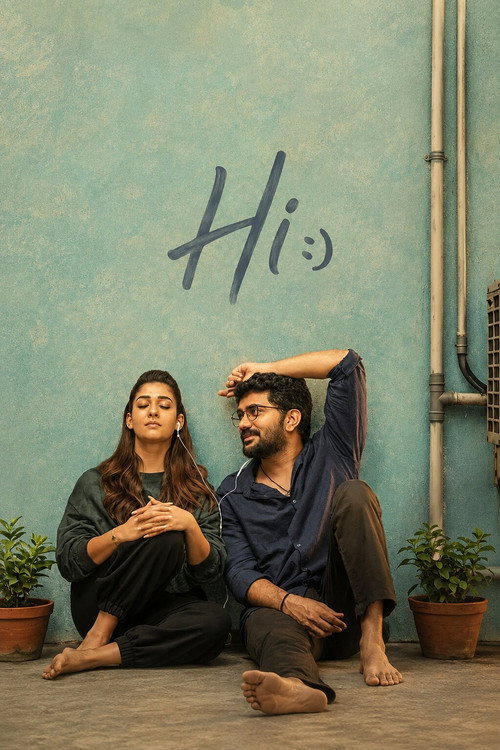
Hi :) (2026)
Directed by Vishnu Edavan
Hi :) is a Tamil romantic drama that arrives wearing the comfortable clothes of a 1990s feel-good entertainer, which is, by current standards, an almost radical aesthetic choice.
Consciousness Markers
The director publicly challenged age-based casting norms for female leads, drawing a pointed comparison to male superstars who face no such scrutiny. The casting of Nayanthara opposite a younger co-lead is framed as a deliberate corrective, which registers as a mild but concrete progressive casting statement.
Critics noted that the final act pivots from lighthearted comedy into a message-heavy family drama, which some found forced. The shift suggests a degree of sermonizing, though it appears to be of the traditional family-values variety rather than the progressive kind.
The director's stated intent to subvert gendered casting double standards carries a faint feminist undercurrent, though the film itself is described as a traditional romantic drama rather than a vehicle for feminist argument.
No LGBTQ+ themes, characters, or representation have been identified in the film or its promotional materials.
No racial consciousness themes are present. The film operates entirely within the Tamil cinema cultural context without commentary on race or caste dynamics.
No climate or environmental themes have been identified in the film's content or marketing.
No anti-capitalist or class critique elements are present. The film is a feel-good romantic comedy with no apparent interest in wealth inequality.
No body positivity themes or messaging have been identified in the film.
No neurodivergent characters or themes have been identified in the film.
The film has no historical setting or revisionist ambitions. It is a contemporary romance.
Why it received this score
Hi :) is a Tamil romantic drama that arrives wearing the comfortable clothes of a 1990s feel-good entertainer, which is, by current standards, an almost radical aesthetic choice. Director Vishnu Edavan, making his debut after apprenticing under action auteur Lokesh Kanagaraj, has elected to abandon the kinetic violence of his mentor's filmography in favor of chance encounters, shared glances, and the slow accumulation of affection. The film is, by most critical accounts, pleasantly traditional. This is noted here not as praise or condemnation, but as a taxonomic observation.
The one area where the film makes any gesture toward contemporary cultural positioning is in its casting. Edavan spoke openly in pre-release interviews about pairing Nayanthara opposite the younger Kavin Raj as a deliberate challenge to the gendered double standard that governs age-gap pairings in Indian cinema. The argument, that male superstars have enjoyed this latitude for decades without comment while female stars are routinely retired from romantic leads, is not without merit. It is also, as social consciousness interventions go, fairly modest. The film does not appear to build its narrative around this observation. The casting is the statement, and the statement is made once, at the press junket, and then the film proceeds to be a romantic comedy.
The final act, according to critics, introduces a message-heavy register that sits somewhat uneasily against the lighter comedic tone of the first half. This is a familiar structural ailment in Tamil commercial cinema, where the third act is traditionally required to earn its emotional weight through a degree of sermonizing. It scores marginally here not because the messaging is progressive in any modern sense, but because the impulse to lecture the audience is, at minimum, present and accounted for. On the full spectrum of cultural awareness available to a 2026 theatrical release, Hi :) has chosen to wave politely from a considerable distance.
Analysis generated by our Consciousness Algorithm
Synopsis
Two individuals initially exchange a simple "Hi," but through a series of chance encounters, shared experiences, and deep conversations, they gradually develop a strong connection and eventually fall in love.