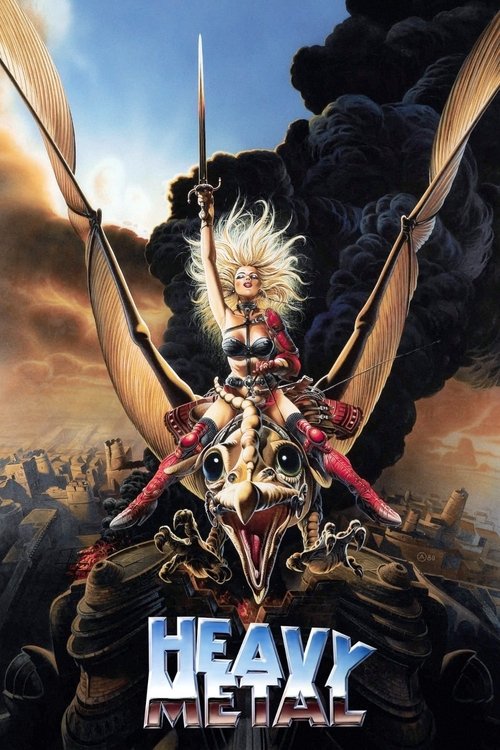
Heavy Metal (1981)
Directed by Gerald Potterton
No — Heavy Metal is not woke, scoring 0 out of 100 on our wokeness meter.
Heavy Metal arrived in 1981 as a Canadian animated anthology assembled from the pages of a magazine that had already made its peace with adolescent appetite.
Consciousness Markers
The voice cast is not assembled around modern inclusive casting priorities; any diversity is incidental rather than a stated representational aim.
There are no LGBTQ+ themes, characters, or subtext in the anthology.
Although Taarna is a female warrior, the film overwhelmingly frames women through 1980s eroticized fantasy imagery rather than a modern feminist agenda.
The film does not engage with racial politics, systemic racism, or racial identity as themes.
There is no environmental or climate-crisis messaging in the film.
The dystopian and criminal settings are genre texture, not a critique of capitalism or wealth.
The film’s visual style emphasizes exaggerated, idealized, and sexualized bodies rather than body-positive representation.
No neurodivergent identity or related theme is present.
The B-17 segment uses WWII imagery for horror-fantasy effect, not historical revisionism.
The film is an erotic, violent fantasy anthology with no preachy or didactic social messaging.
Why it received this score
Heavy Metal arrived in 1981 as a Canadian animated anthology assembled from the pages of a magazine that had already made its peace with adolescent appetite. Eight segments, one glowing orb, several animation houses working in parallel, a soundtrack of Black Sabbath and Devo. The film has no interest in improving anyone. It wants to show us a naked muscular man, a robot with appetites, and a mute warrior woman on a giant bird, and it does so without apology.
The vignettes move through a noir taxi ride in a decaying New York, a nerdy teenager transformed into a loinclothed hero in Neverwhere, a crooked space captain on trial, a zombified bomber crew, a Pentagon abduction, and the last of the Taarakians avenging a slaughtered city. Women appear often and are framed as spectacle: the red-haired double-crosser, Katherine Wells, the buxom stenographer, the Queen, Taarna herself. That is eroticized fantasy imagery of a specific vintage, and it is not a feminist program. The film offers no comment on race, no environmental warning, no critique of wealth, no vocabulary for neurodivergence or body acceptance. Its dystopias are set dressing. Its violence is entertainment.
Taarna is a capable figure and the closest the film comes to a heroine, but she is mute, exoticized, and finally a martyr whose soul passes into a child. That is mythology, not messaging. The B-17 sequence borrows the Second World War for horror effect and makes no argument about history. Nothing here lectures. The film's only thesis is that evil is a green orb and that the correct response is a sword. The ledger comes back empty. A relic, then, and an honest one. It wanted to be disreputable and it succeeded.
This is a picture built for the drive-in and the dorm room, not the seminar. We can admire the rotoscoping and the nerve of it while conceding that its concerns are appetite, dread, and loud guitars. The classification is straightforward, and the film would likely be relieved by it.
It should be noted the picture gave us Taarna, a warrior who fights and dies on her own terms. That is a fine thing. It is also a 1980s fantasy convention, designed by Chris Achilleos with an eye toward the pinup, and no amount of retrospective affection converts it into a program. Heavy Metal remains what it always was: a magazine with a pulse, projected onto a wall, entirely uninterested in our current arguments and better company for it. The score reflects the absence of any of it, not a judgment on the film's quality. It is, by the standards of the ledger, innocent. It is also very loud, and that counts for something in a quieter age.
A sequel followed in 2000, which is its own kind of cultural document, though it changes nothing here. The original stands as a curiosity of Canadian animation financing, a Columbia release with a cult afterlife, and a reminder that not every artifact from the past is waiting to be recruited into a cause. Some of them just want to show you a Corvette falling out of a space shuttle. That image has no politics in it. It has only velocity, and the film is content with that.
Analysis generated by our Consciousness Algorithm


Synopsis
The embodiment of ultimate evil, a glowing orb terrorizes a young girl with bizarre stories of dark fantasy, eroticism and horror.
Questions about Heavy Metal
Is Heavy Metal woke?
No — Heavy Metal is not woke, scoring 0 out of 100 on our wokeness meter. That earns it a verdict of Ultra Based.
Does Heavy Metal have any woke elements?
No. All 10 markers score zero.
How does Heavy Metal compare to other 1981 movies?
It ranks #32 of the 43 films from 1981 we've scored; their average is 5. The wokest is The Fox and the Hound (18).
How is the Woke Score calculated?
An AI-assisted process researches the film and its reception, scores it 0–100 on ten markers, then combines those into one 0–100 Woke Score. It measures a specific set of 2020s cultural themes, not film quality.