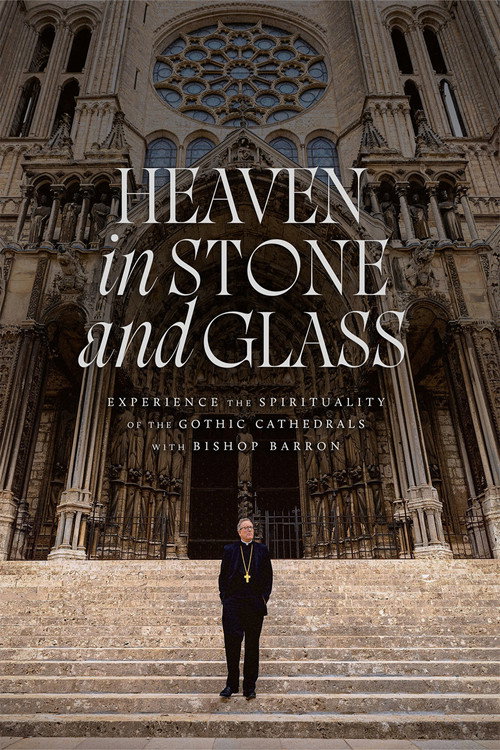
Heaven in Stone and Glass (2026)
Directed by Rob Kaczmark
Heaven in Stone and Glass arrives as a genuine curiosity in the modern documentary landscape: a film that scores low on every progressive cultural marker not through indifference but through active, theologically articulate opposition.
Consciousness Markers
Bishop Barron is, professionally, a man who gives lectures. The film is structured as a theological argument delivered directly to camera across five cathedrals. The lecturing is earnest, confident, and relentless, though its content is the inverse of what this metric was designed to detect.
The film mildly inverts the secularist historiography of the Enlightenment by presenting Gothic Catholicism as the pinnacle of Western achievement. This is revisionism of a traditional rather than progressive variety, and scores accordingly.
The film's sole on-screen presence is a Catholic bishop guiding a theological lecture. Casting diversity is not a concern the filmmakers appear to have entertained, even briefly.
No LGBTQ+ themes are present. The film is produced by a Catholic ministry whose theological framework regards the subject with well-documented traditional views.
There is no feminist framing whatsoever. The Virgin Mary appears in her traditional theological capacity, which is a different matter entirely.
The film contains no racial consciousness framing. Its subject is Western Christian civilizational heritage, presented without any critical race lens.
Gothic cathedrals were built before carbon footprints were a concept, and the film does not attempt to bridge that gap. No climate content is present.
The film does not critique capitalism. If anything, its defense of Western civilizational heritage sits closer to the opposite end of that particular spectrum.
No body positivity content is present. The human body is addressed, if at all, only through the lens of the Incarnation, which is a theological category.
No neurodivergence themes are present. The film's intellectual framework is Thomistic, which is demanding in its own way, but not what we are measuring here.
Why it received this score
Heaven in Stone and Glass arrives as a genuine curiosity in the modern documentary landscape: a film that scores low on every progressive cultural marker not through indifference but through active, theologically articulate opposition. Bishop Robert Barron guides us through five French Gothic cathedrals with the serene confidence of a man who has already resolved every question the twentieth century thought it was asking. The cinematography is genuinely beautiful. The argument is delivered with the pace and structure of a well-prepared homily, which is to say it does not leave much room for dissent.
The film's explicit thesis is that the secularizing West is losing something irreplaceable, and that Notre-Dame's near-destruction in 2019 briefly forced even the non-religious to feel that loss. This is, in the vocabulary of our current cultural moment, a counter-cultural position. It does not ask whether the cathedrals were built by a sufficiently diverse workforce. It does not interrogate the power structures of medieval Christendom. It looks at Chartres and sees, without irony or hedging, an argument for the existence of God rendered in stone and light. The research team found no progressive controversies attached to this film. This is because there is nothing here for the progressive apparatus to metabolize.
The one marker that registers at all is lecture energy, and even here we must be precise. The film does lecture, consistently and without apology. Bishop Barron is not a man who presents multiple perspectives and invites the viewer to decide. He has decided. The lecture energy score of 40 reflects the form, not the content, because the content is a defense of objective truth and sacred tradition, which is not the variety of lecturing this metric was designed to capture. In a decade of cinema increasingly preoccupied with dismantling Western cultural inheritance, this documentary stands in a Gothic nave and points upward. We note this without editorial comment. The score speaks for itself.
Analysis generated by our Consciousness Algorithm
Synopsis
On April 15, 2019, the world watched in horror as flames erupted from the rafters of Notre-Dame Cathedral – an event that captivated global audiences and ignited an overwhelming response of loss, awe, and shared cultural grief. Why did the threat to this sacred space resonate so deeply, even among those with no religious affiliation? Bishop Robert Barron returns to France to answer this question, taking the viewer on a cinematic pilgrimage.