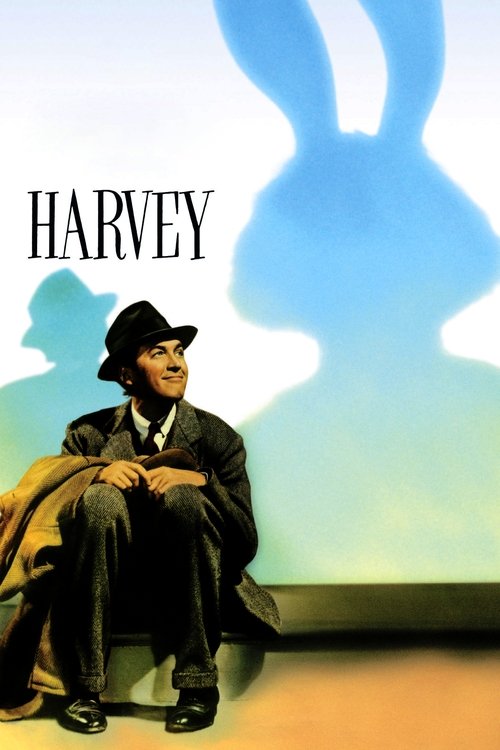
Harvey (1950)
Directed by Henry Koster
No — Harvey is not woke, scoring 0 out of 100 on our wokeness meter.
Harvey arrives from 1950, a year in which a man could befriend a six-foot invisible rabbit and the culture responded with a Pulitzer Prize and a hit film instead of a diagnostic manual.
Consciousness Markers
The film carries a gentle thesis about kindness versus 'normal' people, but it delivers this through charm rather than preachy sermonizing.
The cast is entirely white, reflecting standard 1950 Hollywood casting with no deliberate representation effort.
No LGBTQ+ characters, themes, or subtext appear anywhere in the film.
Veta and Myrtle Mae are present as family members, but the film advances no feminist critique or agenda.
The film contains no engagement with race or racial consciousness whatsoever.
There is no environmental or climate theme in the story.
The film offers no economic critique or anti-capitalist messaging.
Body image and body positivity are not addressed in any form.
Elwood's eccentricity and the sanatorium setting are played for whimsical comedy, not as a modern neurodivergence-affirming narrative.
The film is a straightforward adaptation of a contemporary play with no historical revisionism.
Why it received this score
Harvey arrives from 1950, a year in which a man could befriend a six-foot invisible rabbit and the culture responded with a Pulitzer Prize and a hit film instead of a diagnostic manual. James Stewart plays Elwood P. Dowd, a gentle alcoholic whose chief pleasure is introducing Harvey to strangers in bars. His sister Veta, played by Josephine Hull with a fine trembling agitation, attempts to commit him to a sanatorium. The paperwork goes wrong. She is committed instead. Henry Koster directs the resulting farce with a light hand, and the affair resolves into romance, a recovered coin purse, and a sunrise walk down a country road.
We searched this film for the modern markers and found the shelves bare. The cast is uniformly white, as 1950 Hollywood casting dictated, and the film offers no comment on the matter. There is no racial consciousness, no environmental anxiety, no economic critique, no engagement with body image, and no romantic subtext beyond the heterosexual variety the studio system permitted. Elwood's eccentricity is treated as a charming quirk, not a neurodivergent identity to be affirmed, and the sanatorium is a comic set piece, not an institution to be indicted. Veta and Myrtle Mae occupy the screen as family obligations, and the film has no interest in their grievances as a systemic matter.
The film does carry a mild thesis, delivered with a wink. The taxi driver warns Veta that the formula will make her brother a perfectly normal human being, and normal human beings, he notes, are stinkers. That is the argument. Kindness over conformity. It is a sentiment, not a sermon, and the film never stops to lecture us about it. We score the preaching accordingly, at a whisper. A gentler piece of mid-century whimsy would be difficult to locate, and the culture has since moved on to louder instruments.
Analysis generated by our Consciousness Algorithm


Synopsis
The story of Elwood P. Dowd who makes friends with a spirit taking the form of a human-sized rabbit named Harvey that only he sees (and a few privileged others on occasion also.) After his sister tries to commit him to a mental institution, a comedy of errors ensues. Elwood and Harvey become the catalysts for a family mending its wounds and for romance blossoming in unexpected places.
Questions about Harvey
Is Harvey woke?
No — Harvey is not woke, scoring 0 out of 100 on our wokeness meter. That earns it a verdict of Ultra Based.
Does Harvey have any woke elements?
Very few. None of the 10 markers reaches 30, the level where a marker counts as present; the highest is Lecture Energy at 10.
How does Harvey compare to other 1950 movies?
It ranks #9 of the 10 films from 1950 we've scored; their average is 4. The wokest is The Young and the Damned (11).
How is the Woke Score calculated?
An AI-assisted process researches the film and its reception, scores it 0–100 on ten markers, then combines those into one 0–100 Woke Score. It measures a specific set of 2020s cultural themes, not film quality.