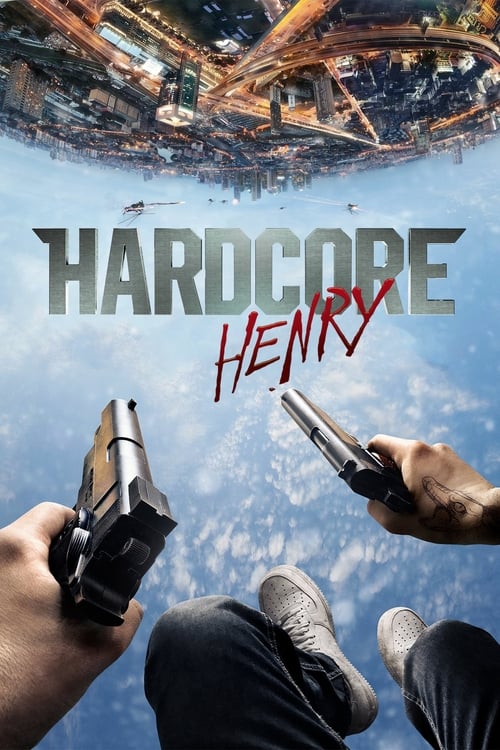
Hardcore Henry (2015)
Directed by Ilya Naishuller
No — Hardcore Henry is not woke, scoring 4 out of 100 on our wokeness meter.
The first thing to report about Hardcore Henry is that it makes no apology for itself.
Consciousness Markers
The cast is largely Russian with an international co-production, but this reflects the film's Moscow setting and financing rather than any deliberate representation-casting agenda. No minority characters are framed with commentary or social purpose.
Akan claims Estelle's research as 'his corporate property,' a faint corporate-villain beat, but the film has no economic critique and treats this purely as villain motivation.
No LGBTQ+ characters, themes, or subtext appear anywhere in the film.
The lone prominent woman, Estelle, is revealed to be a manipulative villain whose arc is a twist built around betraying the male protagonist. No feminist themes or messaging.
The film engages no racial themes or commentary whatsoever; it is a straightforward action thriller.
No environmental or climate themes are present.
No body-positivity themes; the film revels in gore and hyper-masculine action spectacle.
No exploration of neurodivergence or mental health themes.
The film is a fictional sci-fi action romp with no historical subject matter to revise.
Hardcore Henry is nearly dialogue-free, first-person ultraviolence with zero didactic or preachy messaging.
Why it received this score
The first thing to report about Hardcore Henry is that it makes no apology for itself. A man wakes on an airship, gets cybernetic limbs bolted on, and spends the next ninety minutes being flung through Moscow at the speed of a GoPro strapped to a stuntman's skull. The camera is the protagonist's eye. The protagonist never speaks. Sharlto Copley plays roughly seven personalities of the same quadriplegic scientist, and the film treats this as routine. I have classified harder films. I have rarely classified a film so eager to be a carnival ride and nothing else.
For the purposes of our ledger, the field is nearly barren. There are no themes of intimacy to weigh, no environmental sermon, no reckoning with history, no lecture delivered to a captive audience. The lone woman, Estelle, is revealed as a scheming villain, which cancels any feminist reading and replaces it with a plot twist. The cast is Russian because the film was shot in Moscow with Russian money, not from any casting philosophy. Akan claims his wife's research as corporate property, and that is the film's entire economic argument, a whisper of a critique that exists only to give the villain a motive. Nobody here is raising anybody's consciousness. They are punching.
We are left with a technical exercise of real conviction and no message whatsoever. It won a Midnight Madness award at Toronto, earned sixteen million against a two million dollar budget, and was then swept from two thousand four hundred ninety-six theaters in a hurry. This is a film about momentum, and momentum holds no politics. We file it accordingly, with the faint regret of an inspector who arrives at a building and finds only a very loud, very empty room.
Analysis generated by our Consciousness Algorithm


Synopsis
Henry, a newly resurrected cyborg who must save his wife/creator from the clutches of a psychotic tyrant with telekinetic powers, AKAN, and his army of mercenaries. Fighting alongside Henry is Jimmy, who is Henry's only hope to make it through the day. Hardcore Henry takes place over the course of one day, in Moscow, Russia.
Questions about Hardcore Henry
Is Hardcore Henry woke?
No — Hardcore Henry is not woke, scoring 4 out of 100 on our wokeness meter. That earns it a verdict of Ultra Based.
Does Hardcore Henry have any woke elements?
Very few. None of the 10 markers reaches 30, the level where a marker counts as present; the highest is Representation Casting at 10.
How does Hardcore Henry compare to other 2015 movies?
It ranks #226 of the 289 films from 2015 we've scored; their average is 15. The wokest is Chi-Raq (78).
How is the Woke Score calculated?
An AI-assisted process researches the film and its reception, scores it 0–100 on ten markers, then combines those into one 0–100 Woke Score. It measures a specific set of 2020s cultural themes, not film quality.