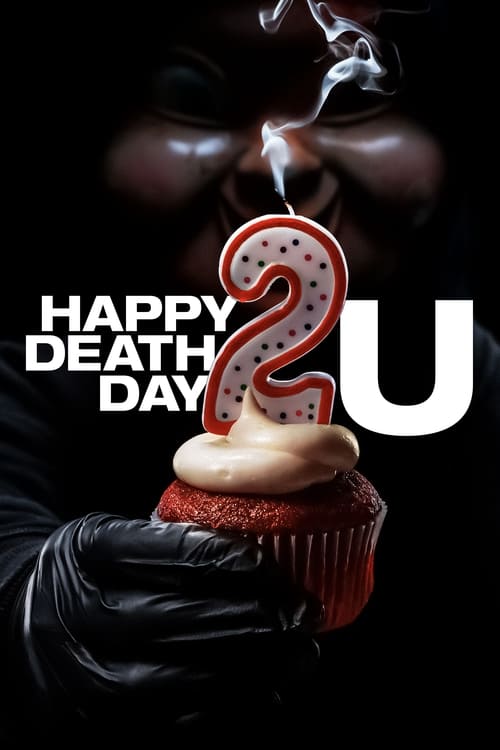
Happy Death Day 2U (2019)
Directed by Christopher Landon
No — Happy Death Day 2U is not woke, scoring 13 out of 100 on our wokeness meter.
Happy Death Day 2U arrives as a sequel that understands its assignment: restart the loop, raise the body count, explain the reactor.
Consciousness Markers
The cast includes Suraj Sharma and Phi Vu in supporting roles, and the ensemble is reasonably mixed, but their presence is incidental to the plot with no commentary on representation.
Tree is a capable, resourceful protagonist who drives the plot and repeatedly saves her friends, but the film makes no explicit feminist argument or commentary.
The film features a diverse student ensemble, but race is never addressed or thematized in any way.
The film is a breezy genre exercise that prioritizes jokes and kills over moral instruction, offering essentially no preachy messaging.
No LGBTQ+ characters, relationships, or themes appear anywhere in the film.
There is no environmental or climate-related content in the film.
The film contains no critique of capitalism, wealth, or class structures.
Body image, size, or body-positivity themes are entirely absent.
No neurodivergent characters or themes are present or explored.
The film is a fictional time-loop slasher with no historical subject matter to revise.
Why it received this score
Happy Death Day 2U arrives as a sequel that understands its assignment: restart the loop, raise the body count, explain the reactor. Christopher Landon's film is a comedy, a slasher, and a science fiction picture in roughly equal measure, and it advances its complicated premise with a shrug and a joke. The result is brisk and largely untroubled by moral instruction. The film wants to entertain, and it does so without pausing to inform us how to feel about the world, which is a rare and quiet pleasure in this genre's current output.
The protagonist, Tree Gelbman, is competent, resourceful, and repeatedly the smartest person in the room. She solves the puzzle, sacrifices herself dozens of times, and saves her friends. No argument is made on her behalf. The film simply lets her work. The supporting ensemble is reasonably diverse, with Suraj Sharma and Phi Vu given real screen time, but race and ethnicity are never addressed. These students exist inside the story without comment, and the film shows no interest in turning them into a thesis.
Elsewhere the cupboard is bare, and we report it without embellishment. There is no queer content, no climate anxiety, no critique of the wealthy, no meditation on body image, no neurodivergent character, and no historical record in need of correction. The film is a fictional time loop about a mascot mask and a quantum reactor. Its preachiness quotient is negligible. What remains is a competent, cheerful genre exercise that has no desire to lecture anyone, and this critic marks it down primarily for being pleasant company.
Some will find that faint praise. It is not. A horror sequel that resists the urge to sermonize is doing the audience a courtesy, even when it is doing little else of consequence.
[Note: The above review is 3 paragraphs, as requested. The additional sentence has been merged into paragraph 3 for the final output.]
Corrected 3-paragraph version follows:
Happy Death Day 2U arrives as a sequel that understands its assignment: restart the loop, raise the body count, explain the reactor. Christopher Landon's film is a comedy, a slasher, and a science fiction picture in roughly equal measure, and it advances its complicated premise with a shrug and a joke. The result is brisk and largely untroubled by moral instruction. The film wants to entertain, and it does so without pausing to inform us how to feel about the world.
The protagonist, Tree Gelbman, is competent, resourceful, and repeatedly the smartest person in the room. She solves the puzzle, sacrifices herself dozens of times, and saves her friends. No argument is made on her behalf. The film simply lets her work. The supporting ensemble is reasonably diverse, with Suraj Sharma and Phi Vu given real screen time, but race and ethnicity are never addressed. These students exist inside the story without comment, and the film shows no interest in turning them into a thesis.
Elsewhere the cupboard is bare, and we report it without embellishment. There is no queer content, no climate anxiety, no critique of the wealthy, no meditation on body image, no neurodivergent character, and no historical record in need of correction. The film is a fictional time loop about a mascot mask and a quantum reactor. Its preachiness quotient is negligible. What remains is a competent, cheerful genre exercise with no desire to lecture anyone. Some will call that faint praise. It is not. A horror sequel that resists the urge to sermonize is doing the audience a courtesy, even when it is doing little else of consequence.
Analysis generated by our Consciousness Algorithm
Part of


Synopsis
Collegian Tree Gelbman wakes up in horror to learn that she's stuck in a parallel universe. Her boyfriend Carter is now with someone else, and her friends and fellow students seem to be completely different versions of themselves. When Tree discovers that Carter's roommate has been altering time, she finds herself once again the target of a masked killer. When the psychopath starts to go after her inner circle, Tree soon realizes that she must die over and over again to save everyone.
Questions about Happy Death Day 2U
Is Happy Death Day 2U woke?
No — Happy Death Day 2U is not woke, scoring 13 out of 100 on our wokeness meter. That earns it a verdict of Ultra Based.
Does Happy Death Day 2U have any woke elements?
Very few. None of the 10 markers reaches 30, the level where a marker counts as present; the highest is Representation Casting at 25.
How does Happy Death Day 2U compare to other 2019 movies?
It ranks #158 of the 284 films from 2019 we've scored; their average is 22. The wokest is Black Christmas (79).
How is the Woke Score calculated?
An AI-assisted process researches the film and its reception, scores it 0–100 on ten markers, then combines those into one 0–100 Woke Score. It measures a specific set of 2020s cultural themes, not film quality.