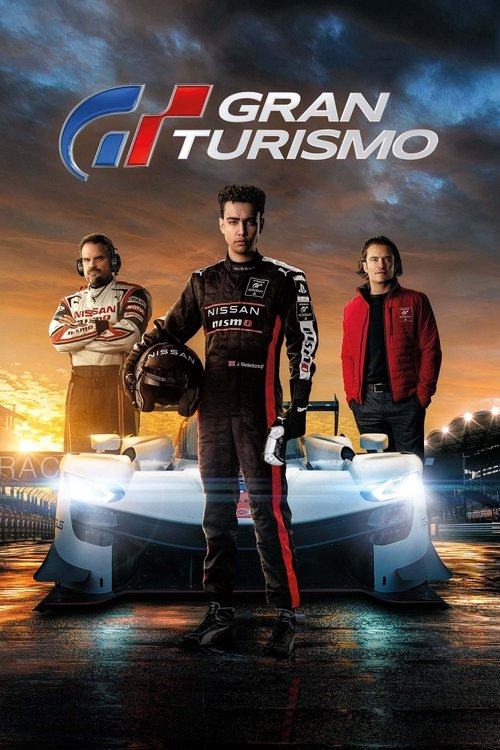
Gran Turismo (2023)
Directed by Neill Blomkamp
No — Gran Turismo is not woke, scoring 17 out of 100 on our wokeness meter.
Gran Turismo arrives as a curious artifact: a video-game adaptation that wants to be a blue-collar underdog saga and a Nissan marketing reel at the same time.
Consciousness Markers
A Black actor (Archie Madekwe) leads as Jann Mardenborough, supported by Djimon Hounsou and a deliberately multinational GT Academy roster of Korean, Spanish, Argentinian, British-Indian, and female drivers. The diversity is partly natural to the true story and global competition, but the film foregrounds an unusually inclusive ensemble for a racing genre historically dominated by white men.
The film bills itself as a true story but takes substantial liberties, combining two separate real races into one Le Mans event and repurposing Mardenborough's fatal Nürburgring crash as a dramatic narrative beat, drawing criticism for its loose handling of fact. The revision serves spectacle rather than ideology.
The film features a Black protagonist and a Black father figure, but race is never thematized or commented upon; the obstacles Jann faces are framed purely as class and credibility struggles, not racial ones.
Female characters exist (Audrey as love interest, Lesley as mother, and two female GT Academy drivers), but they are peripheral and the film advances no feminist critique or gender commentary.
There is mild tension between authentic racing merit and commercial branding (Danny prefers Matty for his 'commercial appeal'), but the film is ultimately a celebratory advertisement for Nissan's GT Academy rather than a critique of wealth or capital.
This is an uncynical underdog crowd-pleaser that generally avoids preaching; critics noted it declined opportunities to make broader social points, keeping its messaging to standard sports-drama inspiration.
No LGBTQ+ characters, themes, or subtext appear anywhere in the film.
No environmental or climate themes are present in this motorsport drama.
No body positivity themes or messaging appear in the film.
No neurodivergence is depicted or explored, despite the gamer-to-racer premise.
Why it received this score
Gran Turismo arrives as a curious artifact: a video-game adaptation that wants to be a blue-collar underdog saga and a Nissan marketing reel at the same time. Neill Blomkamp directs the racing sequences with clean, expensive momentum, and Archie Madekwe gives Jann Mardenborough enough unforced charm to keep the enterprise upright. The film's inclusiveness is real but mostly ambient. A Black lead, a multinational GT Academy roster, and Djimon Hounsou as the skeptical father put a more varied face on a genre long ruled by white men, yet race is never examined. The obstacles are class and credibility, not skin color. Female characters hover at the edges as mother, girlfriend, and two competitors, with no sustained gender argument. LGBTQ+ themes, climate concerns, body positivity, and neurodivergence are absent. The gamer-to-racer premise could have invited a neurodivergence angle; the film does not take it.
The closest thing to a social critique is a mild friction between racing merit and commercial appeal, as Danny favors the telegenic American driver. That friction dissolves into a full-throated endorsement of Nissan's academy and the brand's racing hardware. This is not a film that bites the hand that signs the checks. It is an advertisement with a third-act podium, and it seems content with that arrangement. The script also treats the true story as modeling clay. Two real races become one Le Mans event, and Mardenborough's fatal Nürburgring crash is repurposed as a dramatic setback. The result is efficient spectacle, not ideology, though the liberties are substantial enough to make the based-on-a-true-story card work overtime.
The film avoids sermonizing because its sports-drama engine is uncynical. It wants us to cheer the lap record, not attend a seminar. That restraint is welcome. The film is agreeable, glossy, and almost weightless. It passes through the culture without leaving a mark, like a well-detailed racing simulator after the power is cut.
Analysis generated by our Consciousness Algorithm


Synopsis
The ultimate wish-fulfillment tale of a teenage Gran Turismo player whose gaming skills won him a series of Nissan competitions to become an actual professional racecar driver.
Questions about Gran Turismo
Is Gran Turismo woke?
No — Gran Turismo is not woke, scoring 17 out of 100 on our wokeness meter. That earns it a verdict of Ultra Based.
Does Gran Turismo have any woke elements?
1 of the 10 markers register at 30 or above, led by Representation Casting (55). On Representation Casting: A Black actor (Archie Madekwe) leads as Jann Mardenborough, supported by Djimon Hounsou and a deliberately multinational GT Academy roster of Korean, Spanish, Argentinian, British-Indian, and female drivers.
How does Gran Turismo compare to other 2023 movies?
It ranks #96 of the 200 films from 2023 we've scored; their average is 24. The wokest is Origin (84).
How is the Woke Score calculated?
An AI-assisted process researches the film and its reception, scores it 0–100 on ten markers, then combines those into one 0–100 Woke Score. It measures a specific set of 2020s cultural themes, not film quality.