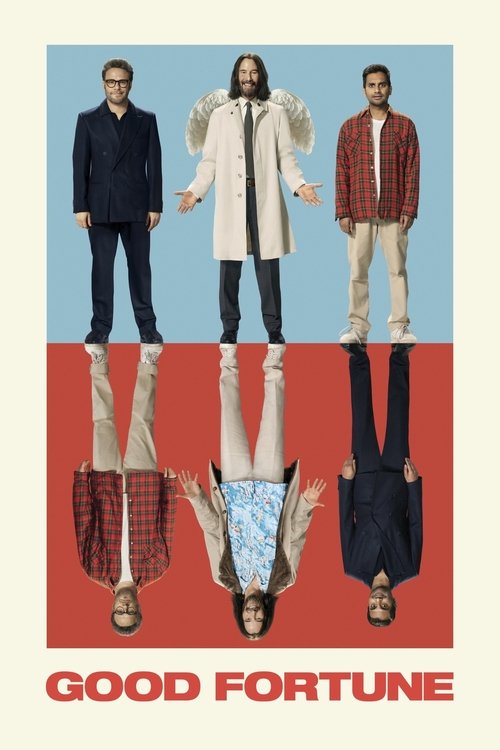
Good Fortune (2025)
Directed by Aziz Ansari
Partly — Good Fortune is somewhat woke, scoring 48 out of 100 on our wokeness meter.
Aziz Ansari's Good Fortune is a celestial body-swap comedy about an angel named Gabriel who tries to teach a struggling gig worker that money will not solve his problems.
Consciousness Markers
The plot explicitly critiques wealth inequality, gig-economy exploitation, and the callousness of a wealthy tech investor, with a unionization subplot and a reformist ending demanding better worker treatment.
The film features a notably diverse principal cast, including Aziz Ansari, Keke Palmer, Sandra Oh, and Stephen McKinley Henderson, but diversity is presented naturally rather than as an explicit casting thesis.
The film delivers explicit moral lessons about money, class, and gig-worker treatment, though it wraps them in comedic fantasy rather than sustained preaching.
Keke Palmer's Elena is a union organizer with clear agency and a principled rejection of wealth, but the film is not centrally concerned with feminist ideology.
There are no substantive LGBTQ+ themes, characters, or storylines in the film.
Despite a diverse cast, the film does not engage with racial identity, systemic racism, or racial consciousness as themes.
There is no climate-related content or environmental messaging in the film.
The film contains no body-positivity themes or messaging.
There is no exploration or representation of neurodivergence in the film.
The film is a contemporary fantasy comedy and does not revise or reinterpret historical events.
Why it received this score
Aziz Ansari's Good Fortune is a celestial body-swap comedy about an angel named Gabriel who tries to teach a struggling gig worker that money will not solve his problems. The lesson goes sideways, and the worker inherits his wealthy employer's life. The principal cast is notably diverse, with Ansari, Keke Palmer, Sandra Oh, and Stephen McKinley Henderson, but the film treats this as an ordinary Los Angeles cross-section. There is no racial thesis, no LGBTQ storyline, no climate crusade, no body-positivity thread, no neurodivergent arc, and no revisionist history. Palmer's Elena is a union organizer with clear agency and a principled rejection of wealth, which gives the film a mild feminist pulse without turning it into a tract. The movie is not interested in identity as a subject. It is interested in money.
The economic argument is the engine. Jeff, the tech investor, owns the app economy's worst instincts, and his fall into motels, car sleeping, and delivery work is designed to show how badly gig workers are treated. The film names the problem: unpaid parking tickets, plasma donation, robotic delivery, union busting, and a boardroom that can afford to do better. Its ending is reformist. Jeff demands higher pay and benefits from his board, which is a fantasy of enlightened capital but still an explicit critique. Elena tells Arj that she does not want wealth and will keep fighting for what she believes. The moral lessons about class and labor are delivered with a grin, not a raised finger, though the grin does not hide the sermon entirely.
As a piece of contemporary fantasy, it avoids historical revision and stays in the present tense. The angel mechanics, the cumbia dancing, and the taco left for Gabriel soften the politics into something warm and digestible. The result is a film with a genuine economic conscience and a diverse ensemble, but little interest in the other cultural battlegrounds of its moment. It is pleasant, modestly scaled, and committed to the idea that a divine clerical error might produce better worker treatment. In the ledger of social consciousness, this film is a labor story first, a comedy second, and a checklist never.
Analysis generated by our Consciousness Algorithm
Part of


Synopsis
A well-meaning but rather inept angel named Gabriel meddles in the lives of a struggling gig worker and a wealthy capitalist.
Questions about Good Fortune
Is Good Fortune woke?
Partly — Good Fortune is somewhat woke, scoring 48 out of 100 on our wokeness meter. That earns it a verdict of Woke-Adjacent.
What makes Good Fortune woke?
4 of the 10 markers register at 30 or above, led by Eat the Rich (70), Representation Casting (60) and Lecture Energy (50). On Eat the Rich: The plot explicitly critiques wealth inequality, gig-economy exploitation, and the callousness of a wealthy tech investor, with a unionization subplot and a reformist ending demanding better worker treatment.
How does Good Fortune compare to other 2025 movies?
It ranks #38 of the 217 films from 2025 we've scored; their average is 26. The wokest is STRAW (92).
How is the Woke Score calculated?
An AI-assisted process researches the film and its reception, scores it 0–100 on ten markers, then combines those into one 0–100 Woke Score. It measures a specific set of 2020s cultural themes, not film quality.