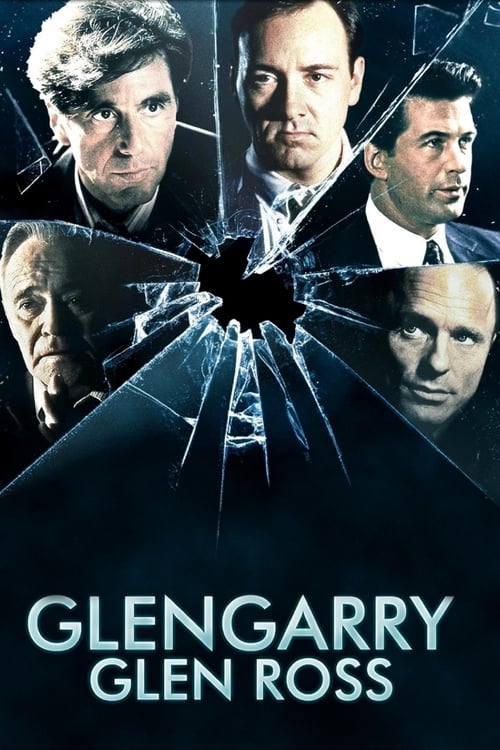
Glengarry Glen Ross (1992)
Directed by James Foley
No — Glengarry Glen Ross is not woke, scoring 19 out of 100 on our wokeness meter.
Glengarry Glen Ross arrives from 1992, an era before the contemporary cultural audit became a standard part of filmgoing.
Consciousness Markers
The film is a brutal, cynical examination of corporate pressure, sales quotas, and the desperation inherent in hyper-capitalism.
The film features a predominantly white, established male cast, offering no commentary on modern representation issues.
While the dialogue is intense, it is focused on sales tactics and personal conflict rather than delivering didactic social commentary.
There are no LGBTQ+ themes or characters present in the narrative.
The plot focuses entirely on the machinations and desperation of male salesmen, lacking any feminist agenda.
The film does not engage with racial dynamics or issues.
Environmentalism or climate change is not a factor in the plot or setting.
There is no focus on body image or body positivity.
No characters are portrayed with neurodivergence.
The film is a fictional drama and does not attempt to revise historical accounts.
Why it received this score
Glengarry Glen Ross arrives from 1992, an era before the contemporary cultural audit became a standard part of filmgoing. Its office is a fluorescent purgatory populated by white men in cheap suits, and the movie makes no effort to diversify the payroll or comment on who is missing from the room. That absence reads as period furniture, not argument. The film has no interest in romance, identity, or the body as a site of affirmation. Its characters are too busy lying to strangers to examine their own place in any broader social taxonomy.
The engine here is money, or the lack of it, and the cruelty of a late-capitalist sales floor. Blake, the motivational enforcer, arrives to announce a contest in which the losers will be fired. The speech is famous because it is monstrous and because it works. Mamet's salesmen do not critique the system from a safe distance. They claw at each other inside it. The leads are currency. The contracts are traps. The American dream is a list of names and phone numbers, and everyone is trying to steal the good ones. This is a hostile portrait of commerce, and it earns its cynicism without ever organizing a lecture.
The film's social awareness is cynical and specific, not sermonizing. It does not pause to explain its politics. It does not flatter the audience with correct opinions. It simply watches desperate men betray each other in a rain-soaked office and lets the indictment assemble itself. For viewers trained to scan for contemporary markers, the pickings are sparse. No climate anxiety. No identity discourse. No lessons about representation. There is only the sound of a phone ringing and a man deciding what kind of lie will pay for dinner. It remains an excellent, sour, unfashionable artifact of American desperation.
Analysis generated by our Consciousness Algorithm


Synopsis
An examination of the machinations behind the scenes at a real estate office. Unscrupulous salesmen try to hawk dubious real estate to suckers.
Questions about Glengarry Glen Ross
Is Glengarry Glen Ross woke?
No — Glengarry Glen Ross is not woke, scoring 19 out of 100 on our wokeness meter. That earns it a verdict of Ultra Based.
Does Glengarry Glen Ross have any woke elements?
1 of the 10 markers register at 30 or above, led by Eat the Rich (60). On Eat the Rich: The film is a brutal, cynical examination of corporate pressure, sales quotas, and the desperation inherent in hyper-capitalism.
How does Glengarry Glen Ross compare to other 1992 movies?
It ranks #13 of the 74 films from 1992 we've scored; their average is 12. The wokest is The Crying Game (62).
How is the Woke Score calculated?
An AI-assisted process researches the film and its reception, scores it 0–100 on ten markers, then combines those into one 0–100 Woke Score. It measures a specific set of 2020s cultural themes, not film quality.