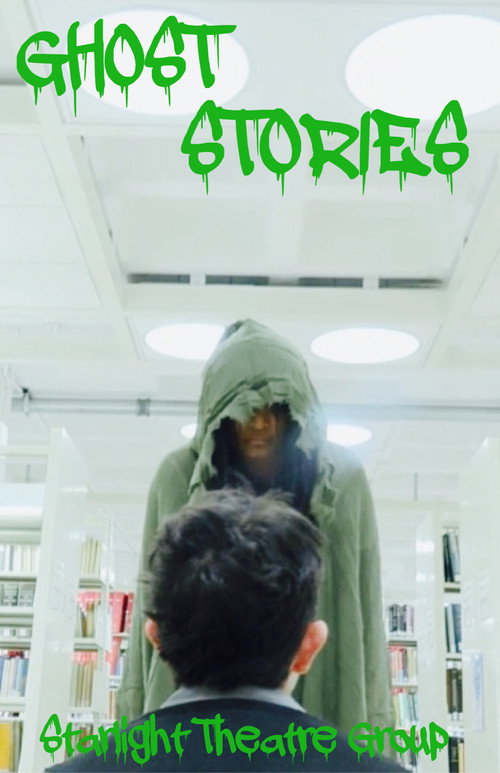
Ghost Stories (2026)
Directed by An Wang
There are films that strain under the weight of their social ambitions, and then there is Ghost Stories (2026), a two-minute horror-comedy short from Starlight Theatre Group in which a librarian discovers the building is occupied after hours.
Consciousness Markers
No evidence of casting choices driven by representational politics. The two-person cast of a two-minute short leaves no discernible agenda on the page.
No LGBTQ+ themes, characters, or subtext are present or documented in this film.
No feminist framing is evident. A librarian encounters a ghost. That is the entire transaction.
No racial commentary, discourse, or consciousness has been identified in the film or surrounding its production.
The climate crisis does not make a cameo. Not even the ghost appears to be motivated by ecological grief.
No critique of capital, labor, or economic systems is present. The library setting gestures at public infrastructure, but the film does not pursue this angle.
No body positivity messaging is present or documented in any available material about this film.
No neurodivergent characters, themes, or framing are present or suggested in the available research.
No historical revisionism is attempted. The film is set in a library, not in history.
At two minutes in length, there is simply not enough runtime to deliver a sermon. The film does not try.
Why it received this score
There are films that strain under the weight of their social ambitions, and then there is Ghost Stories (2026), a two-minute horror-comedy short from Starlight Theatre Group in which a librarian discovers the building is occupied after hours. The film's thesis, insofar as it has one, appears to be that libraries can be spooky. We have examined this proposition from every available angle and found no lurking progressive agenda, no coded messaging, no demographic box-checking. It is, by all measurable criteria, a film about a ghost in a library.
Director An Wang deploys a cast of two, Mac McIntosh as the librarian and Angelina Jackson as the spectral presence, and the resulting work registers on our cultural spectrometer with the faint blip of a film that simply wanted to be a short horror-comedy and succeeded, or failed, entirely on those terms. There is no lecture. There is no systemic critique. The ghost does not represent late-stage capitalism. We checked.
Ghost Stories occupies a rare and almost meditative position on our scale: the absolute floor. It is not a film straining against ideology or reacting to it. It is a film in which a person closes a library and is frightened. In a cultural landscape crowded with films desperate to mean something beyond their runtime, this two-minute exercise in unpretentious genre craft achieves a kind of accidental purity. We note this without admiration or contempt. We note it because the numbers demand it.
Analysis generated by our Consciousness Algorithm
Synopsis
A librarian is closing up the library to only find out that they aren't alone.