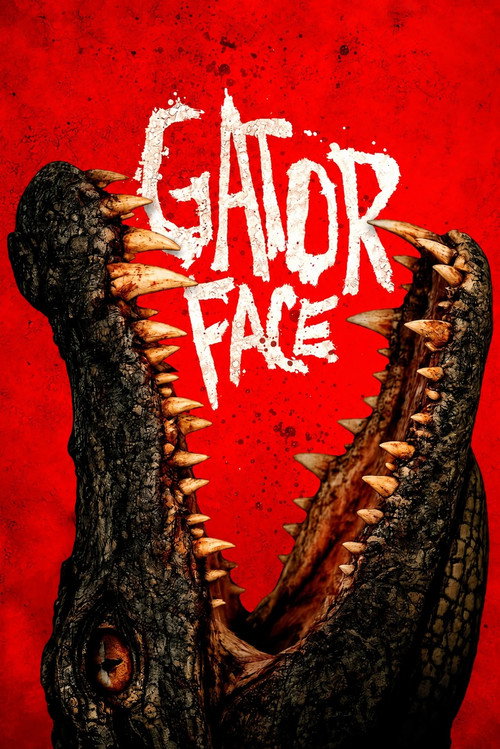
Gator Face (2026)
Directed by Padraig Reynolds
Padraig Reynolds' Gator Face arrives in 2026 as a film that has, with evident deliberateness, opted out of the entire conversation we are apparently required to have about every horror release.
Consciousness Markers
The cast is modestly diverse in a naturalistic, unremarked-upon way, consistent with a group-of-friends ensemble. There is no evidence this was engineered as a statement or presented as such in marketing.
No LGBTQ+ characters, themes, or subtext have been identified in any available material. The film is entirely occupied with the business of alligator-based mortality.
The film employs the classic exploitation-cinema tradition of imperiled young women, which is the precise opposite of feminist framing. No subversive gender commentary has been identified.
Race is not a thematic concern. The backwoods cult is presented as a generic grindhouse menace with no racial or systemic dimension attached.
No climate themes are present. The Florida swamp is a setting, not a sermon.
There is no critique of capitalism, wealth, or class structures. The villains worship a reptilian god, not a market index.
No body positivity messaging has been identified. The film's relationship with bodies is primarily forensic.
No neurodivergent characters or themes are present in any available material.
The film is not in conversation with history, revised or otherwise. It is in conversation with the 1970s drive-in circuit, which is a different matter entirely.
Critics across multiple outlets confirmed the near-total absence of social messaging. The film has no interest in instructing the audience on anything except the inadvisability of Florida swamp vacations.
Why it received this score
Padraig Reynolds' Gator Face arrives in 2026 as a film that has, with evident deliberateness, opted out of the entire conversation we are apparently required to have about every horror release. It is a movie about a cult that feeds tourists to alligators in honor of an ancient reptilian deity, and it is content to be exactly that. Critics have noted the film's explicit rejection of CGI and AI-generated imagery in favor of practical effects and live animal photography, a production philosophy that is itself a kind of statement, though not the kind our scoring apparatus is designed to measure.
The film adheres faithfully to the grindhouse template established by Tobe Hooper and his contemporaries: attractive young people, inhospitable Southern geography, and locals whose relationship with hospitality is complicated at best. The regional stereotyping on display belongs to a tradition of "rednecksploitation" that predates the current era of cultural self-examination by several decades, and it shows no interest in updating itself. The sexualized framing of female victims before their encounters with the alligator-based theology is likewise a period-accurate convention, which is to say it is retrograde without being progressive. These are meaningfully different categories, and collapsing them would be imprecise.
In a cultural moment when even modestly budgeted horror films tend to arrive pre-loaded with thematic intent, Gator Face is a genuine anomaly. It has nothing to say about systemic inequality, the climate, or the evolving landscape of gender identity. It has things to say about practical gore and the bite force of Alligator mississippiensis. We have scored accordingly.
Analysis generated by our Consciousness Algorithm


Synopsis
A Florida vacation becomes a blood-soaked fight for survival when a group of friends are hunted through the swamps by a cult that feeds its victims to ravenous alligators in the name of an ancient reptilian god.