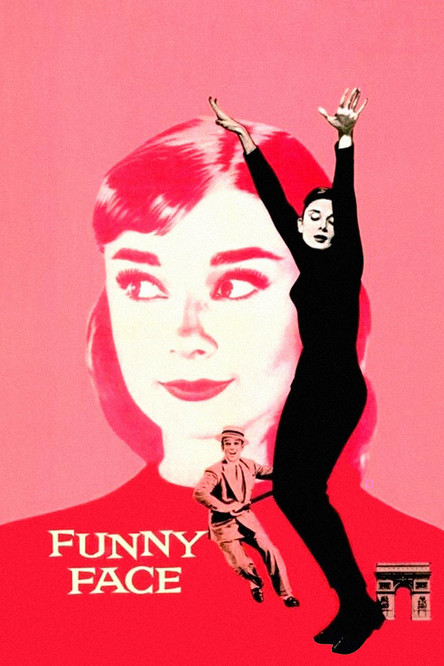
Funny Face (1957)
Directed by Stanley Donen
No — Funny Face is not woke, scoring 0 out of 100 on our wokeness meter.
Stanley Donen's Funny Face (1957) arrives as an impeccably tailored confection, a musical romance in which a Greenwich Village bookseller is transformed into a fashion model by a photographer with a quarter-century of seniority.
Consciousness Markers
The cast is entirely white and the film features no meaningful racial or ethnic diversity; casting is typical of 1950s Hollywood and not driven by modern representation goals.
No LGBTQ+ characters, themes, or subtext are present.
Although women hold fashion-industry roles, the film is a conventional 1950s romance and does not advance a modern feminist agenda.
Race is not a theme; the story unfolds in an all-white milieu without commentary on racial inequality or identity.
No environmental or climate themes appear.
The film briefly mocks fashion and consumerism but ultimately celebrates the industry; it lacks an eat-the-rich critique.
The fashion-model plot reinforces conventional beauty standards and does not promote body positivity.
No neurodivergent characters or themes are present.
The film is a fictional musical romance and does not revise historical narratives.
It includes some philosophical banter about empathicalism, but it is not a preachy modern social-justice lecture.
Why it received this score
Stanley Donen's Funny Face (1957) arrives as an impeccably tailored confection, a musical romance in which a Greenwich Village bookseller is transformed into a fashion model by a photographer with a quarter-century of seniority. The film is a product of its era, and its cultural awareness registers at a level best described as prelapsarian. The cast is uniformly white, the romance follows a conventional arc, and the philosophical musings of the beatnik set serve as window dressing for the central courtship. There is no engagement with racial identity, no subversion of gender norms, and no acknowledgment of any social cause beyond the pursuit of a good hemline.
The film briefly mocks the fashion industry, but the satire is affectionate and the industry emerges triumphant. The plot hinges on the discovery of a new face, and that face conforms to the era's beauty standards without a whisper of body positivity. The protagonist's intellectual pretensions are gently ridiculed, not celebrated, and the resolution rewards romantic conformity. Environmental concerns are absent, as are any LGBTQ+ characters or themes. Neurodivergence is not a concept the film entertains, and history remains unrevised.
The film's lecture energy is minimal, confined to a few comic exchanges about empathicalism that serve the plot rather than any sermonizing. The film is a stylish, well-crafted musical that asks nothing of its audience beyond a willingness to enjoy Gershwin tunes and Hepburn's charm. It is a pleasure, but a politically inert one. In the ledger of social consciousness, Funny Face is a blank page, and it seems entirely content to be so.
Analysis generated by our Consciousness Algorithm
Part of


Synopsis
A shy Greenwich Village book clerk is discovered by a fashion photographer and whisked off to Paris where she becomes a reluctant model.
Questions about Funny Face
Is Funny Face woke?
No — Funny Face is not woke, scoring 0 out of 100 on our wokeness meter. That earns it a verdict of Ultra Based.
Does Funny Face have any woke elements?
No. All 10 markers score zero.
How does Funny Face compare to other 1957 movies?
It ranks #10 of the 13 films from 1957 we've scored; their average is 3. The wokest is 12 Angry Men (18).
How is the Woke Score calculated?
An AI-assisted process researches the film and its reception, scores it 0–100 on ten markers, then combines those into one 0–100 Woke Score. It measures a specific set of 2020s cultural themes, not film quality.