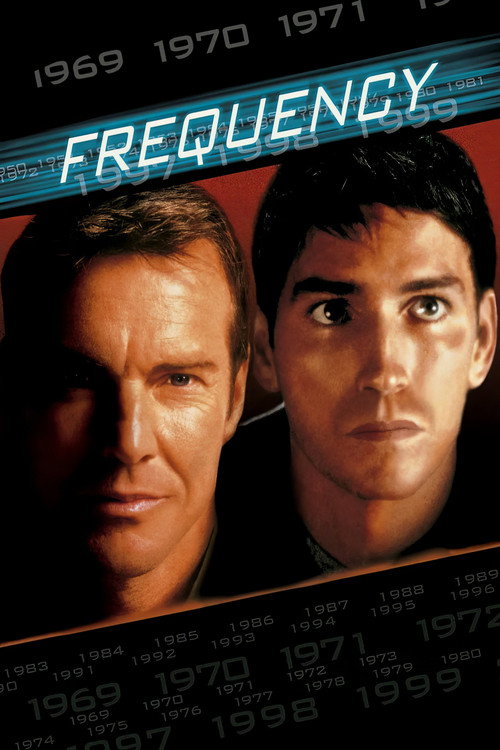
Frequency (2000)
Directed by Gregory Hoblit
No — Frequency is not woke, scoring 9 out of 100 on our wokeness meter.
A ham radio, an aurora borealis, and a father lost to a fire in 1969.
Consciousness Markers
A mostly white cast, with Andre Braugher as Det. Satch DeLeon providing the noteworthy exception in a substantial supporting role. His presence is organic to the story and not framed as a statement.
Elizabeth Mitchell's Julia is a wife, mother, and nurse who exists largely as motivation and victim; no feminist framing or critique of gender roles.
A straightforward genre thriller driven by plot mechanics and father-son sentiment rather than ideological messaging.
No LGBTQ+ characters, themes, or subtext anywhere in the film.
Braugher's character is Black but the film makes no comment on race, racism, or racial identity whatsoever.
No environmental themes or climate content.
No critique of capitalism, wealth, or class structures.
No body positivity themes or commentary on body image.
No neurodivergent characters or themes.
The film involves altering personal history via time travel, but it is not a revisionist reinterpretation of real historical events or figures.
Why it received this score
A ham radio, an aurora borealis, and a father lost to a fire in 1969. Gregory Hoblit's Frequency takes this premise and builds a sturdy if convoluted thriller in which a New York cop named John Sullivan reaches across three decades to warn his firefighter father Frank about the blaze that will kill him. The result is a film more interested in the mechanics of paradox than in any argument about the world. Time travel here is a plot device, not a pulpit, and the movie keeps its eyes on the clock.
The cast is overwhelmingly white, which is unremarkable for a 2000 studio thriller, though Andre Braugher lends the proceedings a measure of gravity as Detective Satch DeLeon, Frank's friend in 1969 and John's boss in 1999. His presence is woven into the story without commentary, and the film never pauses to reflect on race, racism, or identity. Elizabeth Mitchell's Julia occupies the familiar territory of wife, mother, and nurse, a figure who exists to be loved and, in one timeline, murdered. The screenplay offers no critique of that arrangement.
Elsewhere the film is a desert. No LGBTQ characters, no environmental sermon, no class grievance, no meditation on bodies or neurodivergence. The premise allows history to be rewritten, but only personal history, and no real event or figure is reinterpreted for ideological purposes. The film is a competent genre exercise, complete with a serial killer subplot that reviewers at the time found familiar. It wants to move us, and it largely does. It does not want to instruct us, and for that small mercy, we can be grateful.
Analysis generated by our Consciousness Algorithm


Synopsis
When a rare phenomenon gives police officer John Sullivan the chance to speak to his father, 30 years in the past, he takes the opportunity to prevent his dad's tragic death. After his actions inadvertently give rise to a series of brutal murders he and his father must find a way to fix the consequences of altering time.
Questions about Frequency
Is Frequency woke?
No — Frequency is not woke, scoring 9 out of 100 on our wokeness meter. That earns it a verdict of Ultra Based.
Does Frequency have any woke elements?
Very few. None of the 10 markers reaches 30, the level where a marker counts as present; the highest is Representation Casting at 20.
How does Frequency compare to other 2000 movies?
It ranks #57 of the 125 films from 2000 we've scored; their average is 13. The wokest is But I'm a Cheerleader (72).
How is the Woke Score calculated?
An AI-assisted process researches the film and its reception, scores it 0–100 on ten markers, then combines those into one 0–100 Woke Score. It measures a specific set of 2020s cultural themes, not film quality.