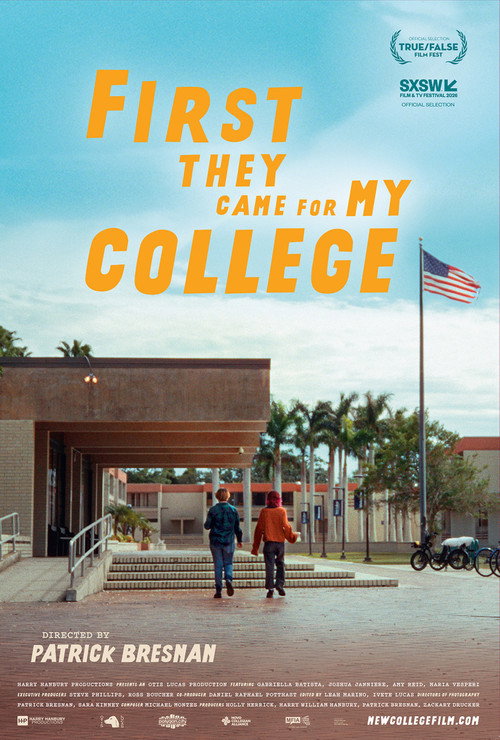
First They Came for My College (2026)
Directed by Patrick Bresnan
Patrick Bresnan's documentary arrives wearing its thesis in its title, borrowing the moral authority of Martin Niemöller's post-war confession to frame a Florida board meeting as a civilizational inflection point.
Consciousness Markers
LGBTQ+ identity is the film's most sustained concern: the abolition of the Gender Studies program, the shuttering of the Title IX office, the disposal of LGBTQ+ library holdings, and the campus's historical role as a queer and trans safe haven are all foregrounded. Co-producer Zackary Drucker's involvement further signals the film's orientation.
The film's entire architecture is an argument: the title, the historical epigraph, the festival circuit, the Ms. Magazine praise, and the vérité framing all converge on a single thesis delivered with mounting urgency. Critics noted it occasionally struggles to reach viewers not already converted, which is the reliable signature of preaching to a choir.
The documentary deliberately centers queer, trans, Black, and non-conforming students as its primary subjects, framing their displacement as the moral heart of the story. The casting of subjects is itself an editorial argument about whose voices constitute legitimate campus life.
The elimination of the Gender Studies program and the Title IX office are presented as direct attacks on feminist institutional infrastructure, and several female student organizers are centered as the documentary's moral protagonists. The framing is feminist in a structural, institutional sense.
The film documents the disposal of library books focused on race and the dismantling of DEI initiatives, presenting these as coordinated erasures of Black and minority student belonging. Rufo's stated intent to 'recompose' the student body is presented with clear racial implication.
The title's invocation of Martin Niemöller explicitly reframes a contemporary political dispute through the lens of historical fascism, asking the audience to read DEI policy battles as early-stage authoritarian creep. The historical analogy is doing substantial argumentative work.
The film's concern for trans students and non-conforming bodies in institutional space touches adjacent territory, but body positivity as a discrete theme is not explicitly developed. The connection is structural rather than rhetorical.
The film's implicit critique of politically connected trustees using state power to reshape a public institution carries faint anti-corporate undertones, but no sustained anti-capitalist argument is made. The target is political power, not economic power.
There is no evidence of climate or environmental themes in the film. The subject matter is entirely confined to academic freedom and campus politics.
There is no evidence of neurodivergence as a theme or subject in the film. New College's reputation for attracting unconventional students is noted but not framed in these terms.
Why it received this score
Patrick Bresnan's documentary arrives wearing its thesis in its title, borrowing the moral authority of Martin Niemöller's post-war confession to frame a Florida board meeting as a civilizational inflection point. This is a bold rhetorical wager. It pays off for viewers who already agree with it, which is, by most accounts, the primary audience.
The film follows students and faculty at New College of Florida as Governor DeSantis installs a new board of trustees, a new president, and trustee Christopher Rufo, who has made no secret of his intentions toward DEI programs, Gender Studies departments, and the campus's long-standing reputation as a refuge for queer and trans students. Bresnan embeds with the student activists directly, a structurally sound choice that gives the film genuine emotional texture. The students are not caricatures. They are frightened, organized, and occasionally funny. The administration is present only through public statements and board meeting recordings, which is a choice the film does not acknowledge as a choice. The result is cinéma vérité with a predetermined verdict, which is a genre unto itself at this point.
Where the film earns its score on the cultural awareness index is in its sheer density of contemporary progressive markers, all operating simultaneously and in earnest. The abolition of Gender Studies, the disposal of library books on race and LGBTQ+ history, the dismantling of the Title IX office, the framing of DEI as a protected institution rather than a contested policy: each of these is presented not as a debatable political question but as an obvious moral atrocity, with the Niemöller epigraph quietly insisting that disagreement is not a position available to serious people. The film is effective advocacy. It is also a remarkably complete specimen. Researchers in this field will want to preserve it carefully.
Analysis generated by our Consciousness Algorithm
Synopsis
When the Governor of Florida transforms a beloved public honors college in a political coup, students and professors confront a new reality: their campus is ground zero in a growing nation-wide assault on academic freedom.