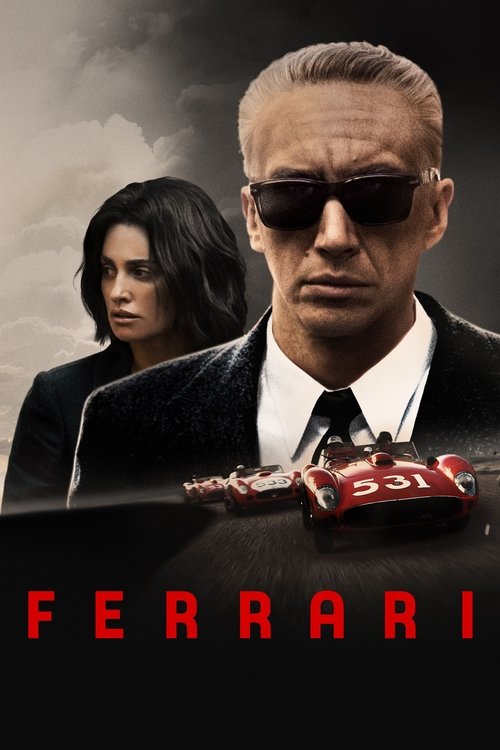
Ferrari (2023)
Directed by Michael Mann
No — Ferrari is not woke, scoring 9 out of 100 on our wokeness meter.
Michael Mann returns to the machinery of men who build fast things and ruin their marriages, which is to say he returns to Michael Mann.
Consciousness Markers
Laura Ferrari is a genuinely substantial character — half-owner of the company, a shrewd negotiator who extracts a $500,000 check and later salvages Enzo's reputation — and Penélope Cruz's performance was widely singled out. But she functions as a biographical dramatic figure, not as a vehicle for a feminist thesis.
A rare case of the marker working in reverse: Italian industrial icon Ferrari and his circle are portrayed by American and Spanish leads, drawing explicit criticism from Italian actor Pierfrancesco Favino for ethnic miscasting. Ethnic plurality exists among the cast but no representational agenda is on offer.
The film's central conflict is corporate finance: cash-flow crises, share dilution, power of attorney, and bribing journalists. But it is told entirely from the perspective of a captain of industry fighting to preserve his empire, not as an indictment of wealth.
Mann's film is a moody, cold-eyed character study that refuses to moralize or address the audience. No speeches, no messaging, no knowing winks.
No LGBTQ+ characters or themes of any kind appear in this 1950s Italian motor-racing drama.
No racial themes or commentary are present; the film is entirely about wealthy white Italians and their business and family crises.
No environmental themes. The film celebrates combustion-engine racing and treats speed as spectacle rather than sin.
No body-positivity themes or messaging present.
No depiction of neurodivergence or related themes.
The narrative streamlines and dramatizes real events, and Piero Ferrari himself noted factual liberties, but this is conventional biopic compression rather than ideologically motivated rewriting of history.
Why it received this score
Michael Mann returns to the machinery of men who build fast things and ruin their marriages, which is to say he returns to Michael Mann. Ferrari is a cold, precise object: a 1957 summer of bankruptcy, infidelity, and the Mille Miglia, rendered in gunmetal and blood. The film has no interest in instructing us. It has interest in a man's checkbook.
The most arresting presence is not the car but Laura Ferrari, played by Penélope Cruz with a fury that suggests she has been storing it for a decade. She owns half the company, extracts a half-million-dollar check as the price of her cooperation, and later rescues her husband's reputation with the same hand that nearly destroyed him. This is a substantial woman rendered substantially, though the film treats her as biography, not as argument. Elsewhere the ledger is thin. There is no racial commentary, no environmental conscience, no interest in the body or the mind, and the LGBTQ+ register is simply absent. Wealth is the subject, not the target: we watch a captain of industry fight to keep his empire, and the film admires the fight.
An Italian actor, Pierfrancesco Favino, objected publicly that Americans and Spaniards were hired to play Italians, a curious inversion of the usual casting debate, in which the complaint is that the leads are insufficiently local. Mann does not moralize. He does not address the audience. He points the camera at a man and lets the silence do the work. That is either restraint or evasion, and after two hours in the cold, it reads as both.
Analysis generated by our Consciousness Algorithm


Synopsis
Set during the summer of 1957. Ex-racecar driver, Enzo Ferrari, is in crisis. Bankruptcy stalks the company he and his wife, Laura, built from nothing ten years earlier. Their tempestuous marriage struggles with the mourning for one son and the acknowledgement of another.
Questions about Ferrari
Is Ferrari woke?
No — Ferrari is not woke, scoring 9 out of 100 on our wokeness meter. That earns it a verdict of Ultra Based.
Does Ferrari have any woke elements?
1 of the 10 markers register at 30 or above, led by Feminist Agenda (30). On Feminist Agenda: Laura Ferrari is a genuinely substantial character — half-owner of the company, a shrewd negotiator who extracts a $500,000 check and later salvages Enzo's reputation — and Penélope Cruz's performance was widely singled out.
How does Ferrari compare to other 2023 movies?
It ranks #154 of the 200 films from 2023 we've scored; their average is 24. The wokest is Origin (84).
How is the Woke Score calculated?
An AI-assisted process researches the film and its reception, scores it 0–100 on ten markers, then combines those into one 0–100 Woke Score. It measures a specific set of 2020s cultural themes, not film quality.