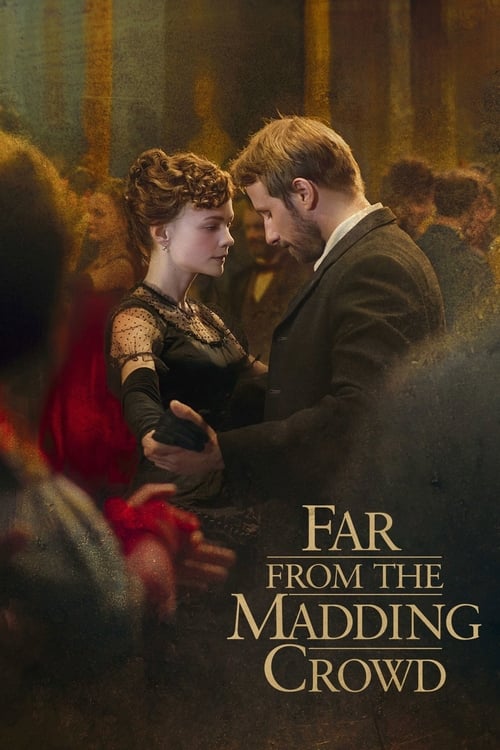
Far from the Madding Crowd (2015)
Directed by Thomas Vinterberg
No — Far from the Madding Crowd is not especially woke, scoring 21 out of 100 on our wokeness meter.
Thomas Vinterberg's 2015 adaptation of Thomas Hardy's 1874 novel is a handsome, well-mannered thing.
Consciousness Markers
Bathsheba Everdene is an independent, headstrong woman who inherits and runs her own farm, declines a proposal on grounds of independence, and asserts agency over her suitors. This is a genuine proto-feminist theme, though it is inherited from Hardy's 1874 source rather than imposed as modern messaging.
The cast is a uniformly white British ensemble (Mulligan, Schoenaerts, Sheen, Sturridge, Temple) with no color-conscious or diverse casting choices; the Victorian Dorset setting is rendered with conventional period-appropriate demographics.
No LGBTQ+ characters, relationships, or subtext appear anywhere in the narrative.
The film engages no racial themes or commentary; the rural English setting is ethnically homogeneous without any racial consciousness.
A storm threatens the harvest and Gabriel protects the hayricks, but this is agricultural drama, not environmental advocacy or climate messaging.
Class distinctions between landowners, farmers, and laborers exist as period texture, but the film offers no anti-capitalist critique or 'eat the rich' framing.
No body-positivity themes or commentary on body image appear in the film.
No neurodivergent characters or themes are present.
The film is a faithful adaptation of Hardy's novel, presenting the Victorian era without any revisionist reframing of history.
The film is a romantic period drama that tells its story through character and incident rather than didactic messaging; it does not lecture the audience.
Why it received this score
Thomas Vinterberg's 2015 adaptation of Thomas Hardy's 1874 novel is a handsome, well-mannered thing. Carey Mulligan plays Bathsheba Everdene, a woman who inherits a farm, runs it herself, and declines at least one proposal on the grounds that she values her independence. The Dorset countryside is photographed with the reverence usually reserved for cathedrals. Sheep are lost. A storm threatens the harvest. A soldier is reckless. The machinery of Victorian rural life grinds on, and the film observes it with the patience of a shepherd watching a distant flock.
The Bathsheba material carries a mild charge of social consciousness. She owns property, gives orders to men, and resists the assumption that marriage is her only available destiny. That this arrives via an 1874 source is the point. The theme is inherited, not imposed. Hardy got there first, and the film simply declines to sand it down. It never stops to explain the significance of what we are watching. Nobody turns to the camera. The audience is trusted to notice.
Elsewhere the ledger is quiet. The cast is a uniformly white British ensemble, and the film makes no comment on the fact. A storm endangers the hayricks, but hayricks are agriculture, not an argument. Class distinctions between landowners and laborers supply texture without critique. There is no lecture here, no sermon, no moment of instruction. It is a romance that respects its own period, and it asks nothing of us except attention. A modest achievement, and a rare one.
Analysis generated by our Consciousness Algorithm
Part of


Synopsis
In Victorian England, the independent and headstrong Bathsheba Everdene attracts three very different suitors: Gabriel Oak, a hardworking young sheep farmer; Frank Troy, a handsome and reckless Sergeant; and William Boldwood, a prosperous and mature bachelor.
Questions about Far from the Madding Crowd
Is Far from the Madding Crowd woke?
No — Far from the Madding Crowd is not especially woke, scoring 21 out of 100 on our wokeness meter. That earns it a verdict of Based.
Does Far from the Madding Crowd have any woke elements?
1 of the 10 markers register at 30 or above, led by Feminist Agenda (35). On Feminist Agenda: Bathsheba Everdene is an independent, headstrong woman who inherits and runs her own farm, declines a proposal on grounds of independence, and asserts agency over her suitors.
How does Far from the Madding Crowd compare to other 2015 movies?
It ranks #68 of the 289 films from 2015 we've scored; their average is 15. The wokest is Chi-Raq (78).
How is the Woke Score calculated?
An AI-assisted process researches the film and its reception, scores it 0–100 on ten markers, then combines those into one 0–100 Woke Score. It measures a specific set of 2020s cultural themes, not film quality.