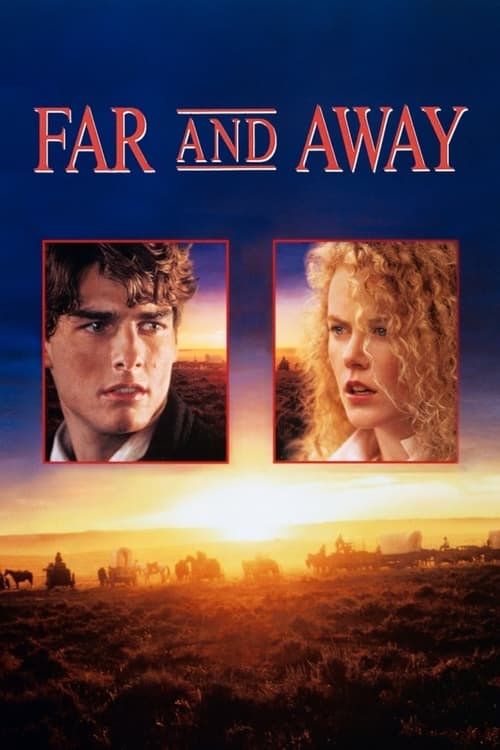
Far and Away (1992)
Directed by Ron Howard
No — Far and Away is not woke, scoring 7 out of 100 on our wokeness meter.
Ron Howard's 1992 epic arrives with the full apparatus of prestige: John Williams conducting, Panavision Super 70, nine cameras chasing eight hundred riders across a Montana field standing in for Oklahoma.
Consciousness Markers
Landlord evictions, burned tenant homes, and the exploitative ward boss Kelly gesture at class division and exploitation, but the film ultimately celebrates individual land ownership and the American dream rather than critiquing capital.
Shannon is written as a headstrong woman who resists being molded into a refined lady and pursues her own ambitions, but this is a conventional romantic-spirited trope rather than a feminist thesis.
The film touches on Irish immigrant hardship and class prejudice, but frames it as period texture and personal struggle rather than any modern racial-justice consciousness.
This is a sweeping romantic adventure with no preachy or didactic messaging; any thematic content is delivered through melodrama rather than lecture.
The cast is almost entirely white, with Irish and Italian characters played by white actors; there is no modern representation-casting intent whatsoever.
No LGBTQ+ characters, themes, or subtext appear anywhere in this 1890s romantic adventure.
There is no environmental or climate theme in the film.
Bare-knuckle boxing provides physicality, but there is no body-positivity messaging.
No neurodivergent characters or themes are present.
The film romanticizes the 1893 Oklahoma Land Run without revising or reckoning with the dispossession of Native peoples, so it offers no revisionist-history angle.
Why it received this score
Ron Howard's 1992 epic arrives with the full apparatus of prestige: John Williams conducting, Panavision Super 70, nine cameras chasing eight hundred riders across a Montana field standing in for Oklahoma. What it does not arrive with is a thesis. The film is a sweeping romantic adventure about Irish immigrants chasing free land, and it conducts itself with the unbothered confidence of a production that never once glanced at a focus group or a cultural syllabus. Tom Cruise boxes bare-knuckle in a Boston basement. Nicole Kidman stabs him with a pitchfork and then marries him with her eyes. The camera swoons. Nobody learns anything about systems.
The social consciousness on display is period texture and nothing more. Irish tenant farmers are evicted and their homes burned, and the ward boss Kelly fleeces his own countrymen in a burlesque hall, which gestures at class division without ever committing to an argument about it. The film's actual destination is a land claim staked by an individual with his own two hands, which is the opposite of a critique of capital. Shannon resists being molded into a refined lady, and that resistance is real, but it exists to make her interesting at dinner parties, not to advance a cause. The 1893 Land Run is staged as a triumph of pluck, and the dispossession that made the territory available goes unmentioned, which spares the film any reckoning and also any revisionism.
The casting is uniformly pale, the romance is heterosexual and legally consecrated, and the only lecture delivered across two and a quarter hours concerns the importance of believing in yourself. Ebert called the story simple-minded and intended for adolescents, which is harsh but not unfair. It remains a handsome, dawdling, sincerely felt piece of old-fashioned moviemaking, and there is something almost restful about a film this expensive that has nothing to say. The spoons get stolen. The horse gets ridden. The flag goes in the ground. Fatigue sets in around the ninety minute mark, as it always does.
Analysis generated by our Consciousness Algorithm
Part of


Synopsis
A young free-spirited Irish woman from an affluent Protestant family spontaneously befriends a street-smart commoner cheated by her family’s hostile land takeovers. They escape to America, ready to take advantage of the 19th century Oklahoma land rush.
Questions about Far and Away
Is Far and Away woke?
No — Far and Away is not woke, scoring 7 out of 100 on our wokeness meter. That earns it a verdict of Ultra Based.
Does Far and Away have any woke elements?
Very few. None of the 10 markers reaches 30, the level where a marker counts as present; the highest is Eat the Rich at 18.
How does Far and Away compare to other 1992 movies?
It ranks #41 of the 74 films from 1992 we've scored; their average is 12. The wokest is The Crying Game (62).
How is the Woke Score calculated?
An AI-assisted process researches the film and its reception, scores it 0–100 on ten markers, then combines those into one 0–100 Woke Score. It measures a specific set of 2020s cultural themes, not film quality.