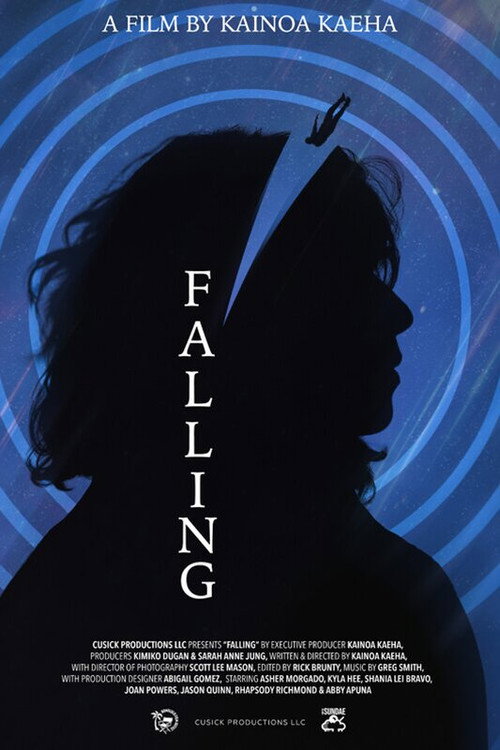
Falling (2026)
Directed by Kainoa Kaeha
Falling is a 16-minute short film from the University of Hawaiʻi at Mānoa, which means it was made with genuine sincerity, a limited budget, and an Honors thesis committee watching from a respectful distance.
Consciousness Markers
The film features an entirely Pasifika and AAPI cast drawn from Hawaiʻi's local creative community, with the production explicitly positioned as an effort to build Indigenous and local film infrastructure. The casting is culturally specific and intentional, though it serves the story's setting organically.
The film is rooted in Pasifika identity and was developed within UH Mānoa's Indigenous film community, lending it a quiet cultural consciousness. There is no explicit racial commentary, but the specificity of place and people carries its own weight.
The director's stated mission to destigmatize suicide and address young men's mental health gives the film an advocacy purpose, though the 16-minute short format and intimate storytelling approach appear to prioritize feeling over sermonizing. The messaging is present but reportedly worn lightly.
The surrogate sister Malu functions as an emotional anchor and active agent in the story, but the film's focus on a young man's grief and mental health means feminist framing is incidental at most.
No LGBTQ+ themes, characters, or narrative elements are present or reported in the film.
No climate or environmental themes are present in this intimate mental health drama.
No anti-capitalist themes or critique of economic structures appear in the film.
Body positivity is not a theme or concern anywhere in the narrative.
No neurodivergence themes are present. The film's focus is on grief, trauma, and suicidal ideation, which are framed as mental health concerns rather than neurodivergent identity.
The film is a contemporary personal drama with no historical revisionism of any kind.
Why it received this score
Falling is a 16-minute short film from the University of Hawaiʻi at Mānoa, which means it was made with genuine sincerity, a limited budget, and an Honors thesis committee watching from a respectful distance. Director Kainoa Kaeha has constructed a grief portrait around a fifteen-year-old boy named Analu, who sits in an apartment processing the loss of someone who made him feel seen. This is, by any clinical measure, a serious and humane subject. The film's progressive sensibilities are largely inseparable from its subject matter: it is about young men's mental health, it features an entirely Pasifika cast, and it was made expressly to destigmatize suicide. These are not decorative choices. They are the film.
The cultural awareness here is less a layer applied on top of the story and more the substrate from which the story grows. The casting draws entirely from Hawaiʻi's local creative ecosystem, and the production was developed within an institution actively trying to build Indigenous film infrastructure in the Pacific. That is a specific and coherent artistic context, not a diversity checkbox. The advocacy energy is present, acknowledged openly by the director in press materials, but a 16-minute short film about a boy sitting alone with his grief has limited bandwidth for lecturing. It mostly appears to be too busy being sad.
Where the scoring needle moves at all, it moves quietly. Representation is deliberate. Racial consciousness is ambient rather than argumentative. The remaining markers sit at or near zero, because a student film about suicide prevention in Hawaiʻi is simply not in the business of climate policy or anti-capitalist critique. We note this not as a criticism but as a taxonomic observation. Falling is a small film with a focused purpose, and focused purposes, it turns out, do not score particularly high on a ten-axis cultural diagnostic. The instrument was not designed for it. Neither, frankly, was the film.
Analysis generated by our Consciousness Algorithm
Synopsis
Alone in the suffocating quiet of his surrogate sister's apartment, fifteen-year-old Analu clings desperately to memories of his lost loved one, Iolani, the one person who made him feel seen. The night becomes a battleground of haunting flashbacks and quiet suffering, as Analu teeters between holding on and letting go. Malu, his surrogate sister, fights to reach the part of him still holding on. Falling is a raw, intimate journey through trauma, where the weight of the past threatens to eclipse the connections that remain.