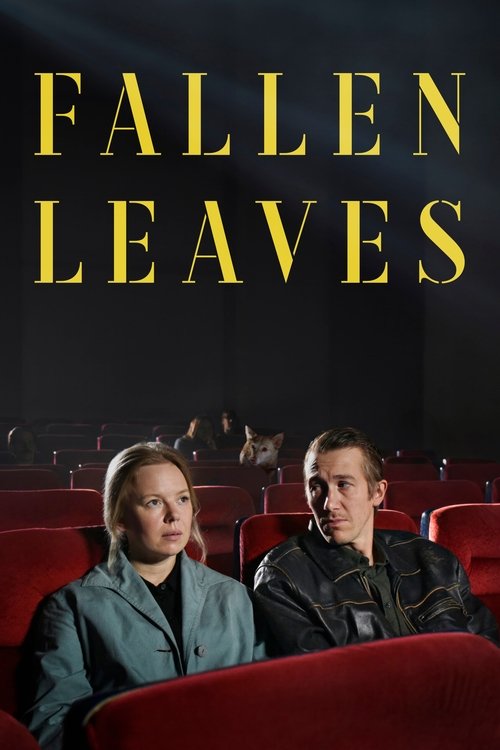
Fallen Leaves (2023)
Directed by Aki Kaurismäki
No — Fallen Leaves is not woke, scoring 15 out of 100 on our wokeness meter.
Aki Kaurismäki has been making films about the working poor for nearly forty years, and Fallen Leaves finds him in no hurry to change the recipe.
Consciousness Markers
A continuation of Kaurismäki's 'Proletariat' series, the film dwells on zero-hour contracts, arbitrary firings, under-the-table wages, and the precarity of the working poor. The critique is structural and sympathetic rather than sloganistic, but the economic indictment is unmistakable.
Kaurismäki's deadpan minimalism is the opposite of preachy; the film's politics are embedded in circumstance rather than delivered as a sermon. A faint didactic pulse exists in its portrait of exploitation, but it never lectures.
The cast is overwhelmingly Finnish and white, with a couple of natural supporting appearances by Middle Eastern-descended actors (Sherwan Haji, Karar Al-Bazoon) that carry no commentary. Casting reflects the film's Helsinki milieu rather than any deliberate diversity mandate.
Ansa is a self-possessed working-class woman who sets boundaries and pursues her own life, but the film offers no feminist thesis or gendered critique; her independence is character, not agenda.
No LGBTQ+ characters, themes, or subtext appear anywhere in the film.
Race is not a subject of the film at all; the narrative concerns class, loneliness, and alcoholism within a homogeneous Finnish setting.
No environmental or climate themes are present.
No body-positivity themes or messaging are present.
No neurodivergence themes or characters are present.
The film is a contemporary fiction with no historical revisionism; the radio references to the 2022 invasion of Ukraine are ambient texture, not a reworking of history.
Why it received this score
Aki Kaurismäki has been making films about the working poor for nearly forty years, and Fallen Leaves finds him in no hurry to change the recipe. Two lonely people in Helsinki, a supermarket shelf-stocker named Ansa and a sandblaster named Holappa, meet in a karaoke bar and spend eighty minutes failing to exchange a phone number. The palette is muted. The performances are flat by design. A stray dog arrives late and steals the picture without appearing to try.
The film is the fourth entry in what Kaurismäki calls his Proletariat series, and the economic grievance is plain. Ansa is fired for taking expired food. Holappa loses a job for drinking, then another, then a dormitory bed. Wages arrive under the table. Contracts are zero hours. The indictment is structural, and it is delivered without a single speech, which is the only reason it lands. Kaurismäki trusts us to draw the conclusion ourselves, and we do.
The film's refusals are just as instructive. There is no sermon on identity, no environmental parable, no lecture on the body or the mind. Race is simply not a subject here; the cast is Finnish because Helsinki is Finnish. Ansa is a woman of stubborn independence, though the film never pauses to congratulate itself for this. The politics live in the circumstances, and the tone stays dry. A faint pulse of instruction beats beneath the exploitation on display, but it never rises to a speech. What we get instead is a romance that radicalizes nothing except our patience for sincerity. It won the Jury Prize at Cannes and represented Finland at the Academy Awards, and it managed both while remaining almost aggressively small. We could use more of this.
Analysis generated by our Consciousness Algorithm


Synopsis
In modern-day Helsinki, two lonely souls in search of love meet by chance in a karaoke bar. However, their path to happiness is beset by obstacles – from lost phone numbers to mistaken addresses, alcoholism, and a charming stray dog.
Questions about Fallen Leaves
Is Fallen Leaves woke?
No — Fallen Leaves is not woke, scoring 15 out of 100 on our wokeness meter. That earns it a verdict of Ultra Based.
Does Fallen Leaves have any woke elements?
1 of the 10 markers register at 30 or above, led by Eat the Rich (42). On Eat the Rich: A continuation of Kaurismäki's 'Proletariat' series, the film dwells on zero-hour contracts, arbitrary firings, under-the-table wages, and the precarity of the working poor.
How does Fallen Leaves compare to other 2023 movies?
It ranks #105 of the 200 films from 2023 we've scored; their average is 24. The wokest is Origin (84).
How is the Woke Score calculated?
An AI-assisted process researches the film and its reception, scores it 0–100 on ten markers, then combines those into one 0–100 Woke Score. It measures a specific set of 2020s cultural themes, not film quality.