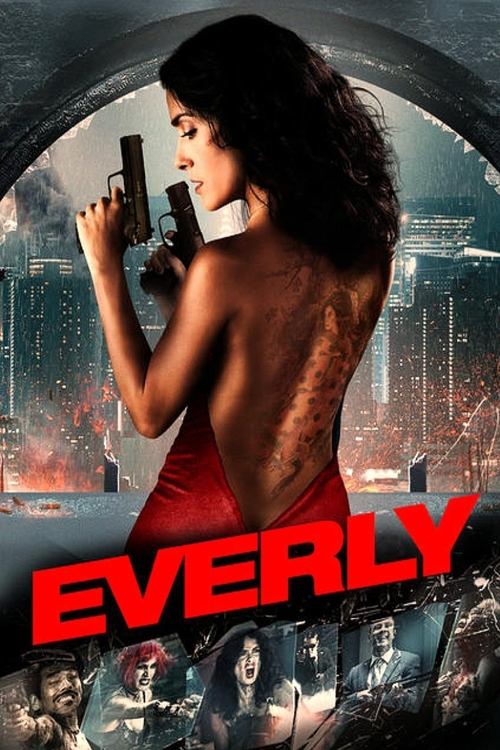
Everly (2015)
Directed by Joe Lynch
No — Everly is not especially woke, scoring 21 out of 100 on our wokeness meter.
Everly arrives in the tradition of the single-location siege picture, a subgenre that has always understood the value of a woman with a gun and a locked door.
Consciousness Markers
The premise — a woman trafficked into sexual slavery who violently dismantles her male captors and their network — carries an inherent female-empowerment revenge thrust, though it is delivered through exploitation-thriller spectacle rather than explicit ideology.
The lead is Salma Hayek as a Mexican-American woman, surrounded by a largely Asian supporting cast. However, the diversity is organic to the Japanese-yakuza setting rather than a self-conscious representational statement.
The villains are the Japanese underworld and their trafficked women, but the film offers no commentary on race or systemic racial issues; the casting is situational, not thematic.
Despite its subject matter, the film is a stylized, gory single-location action piece and does not pause to preach or moralize.
The antagonist profit motive of trafficking and bounty-killing exists as plot mechanics, but the film makes no argument about capitalism or class.
No LGBTQ+ characters, themes, or subtext appear anywhere in the film.
No environmental or climate themes are present.
No body-positivity themes or messaging appear; the film's treatment of the body is exploitative violence rather than affirmation.
The Sadist and Masochist are depraved torturers, not framed through any neurodivergence lens.
No historical revisionism; the film is a contemporary fictional action thriller.
Why it received this score
Everly arrives in the tradition of the single-location siege picture, a subgenre that has always understood the value of a woman with a gun and a locked door. Salma Hayek plays the title character, a woman held in sexual slavery for four years by a Japanese crime lord, who spends the film's runtime converting a plush apartment into a crime scene. The casting is notable: a Mexican-American lead surrounded by a largely Asian ensemble, situated inside a yakuza milieu where that arrangement reads as geography instead of statement. The film does not pause to explain itself, and we respect it for that.
There is a revenge engine here that runs on female fury, and the film is not shy about the image of a trafficked woman dismantling the men who owned her. That energy is genuine, though it is delivered through exploitation spectacle: acid, katanas, torture, and a great deal of screaming. Any empowerment on offer comes wrapped in the aesthetics of a grindhouse poster, which is a complicated delivery system for a message about bodily autonomy. The film never lectures. It has no interest in the moral of its own story, and it certainly has no interest in climate, class, or the politics of the body.
The villains are the Japanese underworld, and the women in the building are commodities traded for a bounty, but the film draws no systemic conclusions from any of it. It is a bloody, stylish, thinly written exercise that treats its own subject matter as raw material for mayhem. We have seen worse. We have also seen the film's ambitions, and they are modest.
Analysis generated by our Consciousness Algorithm


Synopsis
After she betrays a powerful mob boss, a woman matches wits and weaponry with a legion of killers who are out to collect the bounty on the heads of her and her family.
Questions about Everly
Is Everly woke?
No — Everly is not especially woke, scoring 21 out of 100 on our wokeness meter. That earns it a verdict of Based.
Does Everly have any woke elements?
2 of the 10 markers register at 30 or above, led by Feminist Agenda (40) and Representation Casting (30). On Feminist Agenda: The premise — a woman trafficked into sexual slavery who violently dismantles her male captors and their network — carries an inherent female-empowerment revenge thrust, though it is delivered through exploitation-thriller spectacle rather than explicit ideology.
How does Everly compare to other 2015 movies?
It ranks #68 of the 289 films from 2015 we've scored; their average is 15. The wokest is Chi-Raq (78).
How is the Woke Score calculated?
An AI-assisted process researches the film and its reception, scores it 0–100 on ten markers, then combines those into one 0–100 Woke Score. It measures a specific set of 2020s cultural themes, not film quality.