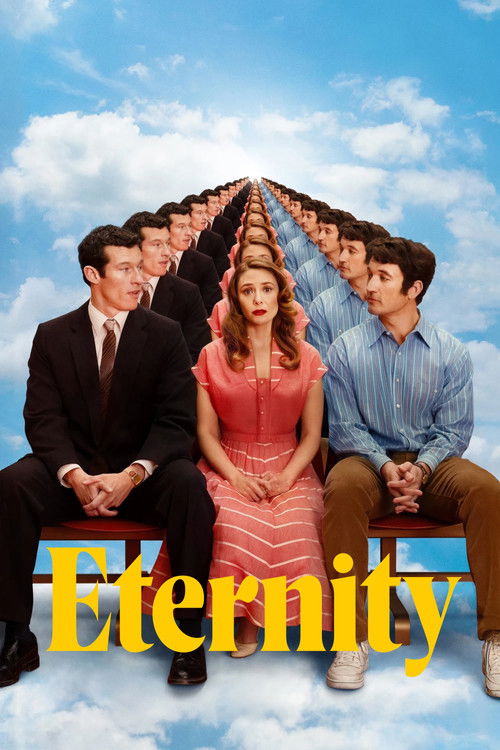
Eternity (2025)
Directed by David Freyne
No — Eternity is not woke, scoring 12 out of 100 on our wokeness meter.
"Eternity" arrives from A24 with the confidence of a film that knows exactly what it is: a high-concept romantic comedy about a widow in the afterlife choosing between her long marriage and her first love.
Consciousness Markers
The supporting cast includes Black and Latina performers in prominent afterlife-coordinator roles, though the romantic leads are white and the film makes no issue of the diversity.
The story centers a woman's romantic agency and her choice between two husbands, but treats it as a conventional screwball-romcom dilemma rather than a feminist statement.
The film has a mild sentimental message about cherishing ordinary moments, but it is delivered through story rather than preachy lecture.
No LGBTQ+ themes, characters, or relationships are present in the plot or research summary.
No racial themes, commentary, or consciousness are present; the diverse casting is incidental to the story.
No climate or environmental themes appear in the film.
The afterlife bureaucracy offers mild comic texture, but there is no anti-capitalist critique or eat-the-rich messaging.
No body-positivity themes or body-image commentary are present.
No neurodivergence themes or neurodivergent characters are identified in the plot or research.
The Korean War is used only as backstory for a first husband; there is no historical revisionism.
Why it received this score
"Eternity" arrives from A24 with the confidence of a film that knows exactly what it is: a high-concept romantic comedy about a widow in the afterlife choosing between her long marriage and her first love. The setting, a bureaucratic Junction where souls sample themed eternities before committing, provides pleasant comic texture. The supporting cast includes Black and Latina performers as afterlife coordinators, and the film treats their presence as ordinary. That is the correct approach. No speeches are made about it. Incidental diversity is not the same as a thesis, and this film does not pretend otherwise.
The central dilemma belongs to Joan, and the film grants her romantic agency. She weighs two versions of love, one seasoned by sixty-five years of argument and one frozen in youthful devotion. This is a woman's choice, handled with the familiar rhythms of a screwball comedy. It is not a feminist manifesto. The film has no interest in dismantling institutions or lecturing us about gender. It wants us to feel the ache of memory and the impossibility of ranking one life against another. On that modest front, it succeeds often enough.
The Korean War appears only as backstory for the first husband. There is no historical reclamation, no racial consciousness, no climate anxiety, no anti-capitalist critique of the afterlife's bureaucratic economy. The body-positive and neurodivergent readings are simply not present. What remains is a mild sentimental message about cherishing ordinary moments, and the film delivers it through story instead of sermon. We are not scolded. We are nudged. The result is a gentle, well-performed diversion that understands the difference between a cultural argument and a good cry. It chooses the good cry, which may be the most honest decision anyone makes in this afterlife.
Analysis generated by our Consciousness Algorithm
Part of


Synopsis
In an afterlife where souls have one week to decide where to spend eternity, Joan is faced with the impossible choice between the man she spent her life with and her first love, who died young and has waited decades for her to arrive.
Questions about Eternity
Is Eternity woke?
No — Eternity is not woke, scoring 12 out of 100 on our wokeness meter. That earns it a verdict of Ultra Based.
Does Eternity have any woke elements?
1 of the 10 markers register at 30 or above, led by Representation Casting (30). On Representation Casting: The supporting cast includes Black and Latina performers in prominent afterlife-coordinator roles, though the romantic leads are white and the film makes no issue of the diversity.
How does Eternity compare to other 2025 movies?
It ranks #153 of the 217 films from 2025 we've scored; their average is 26. The wokest is STRAW (92).
How is the Woke Score calculated?
An AI-assisted process researches the film and its reception, scores it 0–100 on ten markers, then combines those into one 0–100 Woke Score. It measures a specific set of 2020s cultural themes, not film quality.