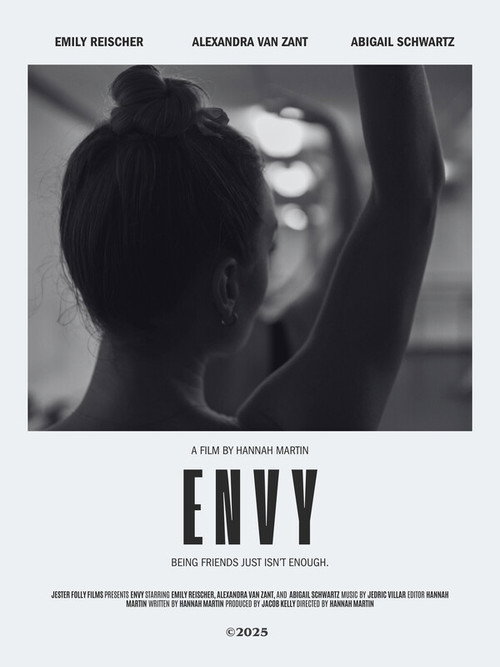
ENVY (2026)
Directed by Hannah Martin
ENVY arrives as an 11-minute short film about ballet and obsession, which is, admittedly, a genre pairing with a long and distinguished history of psychological unraveling.
Consciousness Markers
The central dynamic, a younger girl's adoration of an older girl that blurs into obsession, carries a same-sex romantic charge embedded in the thriller framing. The film does not appear to foreground this as a political identity statement, but the romantic undercurrent is structurally present.
The film features an all-female lead ensemble directed by a woman, which constitutes baseline representational texture. There is no evidence this was a deliberate casting statement rather than simply the natural composition of a ballet school story.
A female director, a fully female-centric story set in the competitive world of ballet. The film does not appear to deliver any explicit feminist messaging, but the space it occupies is coded female in the way ballet dramas tend to be.
An 11-minute short thriller about obsession has almost no room for sermonizing, and no evidence suggests it tries. The score reflects the faintest possibility that the obsession narrative carries an implicit cautionary note, nothing more.
No evidence of racial themes, commentary, or consciousness-raising in the film's premise, research, or reception.
No climate or environmental themes of any kind are present or suggested.
No anti-capitalist or class-critique elements are present. The ballet world is competitive but not framed through an economic lens.
No body positivity messaging found. Ballet settings more typically carry the opposite cultural baggage, though the film does not appear to address that either.
No neurodivergence themes or representation identified in the research or premise.
The film is a contemporary fictional story with no historical setting or revisionist framing.
Why it received this score
ENVY arrives as an 11-minute short film about ballet and obsession, which is, admittedly, a genre pairing with a long and distinguished history of psychological unraveling. Director Hannah Martin works in a space well-trodden by Black Swan and its spiritual ancestors: the dance studio as pressure cooker, the mentor-protégé bond as something darker. The film's social consciousness, such as it is, operates almost entirely through implication. A timid freshman named Molly fixates on an older classmate named Alison, and the romantic charge running beneath that fixation is not incidental to the story. It is the story.
The film earns its modest LGBTQ score not through declaration but through architecture. Nobody delivers a speech. Nobody announces their identity. The same-sex obsession simply sits at the center of the narrative, doing its work quietly, which is, in this critic's estimation, the more dramatically honest approach. The female-dominated cast and female director add a layer of representational texture that feels organic to the subject matter instead of assembled for optics. Ballet has always been a female-coded world. Casting it that way is not a provocation.
What keeps ENVY from registering higher on the cultural consciousness scale is precisely what makes it a functional thriller: it is interested in psychology, not pedagogy. It does not stop to explain itself. It has eleven minutes and it uses them. In a landscape crowded with films that mistake a lecture for a climax, that restraint is, if not revolutionary, at least refreshing.
Analysis generated by our Consciousness Algorithm
Synopsis
When Molly, a timid freshman ballerina, befriends Alison, an older girl in her class, the line between adoration and obsession starts to blur.