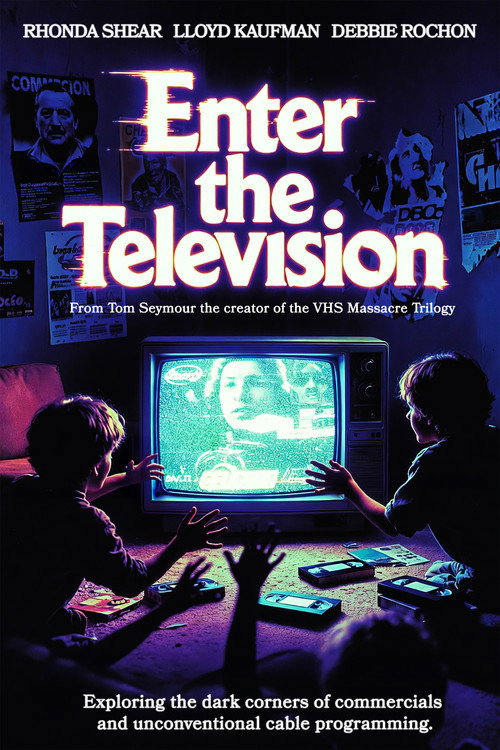
Enter the Television (2026)
Directed by Thomas Edward Seymour
Thomas Edward Seymour's "Enter the Television" arrives from the underground film festival circuit bearing the solemn air of a document that believes, with full conviction, that the history of late-night cable access programming has been criminally underexamined.
Consciousness Markers
The documentary's central thesis is a structural critique of powerful media corporations and their control over public airwaves and distribution channels. Lloyd Kaufman's long-standing anti-consolidation advocacy and the film's framing of independent creators as survivors within corporate-dominated systems gives this marker genuine, if moderate, weight.
A documentary about media conditioning and corporate manipulation of public consciousness carries an inherent sermonizing potential, and Film Threat's note that viewers may leave 'more suspicious of their TV' suggests the film is not above delivering a message. It stops well short of sustained preachiness, however.
Debbie Rochon's documented commentary on gender dynamics within low-budget and genre filmmaking spaces is adjacent to the film's subject matter, and Rhonda Shear's presence as a central figure acknowledges women's roles in cult television. However, there is no evidence of an explicit feminist throughline in the documentary's argument.
The documentary features a modestly diverse roster of cult and underground media figures, including several women in prominent interview roles. This appears to reflect the actual demographics of the underground television and B-movie world rather than any deliberate casting calculus.
The film examines television history through an underground and independent lens, implicitly pushing back against mainstream narratives of media progress. This is a mild archival corrective rather than active revisionism.
No LGBTQ+ themes, representation, or commentary are documented in the film's content or critical coverage. The score is 0.
No evidence of racial consciousness framing, commentary on racial representation in media, or related themes appears in the critical coverage or film description. The score is 0.
The film's subject matter, underground television and media corporatism, has no documented connection to climate themes. The score is 0.
No body positivity themes or commentary are present in the film's documented content. The score is 0.
No neurodivergence themes or representation are documented anywhere in the film's coverage. The score is 0.
Why it received this score
Thomas Edward Seymour's "Enter the Television" arrives from the underground film festival circuit bearing the solemn air of a document that believes, with full conviction, that the history of late-night cable access programming has been criminally underexamined. It is not entirely wrong. The documentary marshals an impressive collection of cult media figures, including Troma founder Lloyd Kaufman and B-movie institution Debbie Rochon, to guide us through the dark corners of commercial television, obscure cable channels, and the corporate machinery that quietly consumed them. Seymour frames independent media survival as a kind of heroic resistance, which is a reasonable position, and he holds it with the steady gaze of a man who has spent considerable time in a VHS archive.
The film's critique of media consolidation is its most substantive claim, and it is a pre-ideological one. Kaufman has been delivering this particular speech since before the phrase "media ecosystem" existed, and his presence here lends the documentary a weathered, almost archaeological credibility. The anti-corporate sentiment is genuine and rooted in the specific economics of distribution and physical media decline, not in any broader 2020s progressive framework. This is a film concerned with who owns the channels, not with who is represented on them. The distinction is meaningful.
Where the documentary edges toward the contemporary is in its implicit argument that independent voices are not merely economically marginalized but culturally suppressed. Film Threat's Alan Ng noted it may leave viewers "more suspicious of their TV," which is the documentary equivalent of sending someone home with a pamphlet. The lecture energy is present but measured, the anti-capitalist framing is structural rather than ideological, and the remaining markers of modern progressive sensibility are essentially absent. "Enter the Television" is, in the final accounting, a nostalgia document with a thesis. It scores accordingly.
Analysis generated by our Consciousness Algorithm
Synopsis
From Tom Seymour creator of the VHS Massacre Trilogy. Enter the Television is a feature-length documentary exploring the dark corners of television from obscure commercials to unconventional cable programming. It examines the evolution of media through an underground lens, revealing how independent voices survive within systems controlled by powerful media corporations.