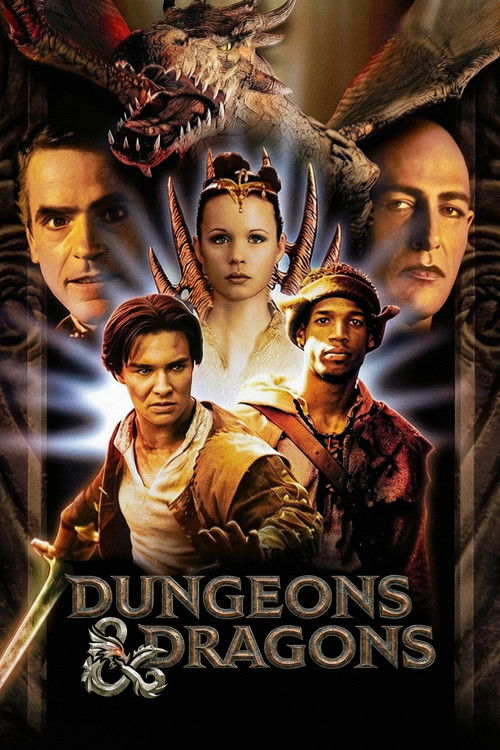
Dungeons & Dragons (2000)
Directed by Courtney Solomon
No — Dungeons & Dragons is not woke, scoring 10 out of 100 on our wokeness meter.
Courtney Solomon's 2000 adaptation of the world's most famous tabletop game arrives freighted with a decade of negotiation, near-misses, and a director's stubborn persistence.
Consciousness Markers
The film features a deliberately multiethnic cast for a fantasy setting, including Marlon Wayans as Snails and Kristen Wilson as the dark elf Norda, though the film itself does not foreground identity politics.
The plot pits oppressed commoners against a ruling mage elite, giving it a mild class-conflict flavor, but it is framed as fantasy governance rather than anti-capitalist critique.
A young empress and several female adventurers occupy positions of authority, but the narrative does not advance a feminist critique or agenda.
The equality-for-commoners subplot is present but delivered as standard fantasy plotting, not as a preachy lecture.
No LGBTQ+ characters, themes, or subtext are present.
The central conflict is between mages and commoners, not racial groups; no racial consciousness or systemic-racism commentary appears.
No environmental or climate themes.
No body-positivity themes or plus-size representation as a social message.
No neurodivergent characters or themes.
The film is a fantasy set in a fictional world, not a historical revision.
Why it received this score
Courtney Solomon's 2000 adaptation of the world's most famous tabletop game arrives freighted with a decade of negotiation, near-misses, and a director's stubborn persistence. The screen delivers something else entirely: a muddled quest for a dragon-controlling rod, performed by actors who seem faintly aware of the material's reputation. On the surface, this is a story about thieves and mages and the fate of an empire. Beneath the surface, there is not a great deal more.
The casting, though, reflects a quiet intention. The producers set out to fill a fantasy world with faces that were not uniformly white, an unremarkable goal now but a deliberate one at the time, and the result is a genuinely mixed ensemble for the genre. Marlon Wayans plays the thief Snails, and Kristen Wilson plays the dark elf Norda, a warrior whose place in the royal court is treated as nothing to explain. Empress Savina, played by Thora Birch, wants to extend rights to the common folk, which sets the ruling mages against her. This gives the plot a mild whiff of class friction, the powerless arrayed against a comfortable elite, though it is fantasy governance and not a critique of capital. The empress and her female companions hold real authority, yet the film never bothers to argue about why that should matter.
Elsewhere the cupboard is bare. No gay characters, no body-positivity messaging, no neurodivergent arcs, no environmental sermon, no reckoning with race as a system, no rewriting of history, because there is no history here, only a fictional map. The equality subplot makes its points with the plainness of a rulebook, never a pulpit. It is a strange artifact: a film that gestures toward diversity in its casting while remaining incurious about the ideas that casting might carry. We classify it, we log it, and we move on.
Analysis generated by our Consciousness Algorithm


Synopsis
The Empire of Izmer is a divided land: elite magicians called “mages” rule while lowly commoners are powerless. When Empress Savina vows to bring equality and prosperity to her land, the evil mage Profion plots to depose her.
Questions about Dungeons & Dragons
Is Dungeons & Dragons woke?
No — Dungeons & Dragons is not woke, scoring 10 out of 100 on our wokeness meter. That earns it a verdict of Ultra Based.
Does Dungeons & Dragons have any woke elements?
1 of the 10 markers register at 30 or above, led by Representation Casting (30). On Representation Casting: The film features a deliberately multiethnic cast for a fantasy setting, including Marlon Wayans as Snails and Kristen Wilson as the dark elf Norda, though the film itself does not foreground identity politics.
How does Dungeons & Dragons compare to other 2000 movies?
It ranks #55 of the 125 films from 2000 we've scored; their average is 13. The wokest is But I'm a Cheerleader (72).
How is the Woke Score calculated?
An AI-assisted process researches the film and its reception, scores it 0–100 on ten markers, then combines those into one 0–100 Woke Score. It measures a specific set of 2020s cultural themes, not film quality.