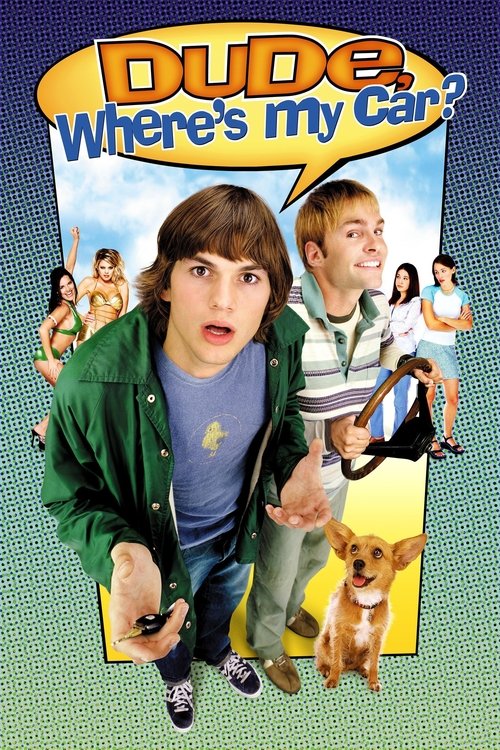
Dude, Where's My Car? (2000)
Directed by Danny Leiner
No — Dude, Where's My Car? is not woke, scoring 0 out of 100 on our wokeness meter.
Dude, Where's My Car? arrives as a relic from a less self-aware cultural moment, a stoner comedy built on amnesia, pudding, and a stolen Renault.
Consciousness Markers
The cast is predominantly white with a few minority actors in stereotypical comedic roles; there is no deliberate inclusive or representative casting agenda.
A brief transgender stripper gag exists but is played purely for laughs and does not constitute a substantive or progressive LGBTQ+ theme.
Female characters are largely defined as girlfriends, sex objects, or alien femme fatales; the film contains no feminist perspective or agenda.
Ethnic stereotypes (Chinese drive-thru, Cantonese tailor, Norwegian aliens) are used for comedy, but there is no racial consciousness or commentary.
The plot involves aliens and a universe-saving device, but no environmental or climate-related themes are present.
The film is a stoner comedy with no critique of capitalism, wealth inequality, or corporate power.
The humor includes breast enhancement necklaces and a hypersexualized giantess; there is no body-positive message.
The characters are depicted as forgetful stoners and idiots, not as neurodivergent individuals; no neurodivergence themes are explored.
The film is a contemporary sci-fi stoner comedy with no engagement with historical narratives or revisionist history.
The film aims only for absurd, lowbrow comedy and contains no preachy or lecture-like messaging.
Why it received this score
Dude, Where's My Car? arrives as a relic from a less self-aware cultural moment, a stoner comedy built on amnesia, pudding, and a stolen Renault. Its ambitions are modest: to string together Dadaist non sequiturs around two young men who cannot remember the previous night. The film has no interest in moral instruction. It wants only to make the audience laugh at a drive-through loop, a Rubik's Cube that saves the universe, and a giant alien woman in a purple bra. In this narrow pursuit it is consistent, if not successful.
The cast is overwhelmingly white, with minority performers appearing as comedic fixtures: a belligerent Chinese drive-through operator, a Cantonese tailor, Norwegian aliens. These are punchlines, not portraits. A brief transgender stripper gag exists solely for a laugh and carries no progressive weight. Women are girlfriends, sex objects, or alien femme fatales. The film's treatment of the body runs toward breast enhancement necklaces and a hypersexualized giantess, which is not body positivity. Its heroes are forgetful stoners, not neurodivergent characters. There is no climate concern, no critique of capitalism, no engagement with history, and no lecture.
This leaves a lowbrow artifact that knows exactly what it is. It does not preach, it does not revise, and it does not seek to improve its audience. That absence of sermonizing is not a virtue; it is simply an absence. The film's cultural footprint, a hand signal for the Pittsburgh Pirates and a catchphrase for a generation of dorm rooms, says more about the era's appetite for nonsense than about any social project. We classify it as a flat profile, a clean sweep of apathy. It is not offensive in the ways that matter to modern cultural critics. It is merely indifferent, which may be worse.
Analysis generated by our Consciousness Algorithm


Synopsis
Two stoners wake up after a night of partying and cannot remember where they parked their car.
Questions about Dude, Where's My Car?
Is Dude, Where's My Car? woke?
No — Dude, Where's My Car? is not woke, scoring 0 out of 100 on our wokeness meter. That earns it a verdict of Ultra Based.
Does Dude, Where's My Car? have any woke elements?
No. All 10 markers score zero.
How does Dude, Where's My Car? compare to other 2000 movies?
It ranks #112 of the 125 films from 2000 we've scored; their average is 13. The wokest is But I'm a Cheerleader (72).
How is the Woke Score calculated?
An AI-assisted process researches the film and its reception, scores it 0–100 on ten markers, then combines those into one 0–100 Woke Score. It measures a specific set of 2020s cultural themes, not film quality.