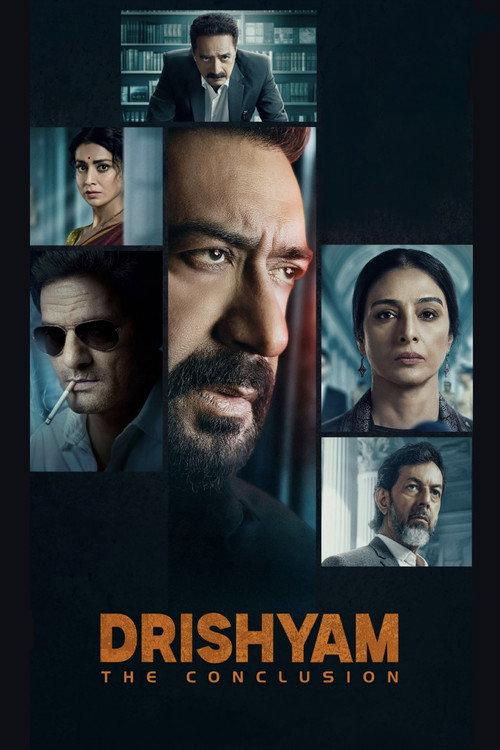
Drishyam: The Conclusion (2026)
Directed by Abhishek Pathak · $2.7M domestic
The Drishyam franchise has always operated on a premise that would make progressive film theorists deeply uncomfortable if they stopped to think about it: a man commits a cover-up, deceives every authority figure in the state, and we are invited to cheer.
Consciousness Markers
Tabu's Inspector General is the film's most formidable institutional force, and Shriya Saran's wife is not a passive figure in the family's survival. However, the narrative engine is explicitly a patriarch protecting his family, and the film frames this as virtue rather than a problem to be interrogated.
The ensemble is drawn entirely from established Bollywood talent without any discernible diversity mandate. Tabu's continued presence as the formidable antagonist Inspector General is notable, but she has occupied this role across three films now, which makes it a franchise fixture rather than a casting statement.
The film touches on social media's role in shaping public protest and mass perception, which critics read as minor commentary on post-truth information ecosystems. This is observational rather than revisionist, and it does not reframe any historical narrative.
The film's moral architecture is, somewhat refreshingly, inverted from the standard progressive sermon: it celebrates a man who lies to the state and wins. Any lecturing energy is directed at the audience's complicity in rooting for institutional subversion, which is the opposite of the usual message.
No LGBTQ+ characters, themes, or subtext are present anywhere in the available research or plot materials. The film's domestic drama is resolutely heteronormative.
The film operates entirely within an Indian cultural context where the Western progressive framework of racial consciousness does not apply. There is no evidence of any such thematic content.
No climate themes, environmental messaging, or ecological consciousness of any kind appears in the film's plot or critical reception.
The film's class dynamics are incidental backdrop. Vijay Salgaonkar is a working-class man, but his struggle is against the law, not capital. No anti-capitalist framing is present.
No body positivity themes or messaging of any kind are present or noted in any available materials.
No neurodivergent characters or related themes appear anywhere in the film's narrative or critical discourse.
Why it received this score
The Drishyam franchise has always operated on a premise that would make progressive film theorists deeply uncomfortable if they stopped to think about it: a man commits a cover-up, deceives every authority figure in the state, and we are invited to cheer. Drishyam: The Conclusion continues this tradition with admirable consistency, asking us once again to root for obstruction of justice as an expression of fatherly love. In the current cultural climate, where institutional skepticism and narrative control are charged political topics, the film arrives as a peculiar artifact: a mainstream thriller that is, by the standards of our scoring apparatus, almost aggressively un-woke.
The film scores a modest 5 on representation casting, largely carried by Tabu's sustained presence as the franchise's most competent character, and a 4 on revisionist history for its peripheral commentary on social media's ability to manufacture public protest. Beyond that, the markers sit at or near zero. There is no climate messaging. There is no body positivity. There is no lecture about systemic racism delivered by a character who pauses the plot to do so. The film is, in the parlance of our instrument, a dry vintage: little tannin, little fruit, almost nothing to detect on the palate except the clean, uncomplicated taste of a man outsmarting the police for the third time. The absence of content is itself a data point.
What the research does surface is a casting controversy involving a producer publicly describing a departed actor as "toxic," which is a word that belongs to the precise cultural moment we are attempting to measure. The irony is that this discourse existed entirely off-screen, in press releases and social media posts, while the film itself proceeded without absorbing any of it. Drishyam: The Conclusion is, in the end, a sequel about a patriarch, made by a franchise, released on a date that is itself a meme about lying to the police. It scores a 3 on lecture energy, and the lecture, such as it is, runs in the wrong direction entirely.
Analysis generated by our Consciousness Algorithm

Synopsis
Years after outsmarting the police, Vijay Salgaonkar's past resurfaces when a new evidence threatens to expose his secret. As the investigation reopens, he must outwit the system once again to save his family.
Critic Reviews
“Its primary strength is that it looks within the franchise to form its own ideas instead of going in a direction that would seem inconsistent with the first two films.”
“Slickly filmed and fleet despite its 150-minute runtime, Drishyam The Conclusion does itself the biggest favour by taking its title seriously.”
“Drishyam 3 may not reinvent the game, but it knows exactly how to keep you playing.”
“Only the sluggish pace one has to endure to get there elicits more yawns than yays.”