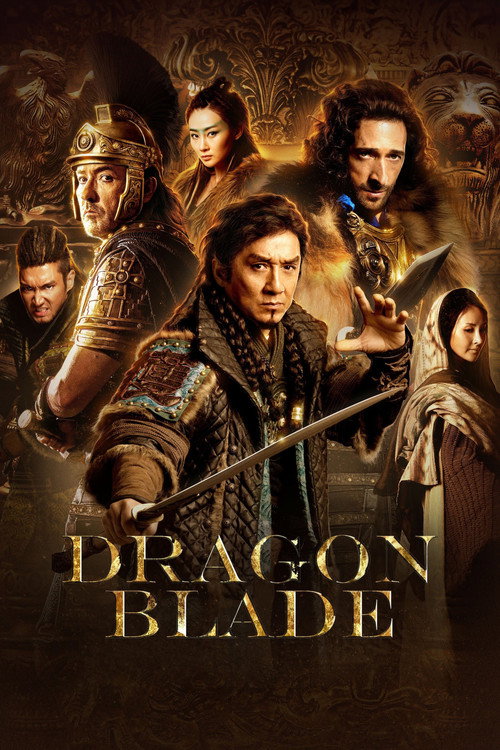
Dragon Blade (2015)
Directed by Daniel Lee
No — Dragon Blade is not especially woke, scoring 26 out of 100 on our wokeness meter.
Daniel Lee's Dragon Blade arrives bearing the full weight of a Jackie Chan peace mission, which is a curious cargo for a picture that spends so much of its runtime arranging enormous armies into battle lines.
Consciousness Markers
The film assembles a genuinely international, multi-ethnic cast (Chinese, American, and various Silk Road peoples) and populates its world with characters of many ethnicities, though this diversity is organic to the historical Silk Road setting rather than a deliberate representation agenda.
Jackie Chan stated he made the film to deliver an explicit message of peace, and critics (notably Indian outlets) faulted it for a 'lack of subtle messages' and propagandistic tone, giving it a mild didactic streak.
The film's central theme is ethnic harmony and cooperation among Chinese, Romans, and nomadic peoples along the Silk Road, including orphans of multiple ethnicities, but this is a humanist peace message rather than modern racial-justice consciousness.
The film dramatizes the speculative Homer Dubs theory of Roman prisoners clashing with Han China, inventing a fictional Roman-Chinese alliance, but this is historical fantasy rather than ideologically motivated historical revisionism.
A Xiongnu woman warrior and Huo An's schoolteacher wife exist in the story, but neither advances a feminist thesis; the wife's role is largely sacrificial and maternal.
No LGBTQ+ characters, relationships, or themes appear anywhere in the film.
There is no environmental or climate-related content in the film.
Corruption within the Protection Squad is a plot device, not a critique of capitalism or class structures.
No body-positivity themes or messaging are present.
No neurodivergence themes or characters are depicted.
Why it received this score
Daniel Lee's Dragon Blade arrives bearing the full weight of a Jackie Chan peace mission, which is a curious cargo for a picture that spends so much of its runtime arranging enormous armies into battle lines. Chan plays Huo An, commander of a Han dynasty customs and peacekeeping outfit on the Silk Road, a man whose chief qualification for the post appears to be an unshakeable willingness to feed starving Romans. The film gathers Chinese, Roman, Xiongnu, Turkic and Parthian players into one fortress and asks them to rebuild a wall together. It is a genuinely international production, and the diversity reads as geography. The Silk Road was crowded. Nobody in the production office needed a consultant to notice that.
The women fare less well. A Xiongnu warrior gets a duel and then a seat in the background, while Huo An's wife teaches orphans of several ethnicities before dying in his arms so that he might protect them. Her function is maternal and sacrificial, and the film has no further use for her. There is no romantic or political life beyond the heterosexual arrangement, no queer presence of any kind, and no interest in bodies that deviate from the heroic mold. The ethnic harmony on display is sincere and entirely pre-modern in its logic: a peace message about people sharing a desert, not a statement about structural injustice. No environmental lament intrudes. No merchant class gets its reckoning.
The history is where the film indulges itself. It dramatizes Homer Dubs' 1941 speculation about Roman prisoners drifting east into Han territory, a theory most historians reject, and builds an entire alliance on top of it. That is fantasy, not ideology with a filing system. The sermonizing is gentler and more general. Chan has said he made the film to spread peace, and it shows. Characters explain the theme aloud, sometimes twice, and Indian critics read the whole enterprise as a national advertisement, which is harsh but not baseless. The result is a lumbering, well-choreographed homily with swords.
Analysis generated by our Consciousness Algorithm


Synopsis
Huo An, the commander of the Protection Squad of the Western Regions, was framed by evil forces and becomes enslaved. On the other hand, a Roman general escapes to China after rescuing the Prince. The heroic duo meet in the Western Desert and a thrilling story unfolds.
Questions about Dragon Blade
Is Dragon Blade woke?
No — Dragon Blade is not especially woke, scoring 26 out of 100 on our wokeness meter. That earns it a verdict of Based.
Does Dragon Blade have any woke elements?
2 of the 10 markers register at 30 or above, led by Representation Casting (35) and Lecture Energy (30). On Representation Casting: The film assembles a genuinely international, multi-ethnic cast (Chinese, American, and various Silk Road peoples) and populates its world with characters of many ethnicities, though this diversity is organic to the historical Silk Road setting rather than a deliberate representation agenda.
How does Dragon Blade compare to other 2015 movies?
It ranks #51 of the 289 films from 2015 we've scored; their average is 15. The wokest is Chi-Raq (78).
How is the Woke Score calculated?
An AI-assisted process researches the film and its reception, scores it 0–100 on ten markers, then combines those into one 0–100 Woke Score. It measures a specific set of 2020s cultural themes, not film quality.