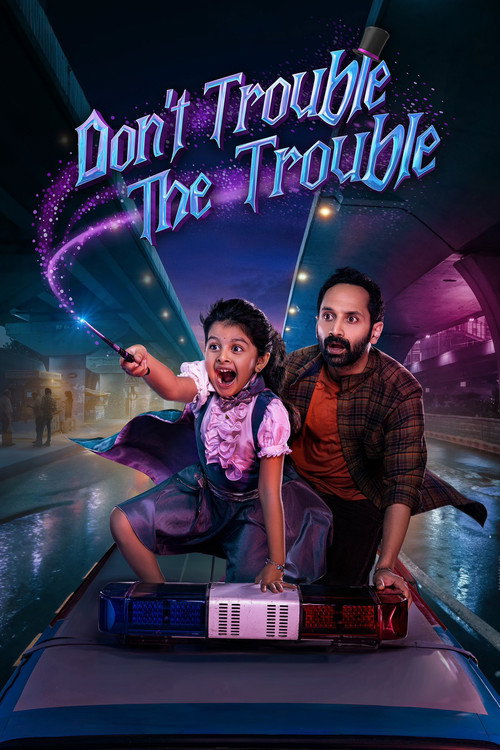
Don't Trouble the Trouble (2026)
Directed by Shashank Yeleti
Shashank Yeleti's Don't Trouble the Trouble arrives bearing the considerable weight of S. S. Rajamouli's name in the presenter credit, a detail the marketing team did not allow anyone to forget.
Consciousness Markers
The film draws from South India's multi-regional talent pool, with a Kerala-born lead making his Telugu solo debut and cross-regional voiceover cameos from Malayalam, Tamil, and Telugu stars. This reflects standard pan-Indian commercial strategy rather than any programmatic diversity agenda.
The premise involves a small-time scammer attempting to kidnap a wealthy family's child for ransom, positioning the protagonist as economically desperate against a backdrop of wealth disparity. The class contrast is a narrative device rather than a sustained critique, but it is present.
The supernatural child at the center of the story is female and possesses formidable powers, which gives her a degree of narrative agency. This reads more as genre convention for a genie-child character than as any deliberate feminist positioning.
The film's thematic core, centered on orphanhood, grief, and unconventional emotional bonding, carries the mild moral warmth typical of family-oriented South Indian commercial cinema. Critics noted no heavy-handed sermonizing, and the messaging stays well within genre norms.
No LGBTQ+ themes, characters, or subtext were identified in the film or its surrounding discourse. The story is a supernatural family comedy-drama with no engagement with this territory.
No racial consciousness framing was identified. The film operates entirely within the conventions of Indian popular cinema without invoking race as a social category.
No climate themes, environmental messaging, or ecological subtext were identified in the film's content or promotional materials.
No body positivity themes or messaging were identified. The film does not engage with this territory in any documented form.
No neurodivergence themes or characters were identified. The supernatural child's unusual behavior is framed as magical rather than neurodivergent.
The film is an original fantasy-comedy set in a contemporary urban context. There is no historical revisionism or reframing of historical narratives.
Why it received this score
Shashank Yeleti's Don't Trouble the Trouble arrives bearing the considerable weight of S. S. Rajamouli's name in the presenter credit, a detail the marketing team did not allow anyone to forget. The film itself is a more modest proposition: a fantasy comedy-drama about a small-time scammer who attempts to kidnap a wealthy child for ransom and discovers, to his significant inconvenience, that the child is a genie. Fahadh Faasil, making his solo Telugu lead debut after his well-received turn as a villain in the Pushpa franchise, brings his characteristic coiled intensity to a role that asks him to be repeatedly humiliated by a supernatural eight-year-old. He manages this with professionalism.
From a social consciousness standpoint, the film presents us with very little to process. The class architecture of the premise, a desperate orphan pitted against a wealthy family, gestures toward economic anxiety without committing to any particular argument about it. The supernatural child is female and commands the narrative with her powers, which some critics may file under "empowerment," though the film seems more interested in the comedic physics of what happens when a genie gets annoyed than in making any broader point about gender. The pan-Indian casting strategy, with voiceover cameos from Mohanlal, Kamal Haasan, and Nandamuri Balakrishna covering Malayalam, Tamil, and Telugu respectively, is a commercial calculation dressed as cultural celebration. We have seen this maneuver before.
The film's moral center, such as it is, involves grief, orphanhood, and unlikely emotional bonds, the standard furniture of family-oriented South Indian blockbuster cinema. Critics found the pacing sluggish and the writing uneven, which suggests the film was insufficiently focused on being either a rigorous social document or a well-constructed entertainment. It is, in the end, a kids' film for grown-ups, as Fahadh Faasil himself described it, which is a category of film that tends to satisfy neither demographic completely. The woke-o-meter remains largely unstirred. Some films simply decline to participate.
Analysis generated by our Consciousness Algorithm
Synopsis
Suri, a magician, accidentally makes a young girl vanish with a spell. The girl, revealed to be a genie who grants wishes, explores the city and unleashes her powers when angered.