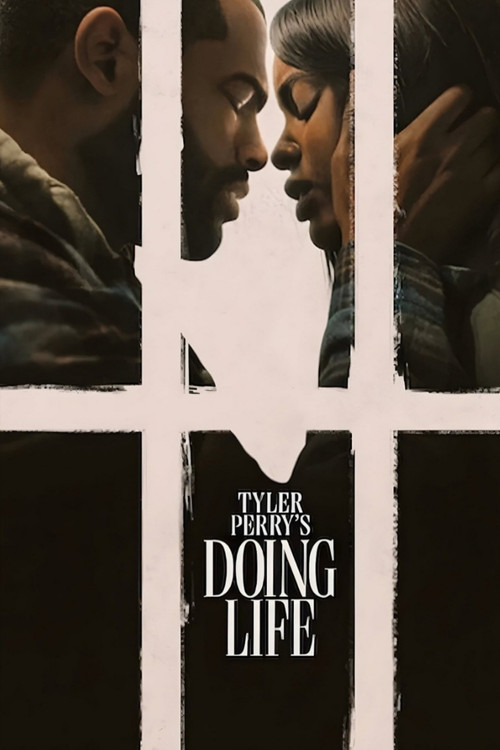
Doing Life (2026)
Directed by Tyler Perry
Tyler Perry, a filmmaker who has built an empire on the melodramatic and the morally instructive, arrives at Netflix with Doing Life and something approaching restraint.
Consciousness Markers
The film centers an almost entirely Black cast in a drama explicitly examining Black masculinity, Black love, and the experience of incarcerated Black men. This is not incidental diversity but a deliberate and foregrounded representational choice, with audience discourse actively celebrating it as such.
The film is explicitly framed around the psychological toll of long-term incarceration on Black families and the rehabilitation of a Black man against a system that expects his failure. Audience and critical discourse repeatedly invokes the carceral system as a racial issue, and the narrative consciously subverts the trope of the recidivist Black ex-convict.
The female lead, Anika, is a single mother pursuing nursing school and holding a position of institutional authority as a prison officer. Her arc involves navigating societal stigma on her own terms, which carries a quiet feminist throughline, though the film does not appear to foreground this as an explicit agenda.
Tyler Perry's characteristic melodramatic style, combined with the film's explicit social messaging around second chances, personal transformation, and societal forgiveness, produces a moderate sermonizing quality. The film's thesis that a man's past does not determine his future is stated rather than merely dramatized, per the available critical commentary.
The film's critique of the carceral system carries a faint structural critique of institutional America, and audience members expressed interest in seeing characters pursue education and upward mobility post-reentry. This is ambient rather than argued, and barely registers.
No LGBTQ+ themes, characters, or subplots are present in the available material. The central romance is a heterosexual one and no evidence suggests otherwise.
There is no evidence of climate, environmental, or ecological themes anywhere in the film's content or reception.
No body positivity themes or commentary are present in the film's content or discourse.
No neurodivergence themes, characters, or framing are present in the available material.
The film is a contemporary drama with no historical setting or revisionist framing. It does not engage with history in any meaningful way.
Why it received this score
Tyler Perry, a filmmaker who has built an empire on the melodramatic and the morally instructive, arrives at Netflix with Doing Life and something approaching restraint. The film follows Anika, a single mother and former prison officer, and Carousel, an incarcerated man of demonstrated growth and accountability, as they conduct a romance through letters. It is, in Perry's own framing, a story about unexpected understanding. It is also, in the framing of approximately everyone who has discussed it online, a corrective document about Black masculinity, the carceral system, and the possibility of human transformation. Both framings are correct, and neither is especially subtle.
The film's racial consciousness is its most legible register. The narrative is constructed around the deliberate dismantling of a specific trope: the Black ex-convict who cannot escape his past. Carousel's arc is explicitly designed to demonstrate accountability, growth, and the capacity for love in a man the system has written off. This is not background texture. It is the argument. Anika's position as a single mother navigating institutional stigma adds a secondary layer, with her nursing school ambitions functioning as a quiet assertion of female self-determination. Perry, to his credit, handles the male redemption arc with more care than his filmography typically suggests he is capable of. Critics note the tension between this seriousness and his familiar melodramatic furniture, specifically the antagonistic family members who exist primarily to be wrong about everything. The furniture remains.
Where the film generates its modest lecture energy, it does so through the gap between what it shows and what it says. The thesis, that a man's past need not determine his future, is a worthy one. It is also delivered with the confidence of a filmmaker who does not entirely trust his audience to notice the theme without assistance. The result sits somewhere between genuine drama and inspirational tract, which is, for a Tyler Perry Netflix production, a more interesting place to sit than most would have predicted.
Analysis generated by our Consciousness Algorithm


Synopsis
A single mother and an incarcerated man forge an unlikely bond through heartfelt letters, unlocking a door to redemption, hope and love against all odds.
Critic Reviews
“Perry loses his way with the crudeness of the script, basically filming a middle school play with the endeavor, which fails to connect as a heartening tale of bonding and responsibility.”
“The dialogue is dreadful, the plotting is ridiculous, and his cavalier treatment of ostensibly serious issues stops being laughably misguided and starts being genuinely offensive.”
“Perry's reflex toward tired tropes is rendered in poor taste.”