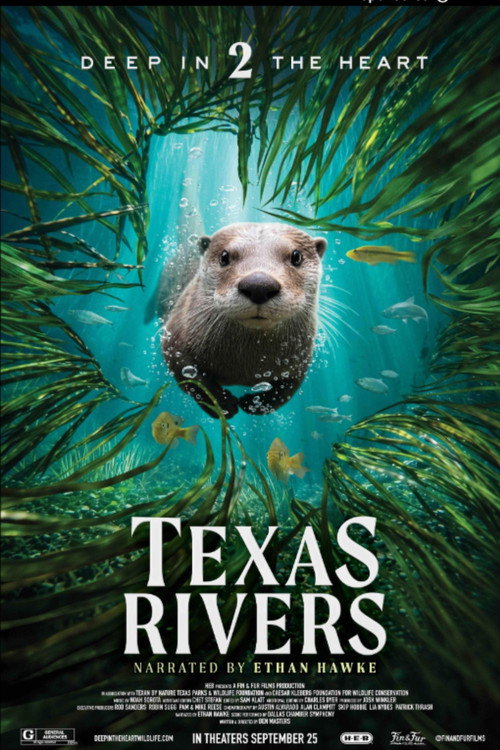
Deep in the Heart II: Texas Rivers (2026)
Directed by Ben Masters
Ben Masters returns to the Texas waterscape with a documentary that is, at its core, a love letter to rivers written in the cadence of a policy brief.
Consciousness Markers
Environmental advocacy is the film's entire reason for existing. It directly links political decisions to ecological degradation and water scarcity, though it frames this as civic stewardship rather than global climate emergency.
Reviews confirm an explicit activist intent, and the film connects natural disasters to political failures with some urgency. The sermonizing is real but is modulated by bipartisan framing and the soothing presence of Texas civic pride.
Indigenous communities are briefly acknowledged as the original stewards of Texas waterways, but this is presented as historical chronology rather than a racial justice argument.
Urban development and population growth are identified as stressors on ecosystems, but the film is sponsored by H-E-B and mainstream Texas institutions, making a full anti-capitalist reading structurally impossible.
The film traces water use from Native American communities through modernity, gesturing at a longer arc of stewardship and loss, but does not deploy this as a revisionist indictment of the historical record.
This is a nature documentary narrated by a single voice. There is no casting apparatus through which representation could be consciously engineered.
The film concerns rivers. No LGBTQ+ themes are present in any form.
No feminist framing is present. The Guadalupe River has not yet been gendered.
No body positivity themes are present. The bodies in question belong to fish.
No neurodivergence themes are present in any form.
Why it received this score
Ben Masters returns to the Texas waterscape with a documentary that is, at its core, a love letter to rivers written in the cadence of a policy brief. Ethan Hawke narrates, having inherited the microphone from Matthew McConaughey in what is either a passing of the torch or a reshuffling of Texan celebrity consciences. The film moves basin by basin through the Rio Grande, the Pecos, the Guadalupe, and their brethren, deploying slow-motion wildlife footage alongside the kind of grave statistical context that makes you want to check your water bill.
The environmental advocacy here is sincere and the cinematography is genuinely lovely, which creates a mild cognitive dissonance when the film pivots from a blue heron standing in golden light to a stern accounting of municipal water mismanagement. Masters has learned from his previous work on borderlands conservation that the most effective delivery mechanism for a policy argument is a beautiful image followed by a number that should alarm you. The film's bipartisan sponsorship, which includes an organization founded by Laura Bush, ensures that the lecture energy never fully tips into the register of a coastal documentary festival screener. It is trying, with evident effort, to make water conservation feel like something a Texan would put on a bumper sticker.
What keeps the film's progressive sensibilities in check is its own framing. The argument is not that capitalism is destroying the rivers, it is that Texas is not being sufficiently Texan about protecting them. This is a meaningful distinction. The film's conservationism is dressed in state pride rather than global urgency, which is either a shrewd rhetorical strategy or a genuine reflection of its makers' values. Probably both. The Rio Grande does not care about the distinction, but the audience apparently does.
Analysis generated by our Consciousness Algorithm
Synopsis
Water, wildlife, and land conservation in Texas. Wildlife stories from each of Texas' major river basins, as well as diving into our state's successes and failures when it comes to managing water for both people as well as ecosystems.