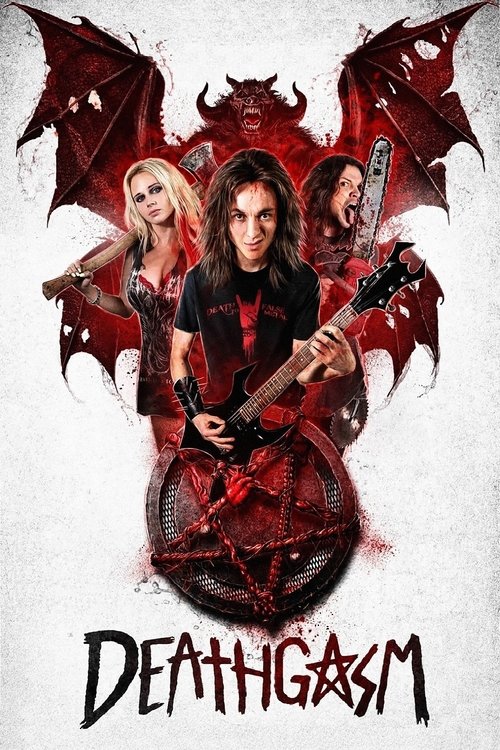
Deathgasm (2015)
Directed by Jason Lei Howden
No — Deathgasm is not woke, scoring 3 out of 100 on our wokeness meter.
Deathgasm arrives from New Zealand in 2015 with a title that promises exactly what it delivers: a teenage heavy metal band, an ancient piece of sheet music, and a small town's worth of demonic possession rendered in practical gore.
Consciousness Markers
The cast is overwhelmingly white New Zealand performers with no evident diversity-conscious casting choices; the film makes no comment on representation.
No LGBTQ+ characters, themes, or subtext appear anywhere in the film.
Medina exists as a romantic interest and the female characters are largely defined by their relationships to the male metalheads; no feminist framework is present.
The film engages no racial themes or commentary whatsoever.
There is no environmental or climate-related content in this demonic splatter comedy.
The film has no economic critique; its antagonists are demons and a cult, not capitalists.
No body-positivity messaging; the film's relationship to bodies is strictly one of dismemberment and gore.
No neurodivergence themes or characters are present.
The film is a fictional supernatural romp with no historical revisionism of any kind.
Deathgasm is proudly low-brow and juvenile, offering no moral instruction or social messaging to its audience.
Why it received this score
Deathgasm arrives from New Zealand in 2015 with a title that promises exactly what it delivers: a teenage heavy metal band, an ancient piece of sheet music, and a small town's worth of demonic possession rendered in practical gore. Brodie, freshly consigned to his Christian uncle's custody, forms a band with Zakk, plays the Black Hymn, and watches his neighbors turn. The film's pleasures are the ones its critics have catalogued for a decade: chainsaws, sex toys, arterial spray, a fortune teller in a back room. It is a splatter comedy that knows its audience and asks nothing of it beyond a tolerance for viscera.
Seen through the lens of contemporary cultural taxonomy, the film is a desert. The cast is white New Zealand performers, and no gesture is made toward representation as a concept. No LGBTQ+ characters appear. Medina exists to be romanced, betrayed over, and finally won, which is the extent of the film's interest in its women. Race, climate, economics, body image, neurodivergence: none of these enter the frame. The antagonists are cultists and demons, not landlords or oil executives. The film's relationship to the human body is strictly dismemberment. Even the Christian uncle, an obvious candidate for a sermon about religious repression, is dispatched as a gag instead of a thesis.
The film is juvenile by design and unbothered by the fact. Howden drew on his own teenage alienation, and the result carries no moral instruction, no invitation to improve, no lesson tucked beneath the blood. It wants to be loud, and it is. There is nothing here to classify beyond the obvious, and the film would take that as a compliment.
Analysis generated by our Consciousness Algorithm


Synopsis
Two teenage boys unwittingly summon an ancient evil entity known as The Blind One by delving into black magic while trying to escape their mundane lives.
Questions about Deathgasm
Is Deathgasm woke?
No — Deathgasm is not woke, scoring 3 out of 100 on our wokeness meter. That earns it a verdict of Ultra Based.
Does Deathgasm have any woke elements?
No. All 10 markers score zero.
How does Deathgasm compare to other 2015 movies?
It ranks #249 of the 289 films from 2015 we've scored; their average is 15. The wokest is Chi-Raq (78).
How is the Woke Score calculated?
An AI-assisted process researches the film and its reception, scores it 0–100 on ten markers, then combines those into one 0–100 Woke Score. It measures a specific set of 2020s cultural themes, not film quality.