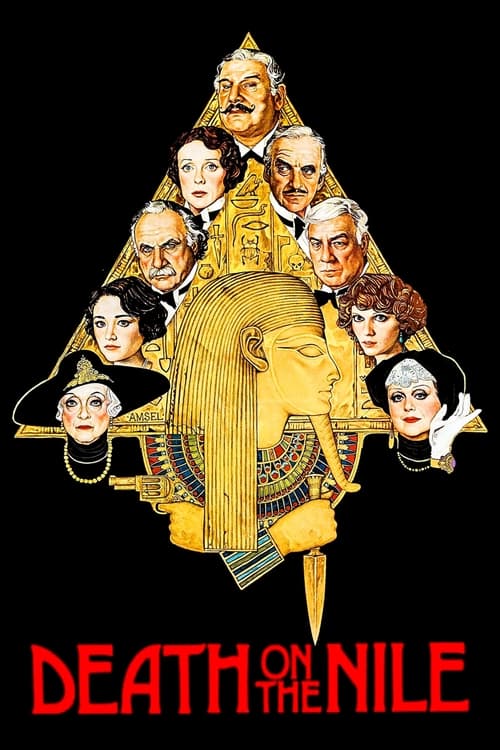
Death on the Nile (1978)
Directed by John Guillermin
No — Death on the Nile is not woke, scoring 6 out of 100 on our wokeness meter.
Death on the Nile presents a meticulously constructed puzzle set against a backdrop of historical inaccuracy and geographical disregard.
Consciousness Markers
A Communist writer, Jim Ferguson, is among the suspects and explicitly resents Linnet's wealth, but this is a minor character motive rather than a sustained anti-capitalist argument.
The cast is a 1970s all-star ensemble, overwhelmingly white, with no modern inclusive casting agenda.
There are no LGBTQ+ characters, themes, or subtext in the film.
Female characters have agency and one is a mastermind, but the film offers no feminist thesis or gender-conscious critique.
The Egyptian setting is decorative rather than racialized; no racial consciousness or commentary is present.
There is no environmental or climate-related messaging.
There is no body-positivity theme or related messaging.
No neurodivergence is depicted or discussed in the film.
The film takes liberties with Egyptian geography, but it does not engage in modern ideological revisionist history.
Poirot's final explanation is genre exposition, not a social-justice lecture.
Why it received this score
Death on the Nile presents a meticulously constructed puzzle set against a backdrop of historical inaccuracy and geographical disregard. This 1978 iteration of the classic mystery genre relies heavily on the star power of its ensemble, yet it fails to engage with any contemporary cultural awareness. The lush Egyptian setting serves a purely decorative function, offering no racial consciousness or deeper commentary on the region. The narrative is a convoluted engine of deduction, moving through a series of highly choreographed encounters on a luxury vessel. This is not a film concerned with social critique or the demands of modern progressive sensibilities.
We find very little in the way of progressive thematic resonance. The depiction of its various suspects offers no exploration of marginalized experiences. While the film features a character whose motive stems from a resentment of extreme wealth, the anti-capitalist undercurrent remains a minor footnote within the larger framework of the whodunnit. The female characters operate within the traditional constraints of the genre, possessing agency only within the bounds of the plot's mechanics, not as a thesis for feminist discourse.
Ultimately, the film is a product of its era, a finely tuned piece of escapism. It does not attempt to elevate its storytelling through heavy-handed social messaging or complex ideological subtext. It is a diversion that prioritizes elegant plotting and period atmosphere over modern social consciousness. The mystery operates purely as a closed loop, a satisfying intellectual exercise that ends with a predictable, albeit dramatic, resolution.
Analysis generated by our Consciousness Algorithm


Synopsis
As Hercule Poirot enjoys a luxurious cruise down the Nile, a newlywed heiress is found murdered on board and every elegant passenger becomes a prime suspect.
Questions about Death on the Nile
Is Death on the Nile woke?
No — Death on the Nile is not woke, scoring 6 out of 100 on our wokeness meter. That earns it a verdict of Ultra Based.
Does Death on the Nile have any woke elements?
Very few. None of the 10 markers reaches 30, the level where a marker counts as present; the highest is Eat the Rich at 10.
How does Death on the Nile compare to other 1978 movies?
It ranks #9 of the 27 films from 1978 we've scored; their average is 8. The wokest is The Wiz (52).
How is the Woke Score calculated?
An AI-assisted process researches the film and its reception, scores it 0–100 on ten markers, then combines those into one 0–100 Woke Score. It measures a specific set of 2020s cultural themes, not film quality.