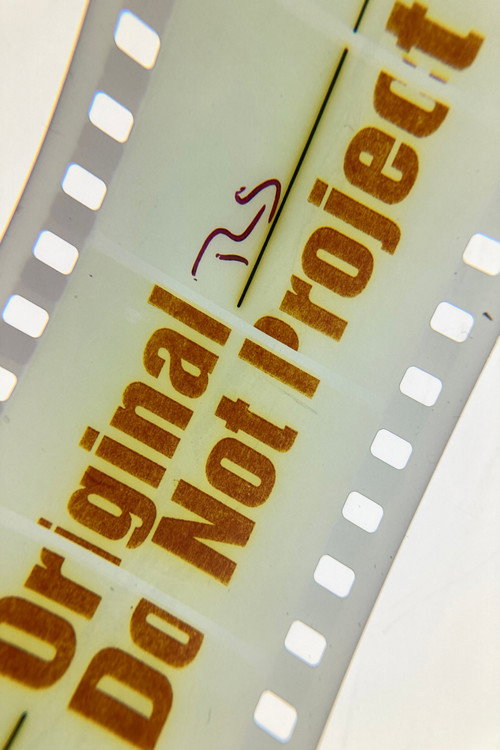
Day One (2026)
Directed by Cameron Worden
Cameron Worden's Day One presents the scoring committee with a challenge that is, in its own way, as formally rigorous as the film itself: how does one measure the progressive social consciousness of a work that contains no society, no consciousness, and, strictly speaking, no content.
Consciousness Markers
The film has no cast. Its performers are photons, silver halide crystals, and optical emulsion. They were not selected for their demographic profiles.
There are no characters, no relationships, and no identities present. A smear of magenta on 35mm stock does not constitute queer representation, however generously one reads the color wheel.
No narrative, no characters, no gender dynamics of any kind. The film declines to have a feminist agenda in the same way that it declines to have a plot.
Racial consciousness requires, at minimum, the presence of a race. This film contains light and noise. No score is applicable.
No environmental messaging detected. The film's devotion to analog photochemical process could theoretically invite commentary on industrial waste, but none is made.
There are no capitalists to eat, no systems to critique, and no rich to soak. There is only celluloid doing what celluloid does when left largely to its own devices.
No bodies appear in this film. Not one. The closest thing to a body is the film strip itself, and it appears to be in fine physical condition.
No human subjects are present, neurodivergent or otherwise. The film's optical soundtrack may produce sensory experiences consistent with an unusual neurological state, but this is the audience's problem, not the film's agenda.
The film engages with the history of analog cinema in a preservationist, not a revisionist, spirit. It honors the medium. It does not reframe it through a contemporary social lens.
The film is constitutionally incapable of lecturing. It has no voice, no characters, no dialogue, and no discernible opinions about how the audience should live their lives.
Why it received this score
Cameron Worden's Day One presents the scoring committee with a challenge that is, in its own way, as formally rigorous as the film itself: how does one measure the progressive social consciousness of a work that contains no society, no consciousness, and, strictly speaking, no content. The film is a photochemical abstract short on 35mm, a cascade of light and color and machinic noise, produced without actors, narrative, dialogue, or any of the usual delivery mechanisms for cultural messaging. We have reviewed it with the same gravity we bring to a Marvel film. The results are what they are.
All ten markers return a score of zero. This is not a failure of the film. It is, if anything, a kind of achievement: Day One is perhaps the purest example in our database of a work that is entirely indifferent to the culture war. The shapes do not represent underrepresented communities. The colors do not bleed in solidarity. The optical soundtrack, generated photochemically, does not contain a hidden monologue about systemic inequality. Worden, whose day job involves preserving physical film at the Chicago Film Society, appears to have made a film about film, full stop, and to have felt no particular obligation to make it about anything else.
The NYFF Currents program, which selected the film, is a reliable habitat for work of this stripe: formally adventurous, institutionally celebrated, and utterly uninterested in the discourse. Day One sits in this tradition with complete comfort. It is, by our metrics, the least woke film we have encountered, not because it is reactionary, but because it has opted out of the conversation entirely, in favor of watching light do things to emulsion. We note this without judgment. We note it, in fact, with something approaching envy.
Analysis generated by our Consciousness Algorithm
Synopsis
Shapes blister and tumble across frame lines, colors splash, bleed, and vanish, machinic noise rumbles and churns. Produced using an entirely photochemical process on 35mm film, with an optical soundtrack generated photochemically, Day One is an odyssey of light and color, an exploration of the primary materials of analog filmmaking, and a miniature cosmos activated inside the cinematic apparatus.