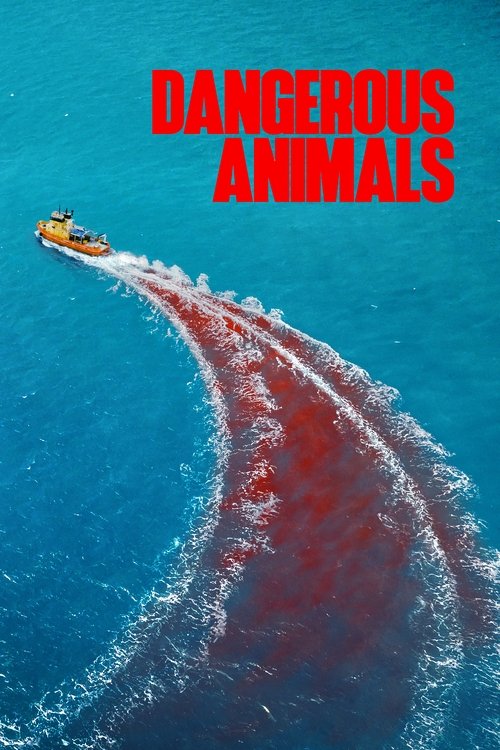
Dangerous Animals (2025)
Directed by Sean Byrne
No — Dangerous Animals is not woke, scoring 11 out of 100 on our wokeness meter.
Dangerous Animals arrives as a survival horror picture from Sean Byrne, in which a shark-obsessed boat captain named Tucker abducts a free-spirited surfer and lowers his victims into chummed water while a VHS camera whirs.
Consciousness Markers
The protagonist is a self-sufficient female surfer who outwits and ultimately kills her male captor, and the killer's victims are women. This is largely the standard 'final girl' survival-horror convention rather than an articulated feminist thesis.
The cast is overwhelmingly white Australian and American performers, with only incidental non-white presence (e.g., Josh Heuston). No deliberate diversity-driven casting is evident.
This is a lean genre survival-horror picture with no preachy messaging or moral instruction directed at the audience.
No LGBTQ+ characters, relationships, or themes appear anywhere in the film.
The film engages no racial themes, commentary, or identity politics whatsoever.
There is no environmental or climate-related content in the film.
No economic critique, class commentary, or anti-capitalist messaging is present.
The film makes no statements about body image, size, or physical appearance politics.
The killer's obsession and unraveling mental state are framed as villainous pathology, not as neurodivergent representation or advocacy.
The film is a contemporary fictional horror story with no historical revisionism or reframing of past events.
Why it received this score
Dangerous Animals arrives as a survival horror picture from Sean Byrne, in which a shark-obsessed boat captain named Tucker abducts a free-spirited surfer and lowers his victims into chummed water while a VHS camera whirs. It is a lean, mean, ninety-odd minutes of Australian coastal dread, and it has almost nothing to say. This is meant as praise. The film's ambitions are entirely mechanical: tighten the screws, keep the sharks real, and let Jai Courtney chew the scenery with the enthusiasm of a man who has been waiting his whole career for a speargun.
The protagonist, Zephyr, is a self-sufficient woman who bites off her own thumb to escape handcuffs and eventually dispatches her captor with his own weapon. That registers as a final-girl convention, not a thesis. She survives because the screenplay requires it, and the film never pauses to explain what her survival means about anything. The cast is largely white and Australian, with a small amount of incidental non-white presence, and nobody involved appears to have given the matter a second thought. There is no romance beyond a single night, no identity politics, no economic grievance, no sharks enlisted in service of a metaphor. The killer's unraveling is presented as plain villainy, the correct posture for a man who films drownings as a hobby.
We are left with a clean specimen. The film instructs no one, lectures no one, and would sooner show a real great white shot in 4K than tell us how to feel about the ocean. In an era of cinema that frequently arrives with a syllabus attached, this one arrives with a speargun and a box of tapes. Refreshing, if you like that sort of thing. I do.
Analysis generated by our Consciousness Algorithm


Synopsis
A savvy and free-spirited surfer is abducted by a shark-obsessed serial killer. Held captive on his boat, she must figure out how to escape before he carries out a ritualistic feeding to the sharks below.
Questions about Dangerous Animals
Is Dangerous Animals woke?
No — Dangerous Animals is not woke, scoring 11 out of 100 on our wokeness meter. That earns it a verdict of Ultra Based.
Does Dangerous Animals have any woke elements?
Very few. None of the 10 markers reaches 30, the level where a marker counts as present; the highest is Feminist Agenda at 28.
How does Dangerous Animals compare to other 2025 movies?
It ranks #157 of the 217 films from 2025 we've scored; their average is 26. The wokest is STRAW (92).
How is the Woke Score calculated?
An AI-assisted process researches the film and its reception, scores it 0–100 on ten markers, then combines those into one 0–100 Woke Score. It measures a specific set of 2020s cultural themes, not film quality.