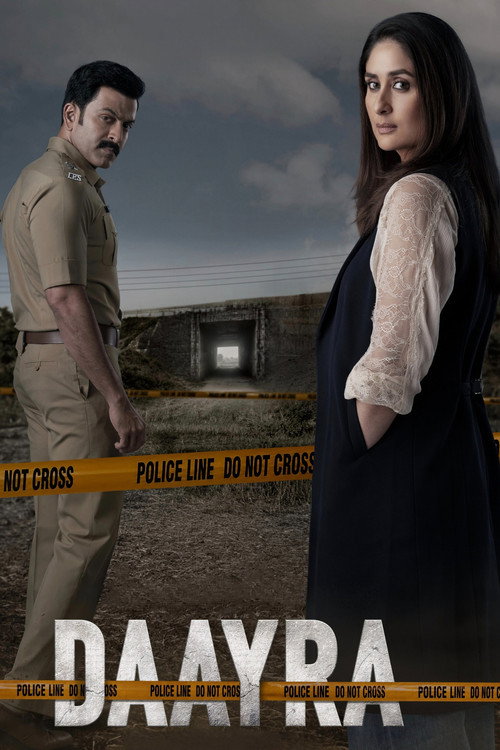
Daayra (2026)
Directed by Meghna Gulzar
Meghna Gulzar has built a career out of arriving at the scene of India's most uncomfortable institutional failures and filing a very thorough report.
Consciousness Markers
The entire narrative engine is a female officer holding a male officer accountable for extrajudicial killings that followed a gang rape, placing gendered violence and institutional complicity at the story's core. The promotional discourse, in which both leads publicly discussed teaching consent to their children, extended the film's feminist framing well beyond the screen.
A woman, played by Bollywood's most bankable female star, is placed unambiguously at the centre of a police procedural as the moral and institutional authority. The film does not treat this as remarkable, which is itself a form of remark.
Critics noted that complex systemic issues occasionally collapsed into a rigid cop-versus-cop moral debate, and The Hindu's review described the film as taking a diagnostic posture toward institutional rot. The script's tendency to simplify its own arguments is, itself, a form of sermonizing.
The film is explicitly positioned as a counter-narrative to Bollywood's decades-long tradition of glorifying encounter specialists and vigilante cops. By using a real 2019 incident as its moral foundation and indicting a genre that has mythologised that very behaviour, it performs a pointed act of institutional revisionism.
No LGBTQ+ themes, characters, or subtext are present in the available research or plot summary.
The film operates within a specifically Indian caste-and-class context, but the research does not indicate that racial or caste identity is foregrounded as a named, self-conscious theme in the modern social-justice sense.
No climate or environmental themes are present. This is a police procedural about extrajudicial killings, not the planet.
The film's critique is directed at state power and the police apparatus, not at capital or economic elites. No anti-capitalist framing is evident.
No body positivity themes are present or suggested by any available material.
No neurodivergence themes, characters, or framing are present in the film's known content.
Why it received this score
Meghna Gulzar has built a career out of arriving at the scene of India's most uncomfortable institutional failures and filing a very thorough report. With Daayra, she turns her attention to the 2019 Hyderabad encounter killings, in which four men accused of gang rape were shot dead by police during what was officially described as a reconstruction exercise. The film casts Kareena Kapoor Khan as DCP Ajooni Kohli, the officer tasked with investigating the man who pulled the trigger. This is, on its face, a straightforward police procedural. It is not straightforward at all.
The film's central argument is that the public's appetite for instant retribution, however understandable given the crimes that preceded it, is precisely the appetite that corrupt institutions have always fed off. Ajooni is not simply catching a bad cop. She is dismantling a social contract that her own audience has already enthusiastically signed. Critics at The Hindu described the film as a "diagnostic look at the rot within the body politic," which is accurate and also the kind of sentence that suggests the film may occasionally prefer the diagnosis to the drama. The Indian Express noted that Kapoor Khan's character is not always given the script she deserves, which is the polite way of saying the film sometimes reduces its most interesting figure to a vehicle for its thesis. The promotional campaign, in which both leads discussed teaching consent to their children, ensured that the film's moral positioning was fully legible before anyone had purchased a ticket.
Daayra sits in a well-populated corner of contemporary Bollywood: the socially urgent procedural that trusts the audience to need explaining to. Gulzar is a more rigorous filmmaker than most who occupy that space, and the film's feminist architecture, placing a woman as the sole institutional conscience in a story about gendered violence, carries genuine weight. The lecture energy is present, but it is at least a lecture delivered by someone who has done the reading. We have seen worse. We have seen much worse. We have seen it recently.
Analysis generated by our Consciousness Algorithm
Synopsis
Raman, who has had a shady record with staged encounters and police brutality, finds himself cornered as Ajooni challenges him on every step.