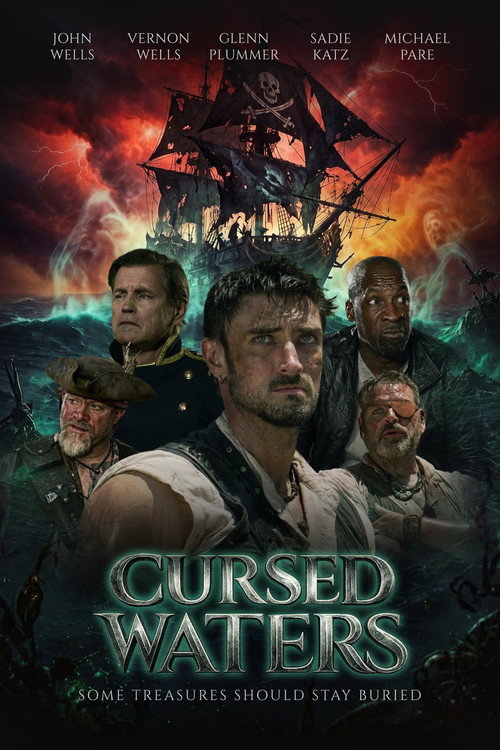
Cursed Waters (2026)
Directed by Adam Werth
Cursed Waters arrives bearing the hallmarks of a film that has more on its mind than its budget can fully accommodate.
Consciousness Markers
The film's central hook is an anti-slavery narrative: the pirate captain is a formerly enslaved man commanding a ship called The Chain Breaker, and the antagonist is from the family that once enslaved him. This is a structurally conscious racial dynamic, though it is deployed as genre backstory rather than sustained social sermon.
The film features a multi-ethnic ensemble with a Black actor (Glenn Plummer) as the lead pirate captain, and the casting appears deliberate in building a diverse crew. Critics noted the ensemble without ideological comment, suggesting it functions more as genre texture than conscious social programming.
The film reframes the pirate genre through an anti-slavery lens, casting escaped enslaved people as the heroic pirates and U.S. Navy officers as the morally compromised pursuers. This is a mild revisionist recontextualization of 19th-century maritime history, though it stops well short of sustained historical argument.
The courtroom framing device, in which a pirate is tried for aiding runaway enslaved people, creates some structural opportunity for moral speechifying. Critics did not flag the film as preachy, suggesting the genre machinery keeps the lectern safely below deck.
No LGBTQ+ themes, characters, or subtext have been identified in any available coverage of the film.
No feminist themes or agenda-driven female characterization are evident. Sadie Katz and Elizabeth Chamberlain appear in the cast, but no coverage suggests their roles carry any feminist framing.
No climate or environmental themes are present. The ocean is a setting, not a statement.
No anti-capitalist or class-critique messaging has been identified. Pirates stealing from ships is, historically, not a Marxist act.
No body positivity themes or related messaging are present in any available coverage.
No neurodivergent characters or related themes have been identified.
Why it received this score
Cursed Waters arrives bearing the hallmarks of a film that has more on its mind than its budget can fully accommodate. Director Adam Werth and co-writer BJ Mezek have constructed a folk horror swashbuckler around a premise that is, on paper, genuinely interesting: a formerly enslaved man captains a stolen Navy vessel called The Chain Breaker, intercepts slave ships off the coast of Mexico, and eventually runs his crew aground on an island occupied by something considerably worse than the U.S. government. The racial architecture of the story is present and legible. It is not, by most accounts, the point.
This is the key distinction a conscientious analyst must make. The film uses an anti-slavery framework as genre scaffolding, the way a lesser production might use a haunted house or a cursed artifact. The antagonist being from the family that once enslaved the captain is a tidy dramatic irony, not a policy brief. The courtroom framing device offers structural space for moral declaration, but critics report that the cult, the blood, and the general business of surviving on a murderous island absorb most of the film's attention. The racial consciousness score reflects a real element of the film's design. The lecture energy score reflects its apparent restraint in deploying it.
What we are left with is a low-budget genre film that incorporates progressive historical sympathies the way a ship incorporates ballast: quietly, structurally, and without drawing attention to itself. It is, in the taxonomy of cultural awareness, a film that knows things without feeling compelled to explain them to you at length. In the current landscape, that is either a failure of nerve or a form of good manners. The evidence does not firmly establish which.
Analysis generated by our Consciousness Algorithm


Synopsis
Shipwrecked pirates fleeing the Navy wash ashore on a remote island, only to discover it's home to a bloodthirsty cult guarding secrets no one was meant to find. Now survival means escaping both the law and something far worse.