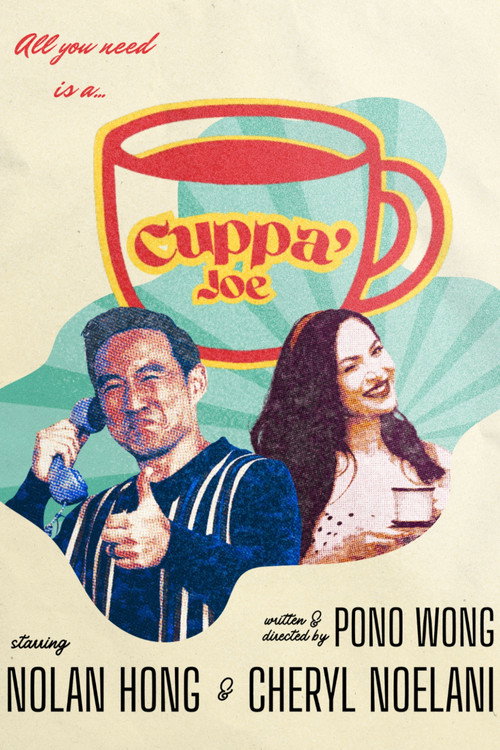
Cuppa' Joe (2026)
Directed by Pono Wong
There is a genre of film that arrives pre-annotated, its themes helpfully embedded in the premise so that no viewer need work too hard to locate them.
Consciousness Markers
Racial and ethnic identity is not a subtext here: it is the text. The film's entire architecture, a dystopian horror allegory wrapped in a 1950s sitcom shell, exists to dramatize the erasure and assimilation pressures faced by Asian and Native Hawaiian diasporas in America. This is as direct an engagement with racial consciousness as eight minutes will permit.
The film is built entirely around an Asian and Native Hawaiian couple, cast with deliberate specificity: Nolan Hong and Cheryl Noelani are not incidental presences but the structural and thematic center of the work. The choice to foreground Pacific Islander identity in a 1950s American domestic setting is a casting statement as much as a narrative one.
The film deploys the 1950s sitcom format as a contested historical space, implicitly arguing that the era's dominant cultural mythology excluded and distorted the experiences of Asian and Pacific Islander Americans. This is a form of revisionist engagement with postwar American iconography, even if the film is too short to develop it as a sustained historical argument.
The film's allegorical structure, diaspora as horror, assimilation as dystopia, is inherently rhetorical. The canned laughter device suggests a filmmaker with a thesis to deliver. That said, the horror genre framing suggests the message is dramatized rather than simply announced, which keeps the sermonizing impulse partially in check.
Mary, the female co-lead, exists within a 1950s sitcom framework that is explicitly being interrogated and subverted. The film's critique of the nuclear family ideal carries a latent feminist dimension, though feminism as a discrete agenda does not appear to be the film's primary concern.
The film's critique of assimilation and the cost of belonging in America carries a faint anti-capitalist undertone insofar as the American Dream being satirized is also an economic promise. This is incidental rather than foregrounded.
No LGBTQ+ themes, characters, or subtext are evidenced in the film's premise, research summary, or festival framing. The central relationship is a heterosexual couple.
No climate, environmental, or ecological themes are present in the film's premise or any available research. The dystopia on offer is cultural, not meteorological.
No body positivity themes, commentary on physical appearance, or related messaging are evidenced anywhere in the available material.
No neurodivergent characters, themes, or framing appear in any available description of the film.
Why it received this score
There is a genre of film that arrives pre-annotated, its themes helpfully embedded in the premise so that no viewer need work too hard to locate them. Cuppa' Joe is, in eight minutes, precisely this kind of film, and it pursues its allegory with the focused intensity of a graduate student who has just discovered bell hooks and has a short film competition deadline on Friday. The 1950s sitcom format, complete with canned laughter, functions as the film's central conceit: the warm, frictionless domesticity of Leave It to Beaver reimagined as a horror trap, a smiling container built to crush the people it claims to welcome. It is, admittedly, a genuinely sharp formal idea. The problem is that the film knows it is a genuinely sharp formal idea.
Director Pono Wong, working within indigenous Pacific Islander storytelling traditions and the Pacific Island Film Festival circuit, brings real biographical investment to the material. The casting of Nolan Hong and Cheryl Noelani as the Asian-Native Hawaiian couple at the center is not incidental: it is the argument. Their presence inside the sitcom frame is the horror. The film's racial consciousness scores extremely high on our instruments here at the bureau, registering the kind of reading that makes the meters hum. The assimilation-as-erasure thesis is deployed with conviction, and the revisionist use of 1950s Americana as a site of cultural critique places the film in a lineage stretching from Jordan Peele back through Charles Burnett, though at eight minutes it has less time to earn its comparisons.
What keeps Cuppa' Joe from a higher overall reading is, paradoxically, its brevity. A film this short cannot fully escape the gravity of its own thesis statement, and the allegorical machinery is visible in every frame. The lecture energy is present, though the horror genre provides some structural resistance to pure sermonizing. We note, with our customary neutrality, that the film received no mainstream critical coverage, no partisan controversy, and a vote count of zero on TMDB at time of assessment. In the taxonomy of cultural consciousness, it is a specimen: small, precise, and entirely certain of what it is trying to say.
Analysis generated by our Consciousness Algorithm
Synopsis
Beneath the canned laughter of a 1950s sitcom, an Asian-Native Hawaiian couple navigates a dystopian allegory of diaspora, identity, and the cost of belonging in America.