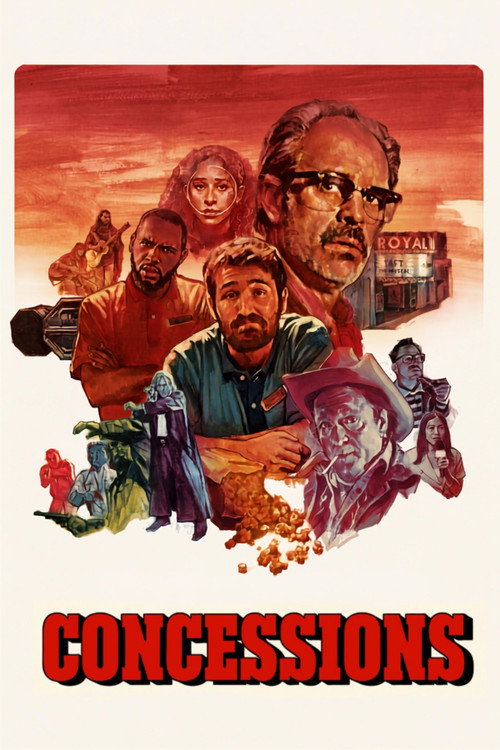
Concessions (2026)
Directed by Mas Bouzidi
Concessions arrives in the tradition of the 1990s American hangout film, a genre defined by its studied refusal to do very much.
Consciousness Markers
The closure of the Royal Alamo Cinema due to rising operating costs and real estate pressure carries a quiet, elegiac critique of market forces displacing cultural third spaces. The film does not lecture, but the villain is implicitly a landlord.
The ensemble is modestly diverse in a naturalistic, unremarked-upon way, consistent with a New York-adjacent indie hangout film. Ivory Aquino, a transgender actress, appears in a supporting role as a TV reporter, though the film draws no attention to this fact whatsoever.
The film's entire production philosophy, shot on 16mm and toured on 35mm, is itself a gentle sermon on the sanctity of physical cinema. The medium is the message, and the message is that you should feel bad about streaming. It is delivered wistfully rather than aggressively.
No LGBTQ+ themes, storylines, or identity politics are present in the film. The casting of Ivory Aquino in a role with no apparent transgender dimension earns the faintest possible acknowledgment.
No feminist agenda, commentary on gender dynamics, or female-empowerment framing is evident. Female characters exist in the ensemble without the film organizing itself around their gender.
Race is not a subject the film examines, comments on, or gestures toward. The diverse cast is incidental to a story about movie theaters dying, not a statement about systemic anything.
No climate themes, environmental messaging, or ecological consciousness of any kind. The only thing dying here is the independent cinema, and that is treated as a real estate problem.
No body positivity themes, commentary on physical appearance, or related messaging is present. The film is too busy mourning 35mm projection to concern itself with this.
No neurodivergent characters, themes, or framing are present. The 'unhinged manager' appears to be unhinged in the classical cinematic sense, not as a representation statement.
The film is not engaged with history, revisionist or otherwise. It is set in a closing movie theater on one final night. There is no history to revise.
Why it received this score
Concessions arrives in the tradition of the 1990s American hangout film, a genre defined by its studied refusal to do very much. Director Mas Bouzidi, drawing on seven years of personal experience working in movie theaters, has made an elegy for the communal filmgoing experience that is, by the metrics of this column, almost aggressively inert. The film concerns itself with busted dreams, bad popcorn, and the slow death of a physical third space under the pressure of real estate economics. These are melancholy subjects. They are not, by any rigorous standard, social justice subjects.
The cast is diverse in the way that New York is diverse: incidentally, without announcement, and without any apparent desire for credit. Ivory Aquino appears as a TV reporter named Linda Chung. The film does not pause to acknowledge that Aquino is a transgender actress. This is, in the taxonomy of cultural awareness, the equivalent of a shrug, and we mean that as a compliment. The closest the film comes to a structural critique is its implicit argument that market forces are bad for movie theaters. The villain, to the extent there is one, is a landlord who never appears on screen. This is a mild position. Most people who have ever paid rent hold it.
What Bouzidi has made is, above all, a love letter to celluloid, shot on 16mm and toured on 35mm prints as a deliberate act of advocacy for physical film exhibition. The sermon is delivered in the medium itself, which is the gentlest possible form of sermonizing. It also features one of Michael Madsen's final performances, as a down-on-his-luck former stuntman named Rex Fuel, a detail that lends the film's themes of faded glory and hard goodbyes an unscripted weight that no amount of social consciousness could manufacture. Concessions scores low on nearly every marker in this index. In 2026, that is its own kind of achievement.
Analysis generated by our Consciousness Algorithm
Synopsis
As the Royal Alamo Cinema closes its doors for good, jaded staff, eccentric patrons, and an unhinged manager stumble through one last night at the movies—grappling with busted dreams, bad popcorn, and hard goodbyes.