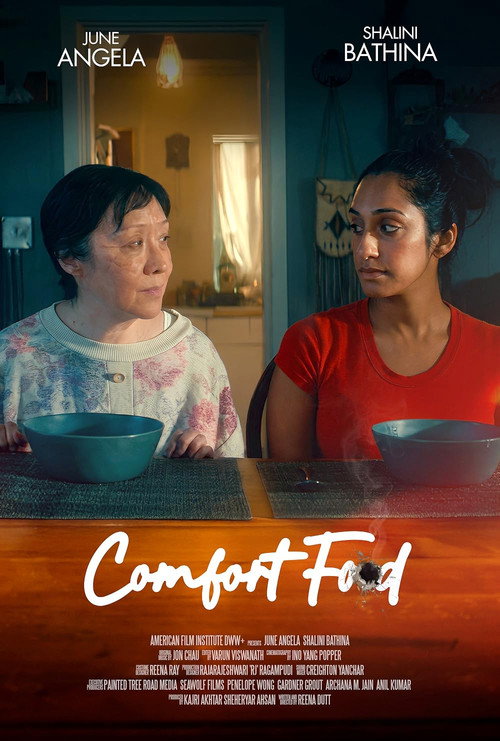
Comfort Food (2026)
Directed by Reena Dutt
Comfort Food arrives via the AFI Directing Workshop for Women, which is itself a sentence that tells you a great deal about the film before a single frame has been viewed.
Consciousness Markers
The film is built entirely around Asian American women, cast intentionally from that community, and produced through a program specifically designed to elevate underrepresented directors. The AFI Directing Workshop for Women context is not incidental to the project's identity.
Press materials explicitly frame the film as an exploration of assimilation pressures within Asian American communities and the contested meaning of American identity. This is not subtext. It is the text.
The film centers a woman navigating grief, duty, and intergenerational conflict largely on her own terms, and was produced through a women-in-directing initiative. The feminist framing is structural rather than polemical, however, keeping the score modest.
The stated thematic mandate, exploring Asian American identity, assimilation, and cultural ownership, carries some inherent sermonizing potential, though the grief-and-family-drama framework suggests the messaging is delivered through character rather than monologue.
No LGBTQ+ themes, characters, or narrative elements are present in the available materials.
No climate or environmental themes are present in any available materials.
No anti-capitalist or class-critique elements are evident in the narrative or promotional framing.
No body positivity themes or discourse are present in the film or its surrounding materials.
No neurodivergence themes or representations are documented in any available source.
The film is a contemporary personal drama with no historical revisionism in evidence.
Why it received this score
Comfort Food arrives via the AFI Directing Workshop for Women, which is itself a sentence that tells you a great deal about the film before a single frame has been viewed. Reena Dutt's short, a proof-of-concept for a feature in development, follows Lisa, an Asian American woman who drives from Oakland to rural Georgia to fulfill her late husband's final wishes at his mother's doorstep. The geography alone is doing thematic work: the progressive coast, the complicated South, a woman of color standing on a decaying porch holding an envelope. The film's promotional materials describe it as an exploration of tensions between Asian American communities over assimilation versus cultural ownership, which is a clean and efficient way of announcing that this film has opinions and intends to share them.
To its credit, the drama appears to be routed through grief and family rather than through speechifying. Two women, a daughter-in-law and a mother-in-law, connected only by a man who is no longer present, sit with their differences. That is a sturdy premise and does not require a manifesto. Dutt's background, which includes short films addressing domestic violence, gun violence, and transracial adoption, suggests a director more comfortable with cause-adjacent material than most, and the racial consciousness embedded in this project is explicit by design rather than accidental byproduct. The film screened at CAAMFest and multiple South Asian film festivals, finding its audience with the precision of a heat-seeking device.
The result is a modestly scored but sincerely intentional entry in the contemporary Asian American identity canon. It is not trying to convert anyone who was not already interested. The lecture energy is present in the architecture of the project, in the framing documents and the festival circuit choices, more than in any documented dramatic fireworks. We are, in the end, watching a short film about a woman on a porch with an envelope. The weight of what the envelope represents, culturally, institutionally, and cinematically, is perhaps heavier than the envelope itself.
Analysis generated by our Consciousness Algorithm
Synopsis
After driving across the country from Oakland, Lisa lands at her mother-in-law Annie's home in Georgia. Lisa sits outside the decrepit farmhouse with an envelope she must deliver as part of her deceased husband's last wishes.