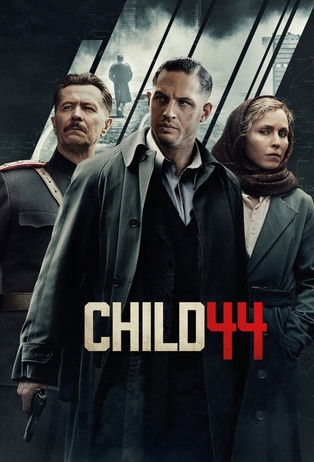
Child 44 (2015)
Directed by Daniel Espinosa
No — Child 44 is not woke, scoring 7 out of 100 on our wokeness meter.
Child 44 arrives dressed as a grim procedural about a Stalin-era security agent hunting a child murderer the state insists cannot exist.
Consciousness Markers
Raisa is a somewhat active partner in the investigation and has a subplot about coerced marriage, but the film offers no feminist thesis or gendered critique of power.
The film dramatizes a grim, loosely historical Stalin-era setting and drew official Russian complaints of distorting historical facts, but it does not reinterpret history through modern progressive sensibilities.
Its political content about totalitarianism is embedded in the thriller plot rather than delivered as a sermon; the tone is grim procedural, not preachy.
The ensemble is overwhelmingly white European actors, several of whom are cast as Russians regardless of actual nationality; there is no deliberate diverse-casting agenda at work here.
No LGBTQ+ characters, themes, or subtext appear anywhere in the film.
The film is concerned with Soviet totalitarianism and serial murder, not race or racial dynamics in any form.
There is no environmental or climate-related content in the film.
The film critiques Stalinist Soviet repression, not capitalism; the state's claim that 'only capitalism creates serial killers' is mocked rather than endorsed.
No body-positivity themes or messaging are present.
The killer is presented as a product of wartime trauma and ideology, not framed through any neurodivergence lens.
Why it received this score
Child 44 arrives dressed as a grim procedural about a Stalin-era security agent hunting a child murderer the state insists cannot exist. The premise is sturdy. The execution is a brown soup of English actors performing Russian accents, and the film never quite decides whether it wants to be a multiplex thriller or an arthouse meditation on totalitarianism. It settles for neither, and the box office agreed.
On the question of representation, the ensemble is a parade of white European performers, several cast as Russians with no regard for actual nationality. This is not a diverse-casting initiative. It is the opposite, an old-fashioned bit of theatrical slumming that drew the usual complaints about borscht-thick vowels. No LGBTQ characters appear. No racial dynamics are examined. The environment is not a concern, and capitalism is not the target; the film mocks the Soviet line that only capitalism breeds serial killers, which is a jab at the state, not at markets. Body positivity and neurodivergence are absent, the killer framed as a product of wartime trauma and ideology. Raisa does some detective work and carries a subplot about a coerced marriage, though the film offers no gendered thesis about power. It notes that life was hard and moves along.
The historical texture is grim and loosely assembled, enough to earn official Russian displeasure over the distortion of facts, though not enough to count as reinterpretation through a modern lens. The politics stay buried in the plot. Nobody stops to lecture. Here is a film that is politically serious without being preachy, historically engaged without being revisionist in the contemporary sense, and mostly just soggy. We score it accordingly, with the solemnity the subject demands.
Analysis generated by our Consciousness Algorithm
Part of


Synopsis
Set in Stalin-era Soviet Union, a disgraced MGB agent is dispatched to investigate a series of child murders -- a case that begins to connect with the very top of party leadership.
Questions about Child 44
Is Child 44 woke?
No — Child 44 is not woke, scoring 7 out of 100 on our wokeness meter. That earns it a verdict of Ultra Based.
Does Child 44 have any woke elements?
Very few. None of the 10 markers reaches 30, the level where a marker counts as present; the highest is Feminist Agenda at 12.
How does Child 44 compare to other 2015 movies?
It ranks #183 of the 289 films from 2015 we've scored; their average is 15. The wokest is Chi-Raq (78).
How is the Woke Score calculated?
An AI-assisted process researches the film and its reception, scores it 0–100 on ten markers, then combines those into one 0–100 Woke Score. It measures a specific set of 2020s cultural themes, not film quality.