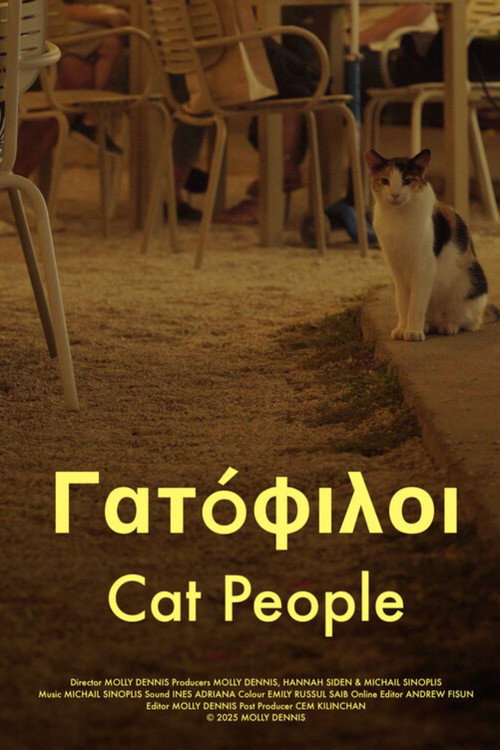
Cat People (2026)
Directed by Molly Dennis
A documentary about the stray cat population of Athens arrives, as all documentaries about urban animal welfare do, with a quiet but firm conviction that you have not been paying sufficient attention to this particular crisis.
Consciousness Markers
Documentaries about animal welfare carry an inherent low hum of moral instruction, the implicit suggestion that we, the viewer, should perhaps care more about stray cats. The score is modest but honest.
The director is a woman and the two central veterinarians appear to be women, which in a documentary context is simply who showed up, not a manifesto. The score reflects mild statistical note, nothing more.
Urban animal overpopulation can be loosely connected to environmental discourse, and a documentary of this type occasionally gestures toward ecological imbalance. Without research to confirm, the score remains minimal.
This is a documentary about stray cats in Athens. The casting criteria were, presumably, proximity to cats and willingness to be filmed near them.
No LGBTQ+ themes are present or implied. The cats themselves have not disclosed their orientations.
The film is set in Greece and concerns cats. No racial consciousness framework is in evidence.
No critique of capital is discernible. The enemy here is feline reproduction, not the bourgeoisie.
Body positivity as a human social movement does not apply. The cats are not being celebrated for their figures.
No neurodivergence themes are present or suggested by any available information.
The film does not appear to reframe historical events. Athens has always had cats. This is not contested.
Why it received this score
A documentary about the stray cat population of Athens arrives, as all documentaries about urban animal welfare do, with a quiet but firm conviction that you have not been paying sufficient attention to this particular crisis. Director Molly Dennis follows two veterinarians and an assortment of volunteers as they navigate the logistical and emotional weight of a city that has, by most accounts, more cats than it strictly needs. The film belongs to a well-established genre: compassionate humans vs. indifferent municipal systems, scored probably with gentle acoustic guitar and the occasional plaintive meow.
From a social consciousness standpoint, the film presents a scoring challenge of almost meditative simplicity. There are no systemic power structures being dismantled here, no identity frameworks being interrogated, no capitalism being asked to account for itself. The protagonists are people who like cats and have chosen to do something about it. This is, in the taxonomy of progressive cinema, roughly equivalent to a film about someone who recycles. We note the female director and the apparent preponderance of women in veterinary volunteerism, and we note it with the same detached acknowledgment a geologist might apply to a moderately interesting rock formation.
What the film does carry is the low, steady lecture energy common to all documentaries that believe, correctly or not, that the audience needs to be informed that stray animals experience suffering. This is not an unreasonable belief. It is simply not a particularly novel one. Cat People arrives at its moral position early and stays there, undisturbed, for its entire runtime, much like a cat that has found a warm spot on a radiator and sees no reason to move.
Analysis generated by our Consciousness Algorithm
Synopsis
As Athens faces a stray cat crisis, two veterinarians and a network of volunteers give their time and resources to help the city's overwhelming cat population