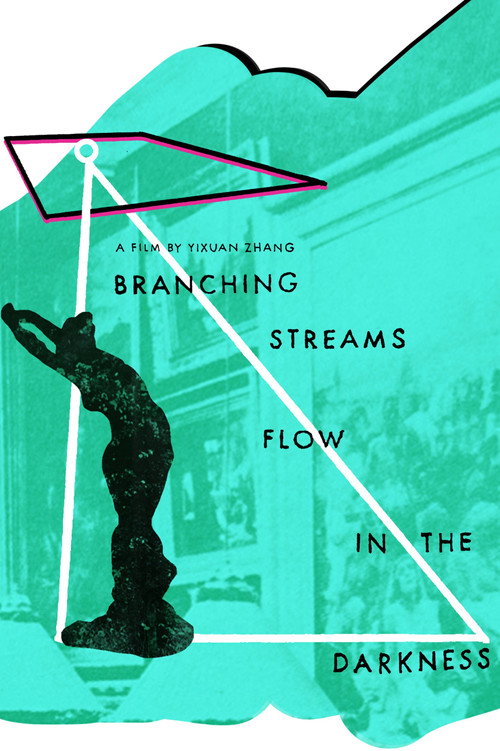
Branching Streams Flow in the Darkness (2026)
Directed by Yixuan Zhang
Yixuan Zhang's fifteen-minute experimental short arrives at the New York Film Festival's Currents program bearing historical photographs of a billiards room, a garden path, a solarium, and a parlor, then proceeds to do something genuinely unusual with them: nothing political whatsoever.
Consciousness Markers
The film contains no cast members and no discernible characters. Representing a billiards room stereoscopically is, as yet, not a diversity initiative.
No LGBTQ+ themes, characters, or content are present. The parlor remains resolutely uncategorized.
No feminist framing or gendered critique is present. The solarium does not appear to be making a point about the patriarchy.
No racial themes or commentary are present. The historical photographs are examined for depth illusions, not systemic inequity.
No climate themes are present. The darkness through which the streams branch contains no carbon footprint messaging.
No anti-capitalist content is present. The billiards room, historically a room of the bourgeoisie, is photographed without apparent resentment.
There are no bodies in this film. The absence of human figures makes body positivity scoring a philosophical exercise we will decline to perform.
No neurodivergence themes or characters are present. The film's own formal logic is unusual, but that is not the same thing.
Historical photographs are manipulated spatially, not ideologically. The film revises depth perception, not the historical record.
The film has no dialogue, no characters, and no discernible thesis to press upon the audience. It is, in this one specific respect, a relief.
Why it received this score
Yixuan Zhang's fifteen-minute experimental short arrives at the New York Film Festival's Currents program bearing historical photographs of a billiards room, a garden path, a solarium, and a parlor, then proceeds to do something genuinely unusual with them: nothing political whatsoever. The film deploys stereoscopic 3D to probe the illusory depths lurking within flat photographic surfaces, coaxing a kind of uncanny spatial trembling from images that were never meant to move. It is, by any measure, a formal exercise, and a committed one.
This presents a scoring challenge of some delicacy. Our ten markers, honed across hundreds of features laden with messaging and moral urgency, find themselves with nothing to grip. There are no characters to cast diversely. There is no dialogue through which a protagonist might explain systemic injustice to a skeptical colleague. The darkness through which the streams branch is purely cinematic darkness, unburdened by metaphor about the climate or the patriarchy. We have examined the billiards room closely. It is simply a billiards room.
The result is a film that scores a clean zero across all ten dimensions of cultural consciousness, not through cynicism or reaction, but through a total indifference to the project entirely. Zhang is interested in the two-dimensional surface of the screen and what hides inside it. This is, in the current landscape, a genuinely eccentric preoccupation. We record it here without judgment, and with something that, in a less rigorous critic, might be mistaken for relief.
Analysis generated by our Consciousness Algorithm
Synopsis
A garden path, a billiards room, a solarium, a parlor—historical photographs of these shadowy scenes and spectral atmospheres are subject to strange and subtle transformations in Yixuan Zhang's evocative stereoscopic film, which explores the uncanny space-time and illusions of depths hidden within the two-dimensional surface of the screen.